The network passed 50,000 km of route in late 2025, more than every other country’s high-speed lines put together, China State Railway Group said in a statement reported by Newsweek.
That scale and cost advantage now positions Chinese manufacturers to dominate export markets as well as their own, British railway historian Christian Wolmar argues in “Fast Track”, a global transport history book published July 23 by the Penguin imprint Michael Joseph.
Wolmar, who spent a week riding the network in May 2025 and toured two manufacturing plants for the book, puts the end-2025 total at 50,400 km, about 70% of the world’s high-speed track.
The network carries an average of 9.36 million passengers a day across 9,346 services, rising above 16 million passengers and 10,000 services at peak, he wrote in a column for The Times drawn from the book.
It has grown by an average of about 8 km of route a day since the first line opened between Beijing and Tianjin during the 2008 Olympics. In under two decades that has produced a system more than three times the size of Britain’s entire current railway network.
A World Bank study of 27 Chinese high-speed lines found a weighted average of CNY129 million per km for 350 kph projects and CNY87 million for 250 kph projects, the International Railway Journal reported. In dollar terms the bank put typical Chinese infrastructure cost at $17 million to $21 million per km, against $25 million to $39 million in Europe and as much as $56 million in California.
Wolmar estimates Chinese construction at CNY100 million to CNY200 million per km ($14.8 million to $29.6 million), while cautioning that precise figures are hard to establish.
Wolmar found CRRC’s Changchun complex in northeastern China silent and spotless, with no oil stains on the concrete and workers in the axle shop wearing tracking badges so managers knew where each of them was at any moment.
He puts the workforce at 20,000, while Engineering News-Record reported the subsidiary employed more than 18,000 people building metro cars, trams and intercity stock alongside high-speed trainsets.
|
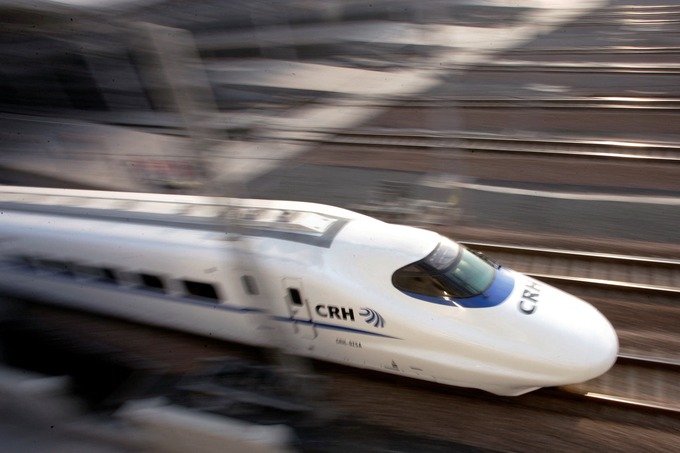
A bullet train speeds during its debut near a railway station in Shanghai, Jan. 28, 2007. Photo by Reuters |
Lighter bodies using new materials cut energy use, noise and vibration, Wolmar writes. Fully segregated lines carried mostly on concrete viaducts tens of meters above the ground cost more upfront but reduce track damage and maintenance later.
In-service Fuxing trainsets top out at 350 kph, though many routes are timetabled at 300.
CRRC is testing the CR450, designed for 400 kph in commercial service; prototypes have reached 453 kph and the design is due to be finalized in 2026, with no date announced for passenger service, Railway News reported in March.
Baggage passes through scanners before entry, seats are booked online with no paper tickets, and locals scan ID cards at automatic gates while foreigners queue for manual passport checks.
People on the Supreme People’s Court’s list of judgment defaulters cannot buy tickets at all, and in 2018 alone blacklisted individuals were blocked from purchasing train tickets 5.5 million times and airline tickets 17.5 million times, the Associated Press reported.
Wolmar paid $166 for a business class seat on the 819 km Beijing-Qingdao run, where second class currently costs CNY320 to CNY380 and first class CNY527 to CNY599.
Beijing plans to reach 70,000 km of high-speed rail by 2035. Wolmar credits the political system for making that plausible, arguing the state can raise capital, clear land and concentrate resources on priority projects in ways Western governments manage only in wartime.
The European Commission blocked a merger of Siemens’ rail arm with Alstom on Feb. 6, 2019, a deal France and Germany had backed as a counterweight to China, with competition commissioner Margrethe Vestager saying it would have raised prices for signaling systems and the next generation of very high-speed trains.
The Commission found no Chinese supplier had ever bid for a European signaling contract or delivered a very high-speed train outside China, and saw no prospect of entry in the foreseeable future. Then-French finance minister Bruno Le Maire called the ruling an economic mistake and argued the relevant market for competition analysis should be the world, not Europe.
Wolmar takes the same position, writing that the West needs a coordinated industrial strategy and should reconsider the competition thinking that killed the deal.