44
Kartikeya Sharma, MP, said, India’s constitutional philosophy offered an important foundation for global discussions on the future of law and governance.
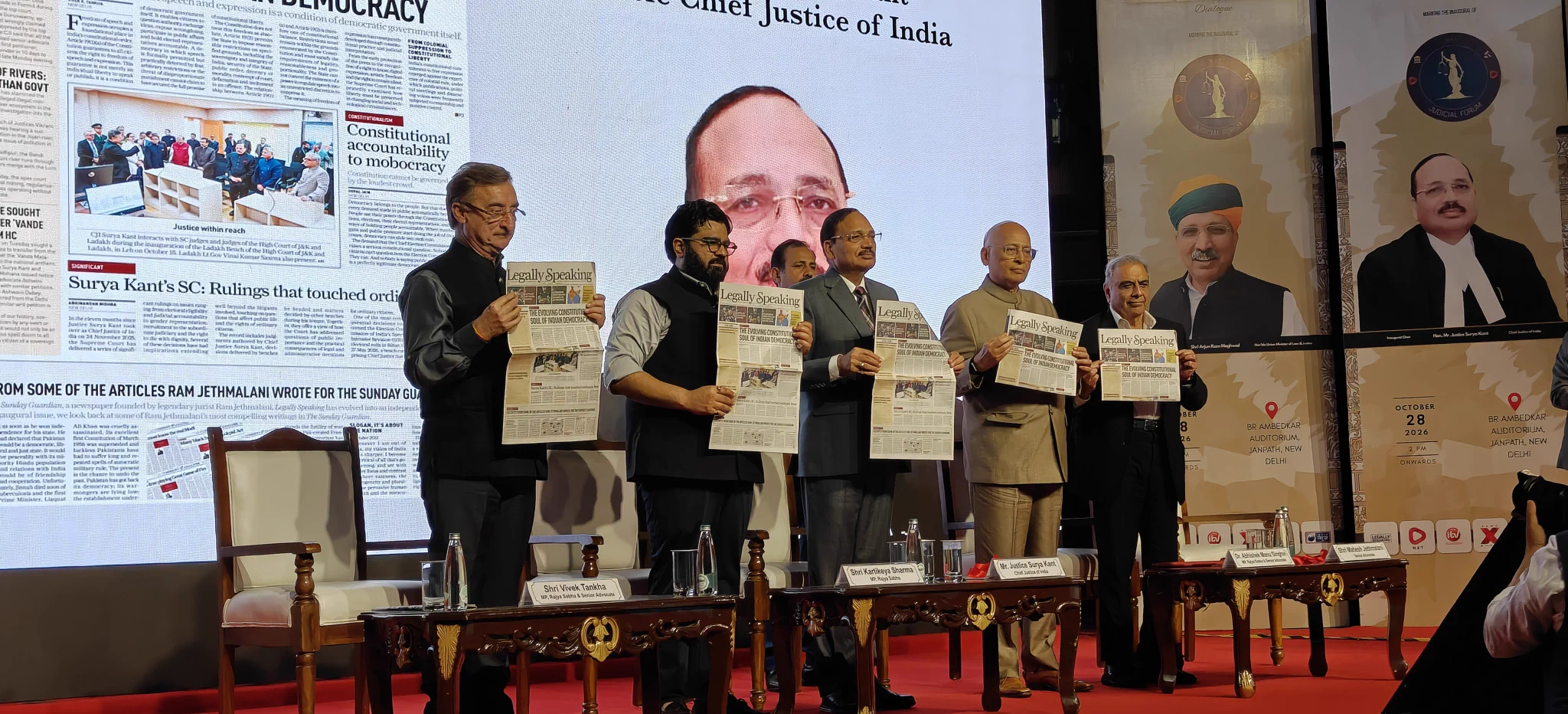
Chief Justice of India, Justice Surya Kant on Wednesday inaugurated three initiatives of the iTV Network, of which Read is a part. The NXT Judicial Forum, NXT Judicial Fellowships and Legally Speaking, a legal newspaper, were announced by Rajya Sabha MP Kartikeya Sharma at the Fourth Law and Constitution Dialogue 2026 of the iTV Network.
The initiatives aim to strengthen international judicial cooperation, nurture young legal professionals and make judicial decisions and constitutional issues more accessible to ordinary citizens. Describing the initiatives as important steps towards bringing judicial institutions, the legal fraternity and the wider public closer, the CJI called for moving beyond occasional judicial conferences towards sustained institutional engagement among courts across jurisdictions.
He said judicial institutions must continuously exchange experiences, assess emerging challenges and learn from one another. “Justice is strengthened not only by what courts decide, but how freely we discuss the way they work,” Justice Surya Kant said, underlining the importance of platforms that facilitate practical exchanges and collaborative solutions to common challenges. The CJI said judicial exchanges should deliver outcomes beyond formal discussions.
He called for a continuous institutional platform with quarterly deliberations, task forces and publications documenting recommendations and experiences. Identifying public confidence in the judiciary, commercial justice, the future of adjudication and nurturing young legal professionals as priority areas, he also highlighted the potential of Indian judicial practices, including Lok Adalats and the translation of judgments into regional languages, to offer lessons to other countries, particularly in the Global South.
Kartikeya Sharma, Member of Parliament and founder of the NXT platform, said India’s constitutional philosophy, rooted in the supremacy of law, equality and justice, offered an important foundation for global discussions on the future of law and governance. “Our civilisation never said that the king is the law. It said the law is above all,” Sharma said, tracing India’s constitutional values to the principles of dharma reflected in ancient Indian thought, the Upanishads and Kautilya’s Arthashastra.
He also highlighted the significance of universal adult suffrage adopted at the commencement of the Republic on January 26, 1950, saying the Constitution had translated India’s civilisational emphasis on the rule of law into a modern framework of equality, liberty and judicial independence. Sharma said that emerging challenges such as AI-generated deepfakes, data breaches, cross-border crime and intellectual property disputes required international cooperation, while solutions would have to account for the specific social, linguistic and administrative conditions of individual countries.
Explaining the vision behind NXT, he said India should emerge as a destination for global discussions on innovation, technology, governance and law. Highlighting the practical impact of the platform, Sharma cited an Indian-developed AI-enabled breast cancer screening technology being deployed through the Namo Shakti Rath initiative. He said the programme had conducted more than two lakh screenings and contributed to saving over 10,000 lives through early detection.
He also referred to 5,005 screenings conducted in 24 hours in Varanasi on International Women’s Day this year, an achievement that earned a Guinness World Records recognition. Sharma announced that the first assembly of the NXT Judicial Forum would be held in March 2027, bringing together serving and retired judges, jurists, law faculties and students from common-law and civillaw jurisdictions.
The NXT Judicial Fellowship will bring students from leading international universities, including Harvard, Oxford, Cambridge, Columbia and Stanford, together with Indian law students for a 10-day programme in New Delhi. The fellowships will be named after Dr L.M. Singhvi, senior advocate and former Union law minister Ram Jethmalani, and Justice R.K. Tankha.
The third initiative, the newspaper Legally Speaking, will explain important judicial decisions and their implications in accessible language. Sharma said the publication would build on the existing television programme, which has been running for eight years, and help citizens understand how court judgments affect their everyday lives.
The dialogue was also addressed by Union Minister for Law and Justice Arjun Ram Meghwal, who spoke on the theme of Agentic AI and the changing nature of the legal system, stressing that technological advancement must complement rather than replace human capabilities.
“Whatever the technology, it is not a replacement for human beings,” Meghwal said, maintaining that human judgment, discretion and accountability would remain indispensable in judicial decision-making. The dialogue brought together judicial and political figures to deliberate on international judicial cooperation, the implications of artificial intelligence for justice delivery, constitutional values and the need to make the legal system more accessible.