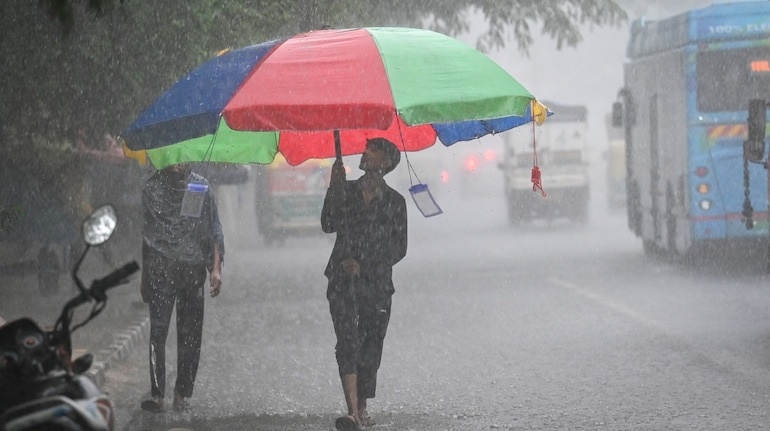
The monsoon is at its peak in the national capital, Delhi, and the entire Delhi-NCR (Noida, Greater Noida, Ghaziabad, Gurugram, and Faridabad). Following torrential rain and intermittent showers overnight, the weather remained extremely rough on Friday, August 7th. The India Meteorological Department (IMD) has issued a ‘Yellow Alert’ for Delhi and Gurugram, warning of strong thunderstorms, lightning, and moderate to heavy rain. The rain has caused heavy waterlogging at several key intersections and major highways in the city, causing severe traffic jams for office-goers during the morning peak hours. The Delhi Traffic Police and Gurugram Police have advised motorists to avoid unnecessary travel and check traffic updates before commuting.
Yellow Rain Alert for Delhi-NCR: Weather Department’s New Forecast
According to the latest bulletin issued by the Meteorological Department, the monsoon trough is currently passing over Delhi and the plains of North India, significantly increasing the humidity level in the atmosphere. Senior IMD scientists say that on August 7, isolated areas of Central, South, East, Northwest, and New Delhi may experience heavy rain and thundershowers. Gurugram and Faridabad also face the risk of light to moderate rain and lightning. Although no formal warning has been issued for Noida and Ghaziabad today, cloudy skies and intermittent rain are expected there as well.
This significant change in weather has led to a significant drop in temperatures. The maximum temperature in Delhi is expected to drop below normal, ranging between 31 and 32 degrees Celsius, while the minimum temperature is expected to be around 24 to 25 degrees Celsius. While this drop in temperature has brought significant relief to Delhiites from the long-suffering humid heat, waterlogging, caused by poor municipal and road infrastructure, has exacerbated their woes. The Meteorological Department also predicts that this monsoon trend in Delhi-NCR may continue until August 10th, and intermittent yellow alerts will remain in effect during this period.
Waterlogging and Severe Traffic Jams: From the Delhi-Gurugram Expressway to AIIMS, Traffic Has Come to a Halt
The most direct and severe impact of the incessant rain has been on the capital’s traffic system. Since Friday morning, long queues of vehicles have been seen on the main connecting roads between Delhi and Gurugram. Traffic on the Delhi-Gurugram Expressway (NH-48) is crawling due to waterlogging from Dhaula Kuan to the Rajokri flyover and Narsinghpur. The traffic jams have become even worse at many locations due to vehicles getting stuck in the water. Additionally, extremely slow traffic movement was recorded on Dhaula Kuan, Aruna Asaf Ali Marg, Shaheed Jeet Singh Marg, JNU Gate to Zia Sarai Marg, and the area around AIIMS.
Long queues of vehicles also formed on the Delhi-Meerut Expressway, Ring Road, Mathura Road, and Vikas Marg in the morning. Roads near Sainik Farms, Rohtak Road, and Kalindi Kunj were flooded with knee-deep water, making it difficult for two-wheeler and four-wheeler riders to find safe passage. Angry commuters shared their experiences on social media, stating that a journey that normally takes 15 to 20 minutes is now taking over an hour. The combined effect of traffic signals and waterlogging at the intersections near the Green Park Metro Station and Yusuf Sarai Market presented a distressing situation for drivers.
Waterlogging has plagued local businesses and citizens, exposing the Municipal Corporation’s claims.
The rains are not only plaguing commuters, but also residents and local businesses in low-lying areas of Delhi. In the Shastri Park area of Northeast Delhi, flooded roads, causing water to enter shops, damaging goods and disrupting business activities. As usual, areas like Rohtak Road, Mundka, and Nangloi are facing severe waterlogging problems this year. Due to the lack of timely cleaning of drains, rainwater is unable to drain easily from the roads.
Teams from the Municipal Corporation of Delhi (MCD), Public Works Department (PWD), and New Delhi Municipal Council (NDMC) have been instructed to deploy mobile pump sets and cranes in vulnerable areas prone to waterlogging. Municipal Corporation officials claim that automatic pumps are being continuously operated to drain water in areas such as ITO, Minto Bridge, Tilak Bridge, and underpasses. Despite this, overflowing drains and accumulation of garbage have blocked water drainage in many places. In Gurugram, the situation became so dire that the police administration had to appeal to private corporate companies and private establishments to allow their employees to work from home to reduce the number of vehicles on the roads.
Monsoon’s Forward Trend and IMD’s Public Safety Advisory
The Meteorological Department (IMD) predicts that monsoon winds will remain highly active over most of North India for the next few days. In addition to Delhi-NCR, Uttar Pradesh, Uttarakhand, Bihar, Rajasthan, and Himachal Pradesh are also affected.