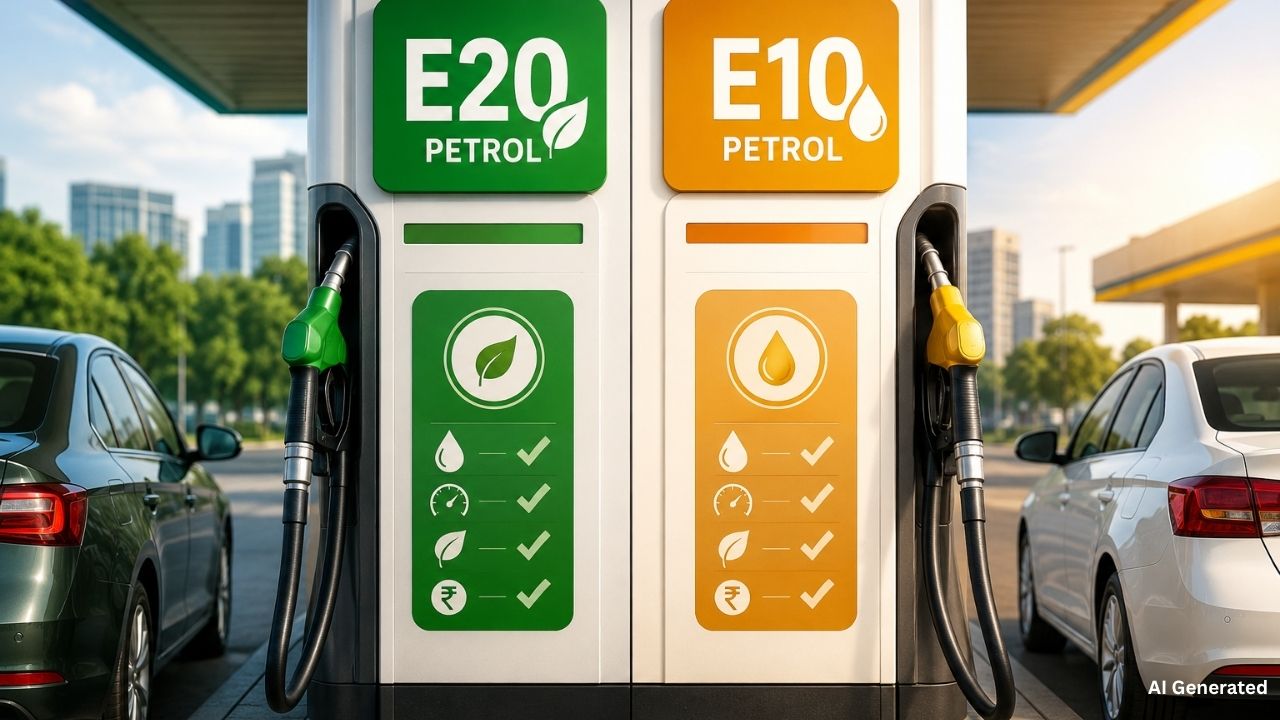
For quite some time now, there has been a lot of controversy across the country regarding E20 petrol. Various videos surfaced on social media in which E20 petrol was said to be harmful for vehicles, but the government has been saying from the beginning that this is all a rumor and E20 is not causing any harm to vehicles.
After this, it was also discussed that the government can replace E20 with E10 petrol, but now Bharat Petroleum Corporation Limited (BPCL) has clarified the situation regarding this. The company said that there is no proposal to replace the existing E20 blended petrol with E10.
What is BPCL’s statement?
BPCL said in its statement, “Shri Sanjay Khanna, Chairman and Managing Director of BPCL, after its Annual General Meeting, said that there is no proposal to replace the existing E20 blended petrol with E10. His statement is being misrepresented, giving the impression that E10 is being considered as an option, which is not correct.” According to BPCL, E20 fuel has been tested in lakhs of vehicles over the last three years. The company claims that no evidence of any damage or other problem was found in the engine during this period.
How did the controversy start?
This clarification by BPCL came after reports that the Petroleum Ministry was discussing the possibility of premium 95-octane petrol with 10 percent ethanol blending with state oil companies Indian Oil Corporation, BPCL and Hindustan Petroleum Corporation. It was told that with such an option, owners of old vehicles can get fuel with low ethanol content and for this there will be no need to create a separate E10 distribution network across the country.
At present, E20 is available as standard petrol blend at petrol pumps across the country, which contains 20 percent ethanol. Questions have been raised about fuel with high ethanol content, especially among owners of older vehicles, regarding mileage and vehicle compatibility.
How much reduction in mileage was revealed due to E20?
The government has been continuously saying that the use of E20 does not harm the vehicle or engine. However, Union Petroleum Minister Hardeep Singh Puri had indicated earlier this year that the use of E20 could affect mileage. According to the Petroleum Ministry, there may be a slight reduction in fuel efficiency of about 3 to 5 percent when E20 is used in vehicles designed for E10. One reason for this is that the energy density of ethanol is lower compared to petrol. In such a situation, increasing the proportion of ethanol in the mixture may affect fuel efficiency.
When was the ethanol blending program started?
The ethanol-blending program in India was started as a pilot project in 2001. After this it was gradually expanded. The objective of the program is to reduce dependence on petroleum imports, reduce vehicle emissions and promote the use of domestically produced ethanol. E20 is part of this broader ethanol blending policy.