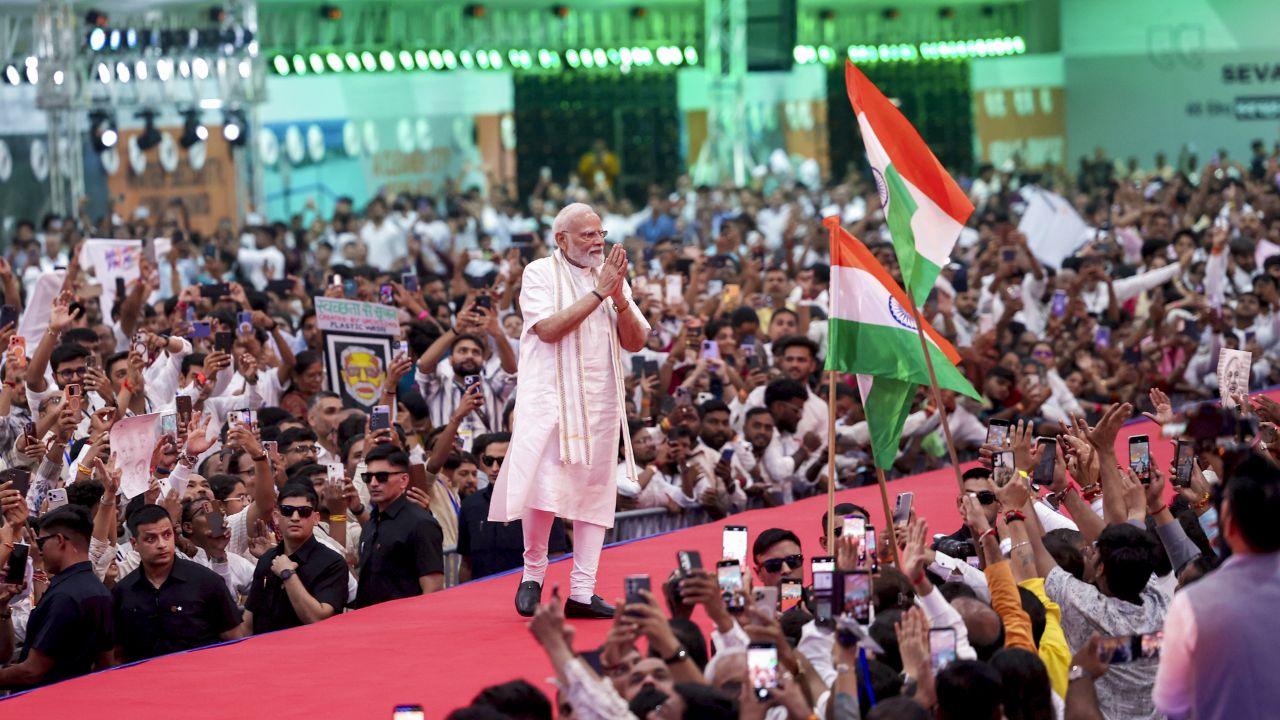
'NaMo for Developed India' program was organized in Vadodara, Gujarat on Tuesday. When Prime Minister Narendra Modi arrived to address this program, a lot of things seemed to have changed. Usually, Prime Minister Narendra Modi enters the stage from the side but this time a ramp was built in front of his stage. He walked up to the stage, walking among the youth and greeting them. During this, high energy music kept playing according to the youth. This is now also being seen in connection with GenZ's efforts to connect. After the strong demonstration of Cockroach Janata Party (CJP) at Delhi's Jantar Mantar, the Prime Minister himself has started making vertical videos and has now adopted another tactic.
There is another reason for discussing this method. Leaders like Joseph Vijay alias Thalapathy Vijay, who miraculously came to power in Tamil Nadu, Rahul Gandhi, former Andhra Pradesh Chief Minister Jagan Mohan Reddy and Abhishek Banerjee have also used this method to connect with the public. In this, instead of seating dozens of people on the stage, a leader is in the middle and presents his views among the supporters sitting around. To keep the public away from the traditionally built stage, some gap is left and then a seating area is created. It is believed that this creates a distance and to fill this gap, screens are also installed in big rallies.
Also read: From studies, writing to marriage, what gamble did CM Yogi play on Nishad voters?
In comparison, in a ramp stage, the leader or speaker stands in the middle of the public and more and more people are able to see him near him. Many times these leaders talk to the public from there, shake hands or even answer questions. On the contrary, this is not possible in a system with big platforms on one side and the public on the other. Perhaps this is the reason why the Bharatiya Janata Party (BJP), which is struggling with the problem of distance from the youth, and Prime Minister Narendra Modi himself have taken steps towards adopting this method of communication.
Rahul Gandhi and CJP increased concern?
It has been seen that BJP found it very difficult to counter the increasing anger of the youth due to CJP's performance. This is the reason why Prime Minister Narendra Modi asked his ministers to connect with the youth through platforms like Instagram. He himself started it and now leaders like Yogi Adityanath have also started making vertical videos. However, continuous efforts are still going on in BJP on how to communicate better with the youth. It is being said that its effect can also be seen in the possible cabinet reshuffle and more young leaders can be made ministers.
Also read: A temple is being built for the Prime Minister, what do the Vedas say about worshiping the person? understand
On the other hand, the increasing popularity and activism of Rahul Gandhi has also increased the graph of BJP's concerns. Rahul Gandhi is active every day and is visiting different cities and communicating with the youth through the 'Students' Echo' program. These programs of Rahul Gandhi are in discussion because the method of communication has been changed in these also. In these, Rahul Gandhi calls the youth and listens to them first. Later he presents his views. Describing these programs as non-political, he is trying to connect more and more youth.
Apart from this, CJP's continuous activism and efforts to corner the government on various issues have put BJP under further pressure. The result of this is that Prime Minister Narendra Modi himself is moving forward and adopting those methods from which BJP was perhaps keeping distance till now.
In this sequence, he is making selfie videos, saying 'Hi friends' instead of 'Friends' and using many words used among GenZ.

Why is BJP in tension?
Elections are to be held in states like Uttar Pradesh, Uttarakhand, Punjab, Gujarat, Manipur and Goa in the coming time. There are BJP governments in five of these states. In four out of five states, BJP has been in power for the last two or three times. In such a situation, BJP does not want to add the resentment of the youth to the increasing anti-incumbency.
Also read: 20,700 crore cost, 326KM length; PM Modi inaugurated 3 sections of WDFC
Election Commission data shows that out of the total voters in the 2024 Lok Sabha elections, 22.78 percent were those whose age was between 18 to 29 years. That is, about 20 percent of the voters are of young age and they come from the same class which forced Dharmendra Pradhan to resign by protesting at Jantar Mantar. 21 percent voters of that age group are in UP, 23 percent in Gujarat, 21 percent in Punjab, 22 percent in Uttarakhand, 20 percent in Goa and 24 percent in Manipur. In such a situation, no party wants to take the risk of angering these youth.