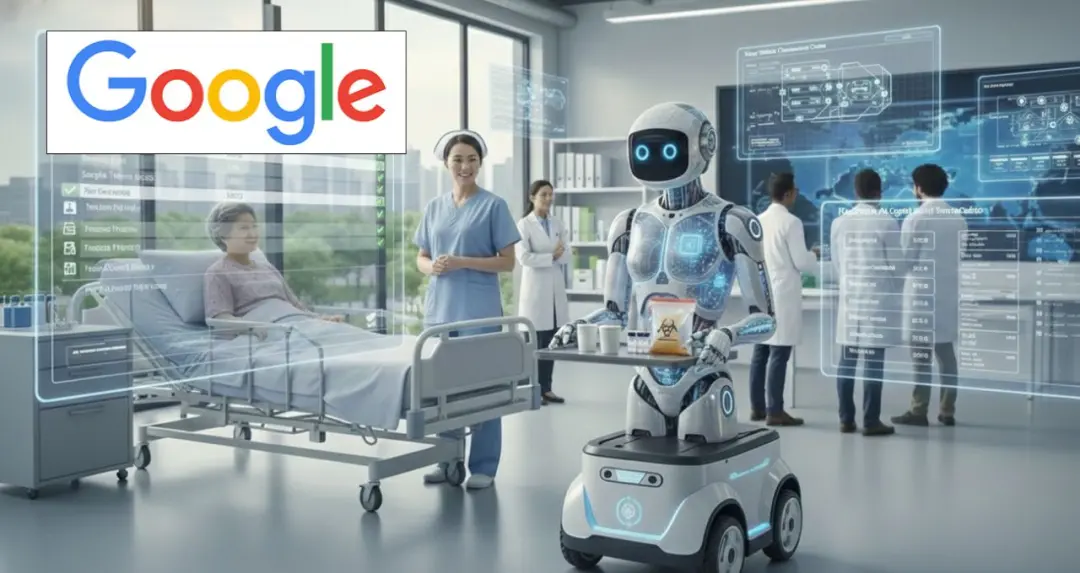
Google and NASA are creating a special AI robot to help travelers going to the Moon and Mars. Along with delivering medical goods, this robot will also be able to perform other important tasks. Its initial investigation has been done.
Tech:If a passenger's health deteriorates in space, it may take a long time for help from Earth to reach for treatment. In view of the long missions to Moon and Mars, NASA has started looking for a solution to this problem. With the help of Google, a robot is being created which will be able to deliver medicines and testing equipment if needed. At present it is being given training to do different types of work.
How will Google's new robot be useful in Moon and Mars missions?
NASA is preparing to keep humans on the Moon for a long time in the coming years. For this, work is going on on Artemis mission. There is a plan to send humans to Mars also. In such missions, astronauts may have to stay away from Earth for several months. If someone gets injured or falls ill during this period, it will not be easy to treat them.
Google gave information about this project in its blog on 27 October 2026. The company said that different teams of NASA are working together to create such a robot, which can make the daily tasks of astronauts easier. This includes teams from NASA's Human Research Program, Johnson Space Center and Jet Propulsion Laboratory.
This robot will not only do work related to treatment. It will also be responsible for finding and bringing any item needed inside the spacecraft, keeping medical equipment at the right place and handling small tasks.
Suppose an astronaut suddenly experiences severe pain in his back. The doctor suspects that the cause could be kidney stones. In such a situation, the robot can bring the ultrasound machine and help in preparing the necessary items for the test. However, only the medical officer will decide on the examination and treatment of the patient.
If trouble increases on Mars, help will not come immediately from Earth
Mars is much farther from the Earth than the Moon. The biggest problem for the astronauts present there will be timely contact. According to Google, it can take up to 44 minutes to send a message from Mars to Earth and get a response back.
Now imagine, an astronaut's health suddenly worsens and he needs immediate treatment. In such a situation, it may be too late to take the next step after consulting the doctor present on earth. That's why NASA wants such technology so that astronauts can get initial medical help themselves.
Google and NASA are already working on a technology called Crew Medical Officer Digital Assistant i.e. CMO-DA. Its purpose is to help medical officers in space to understand the patient's problem and get information related to treatment.
Now, taking a step forward in this direction, a robot is being prepared. The difference will be that it will not be limited to just giving information, but will also do work like picking up goods when needed.
At present this technique is not being considered an alternative to the doctor. Its job will be to help the astronauts, while medical decisions will be taken by humans only.
Good results obtained in the test of lifting medical bag
During initial testing, Google and NASA gave the robot the task of finding a medical bag and placing it at another place. The robot got 85 percent success in this test. However, this is still a preliminary result and will need to be tested in many ways before it can be used on real space missions.
Google DeepMind's MuJoCo simulator was used to train the robot. In this, different situations are created on the computer itself to see how the robot will work. This helps in finding out the shortcomings before testing it on the real machine.
According to the company, in this project work has also been done on Pi0 AI model with four billion parameters. It was fine-tuned in about two and a half hours with the help of Google Cloud. In the last two years, the team has examined about 15 types of computing devices. The effort is to ensure that the robot can work well even with less power, because both power and space are limited in spacecraft.
Further, this robot can also get the facility to understand the instructions given by voice. Apart from this, there is also a plan to seek its help in works like checking blood pressure and preparing items for ultrasound.
Right now this robot is in the initial stages of preparation. NASA has not given any date for sending it into space. Only after the upcoming tests will it become clear how useful this robot proves to be for astronauts.