

120
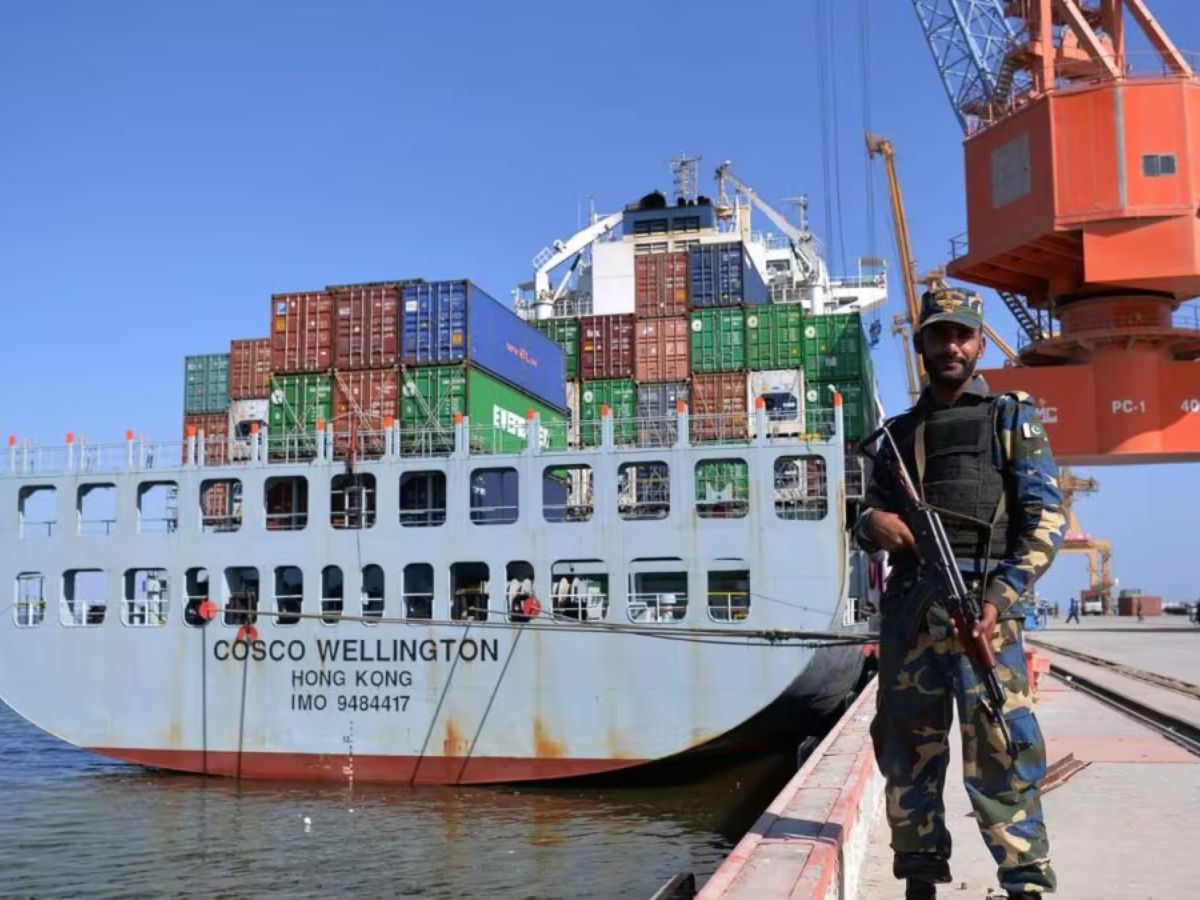
Gwadar Port is facing a rare and dangerous convergence of threats from both land and sea. On one side, strained relations between Pakistan and Afghanistan continue to disrupt critical trade corridors, undermining the port’s economic viability. On the other, a recent maritime attack has exposed new vulnerabilities, with insurgents extending their reach into previously secure waters. The killing of coast guard personnel near Jiwani marks a turning point, signalling that Gwadar is no longer insulated from regional instability. With diplomacy stalled and security risks rising, the port’s strategic promise appears increasingly uncertain.
The attack near Jiwani sits roughly within striking distance of Gwadar Port, the centrepiece of the China-Pakistan Economic Corridor and, in theory, China’s shortcut to the Arabian Sea. In practice, Gwadar has struggled for years to live up to its billing — commercially underperforming, perpetually behind schedule, and ringed by a security apparatus straining against constant pressure.
The timing compounds the damage. Just days before the Jiwani attack, Chinese-mediated peace talks between Pakistan and Afghanistan ended in Urumqi without agreement. The negotiations, held from April 1 to April 7, were brokered by Beijing with considerable diplomatic investment. They produced nothing binding.
The two sides came to Xinjiang carrying grievances that no conference room could easily dissolve. Pakistan wanted firm, verifiable commitments from the Taliban government to act against Tehrik-i-Taliban Pakistan militants using Afghan soil as a staging ground. Islamabad had launched Operation Ghazab lil-Haq in February — a cross-border campaign targeting alleged TTP hideouts — and the fallout had been severe. Relations between Islamabad and Kabul collapsed almost entirely.
The Taliban, for their part, were unwilling to hand Pakistan the kind of written guarantees that Islamabad demanded. The talks closed with vague references to continued dialogue. Both sides returned home having given nothing of substance away.
For China, the failure stung. Beijing had positioned itself as the essential broker — the one power with enough leverage over both Islamabad and Kabul to force a breakthrough. That leverage, it turned out, had limits.
Gwadar’s value is not simply as a port. It is the southern anchor of an ambitious trade architecture — a web of roads, pipelines, and rail lines intended to link China’s western provinces to the Middle East and Central Asia. A proposed corridor through the Peshawar-Kabul route was supposed to open Pakistan’s landlocked northwest to CPEC-linked commerce. That requires stable Pakistan-Afghanistan relations. Instability and unending hostility between two nations make Gwadar Port a stranded asset — expensive, well-guarded, and increasingly pointless.
The maritime attack piles onto this structural problem. Shipping companies already factor Balochistan’s instability into their risk calculations. Insurance underwriters are not known for generosity toward ports where coast guard vessels get blown up. If the sea lanes around Gwadar are now considered live threat zones, the commercial case for routing cargo through the port weakens further.
Security analysts have watched the Balochistan Liberation Army’s evolution with growing unease. The group, which claims the maritime attack, began as a rural insurgency focused on grievances over resource extraction and political marginalisation. Over time it acquired more sophisticated tactics, more disciplined targeting, and — apparently — a maritime capability.
That last development carries particular weight. Land-based attacks can be managed, at least partially, through convoy escorts, checkpoints, and fortified compounds. Maritime threats are harder to contain. Coastlines are long. Patrol resources are finite. And in the waters between Jiwani and Gwadar, the distances are short enough that even a small, fast vessel can close rapidly.
Pakistan’s Coast Guard was not built for this kind of threat. Whether it can adapt quickly enough is a genuine question.
There are, to be fair, fragments of cautious optimism buried beneath the wreckage. Pakistani airstrikes on Afghan targets reportedly decreased after the Urumqi talks concluded, suggesting neither side wants full escalation. Afghan officials have hinted at written assurances on militant activity, though nothing formal has materialised. d.
However, China has said it will continue to facilitate dialogue between Pakistan and Afghanistan. But optimism requires evidence, and the evidence is thin. A patrol boat lies at the bottom of the Arabian Sea. Three families are grieving. Peace talks came home empty-handed. And Gwadar Port — once described in grand communiqués as a gateway to regional transformation — stands at an intersection that, right now, nobody wants to be at.

Comments are closed.