
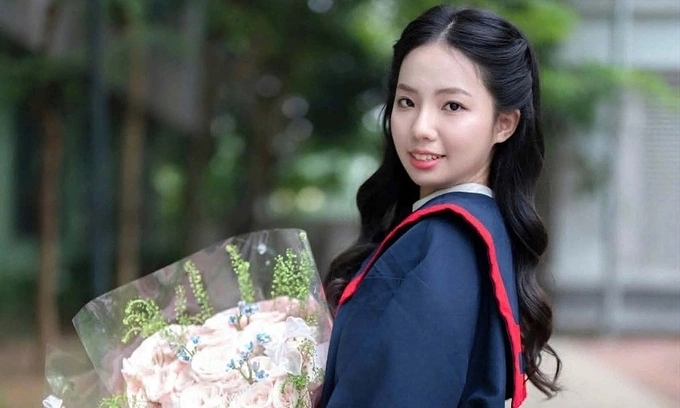

Nguyen Ngoc Thao Nguyen, 18, recently received a conditional offer from Peking University, which adds to admissions she secured from Tsinghua University and Fudan University in May, during her final year at Hanoi’s Newton Secondary and High School.
The three institutions consistently rank among the world’s most prestigious. In the Times Higher Education World University Rankings 2026, Tsinghua leads the Chinese institutions at 12th globally, followed by Peking at 13th. Fudan placed 36th out of more than 2,100 institutions worldwide.
In the 2026 U.S. News & World Report Best Global Universities rankings, Tsinghua climbed to sixth place. This positioned it ahead of renowned American Ivy League schools like Yale and Columbia, while Peking and Fudan ranked 19th and 49th, respectively.
“I’m very happy because these were all major goals I had set for myself a long time ago,” Nguyen said.
Nguyen Ngoc Thao Nguyen in a yearbook photo for her graduation ceremony from Hanoi’s Newton Secondary and High School. Photo courtesy of Nguyen |
Her dream of studying in China began in the 10th grade. Initially drawn to the country’s language and culture through television programs, her focus shifted toward comparing legal systems after traveling abroad with her family.
“I realized that every country operates differently,” she explained. “A stable legal system provides the foundation for economic and social development, so I wanted to learn more about this field.”
She ultimately chose China for its highly competitive and dynamic academic environment.
To achieve her goals, Nguyen followed a meticulously planned roadmap. During her first two years of high school, she focused heavily on extracurricular activities. By the start of her senior year, she pivoted to earning crucial international qualifications, including the HSK Chinese-language certificate, the IELTS English test, and the CSCA aptitude assessment used by Chinese universities.
To master English and Chinese simultaneously, she created an immersive learning environment using films and podcasts. She frequently utilized cross-language subtitles, applying English text to Chinese-language audio and vice versa, to sharpen her language reflexes. She also dedicated significant time to practice exams, meticulously reviewing her mistakes.
The demanding schedule often left her feeling immense pressure ahead of major exams. To unwind, Nguyen turned to her passion for music and dance. She has participated in dancesport competitions since childhood and plays three instruments: the piano, the violin, and the guzheng, a traditional Chinese string instrument.
She credits her exposure to the arts with strengthening her concentration, discipline, and ability to balance academics with personal interests. Mastering the guzheng also deepened her appreciation and understanding of Chinese culture.
 |
Nguyen Ngoc Thao Nguyen holds a card painted with “Tsinghua”. Photo courtesy of Nguyen |
When it came time to apply, her personal statement, spanning about two A4 pages, focused on her personal growth, academic achievements, extracurricular involvement, and motivation for pursuing law.
Rather than simply listing her accomplishments, she aimed to demonstrate clear goals, leadership potential, and the maturity she had gained through real-world experience.
Part of that experience came from serving as the head of finance for her school’s media and arts clubs. She founded the “Mid-Autumn of Love” charity program in 2024.
The initiative supported roughly 100 children in Hanoi’s My Duc District who were affected by Typhoon Yagi, the most powerful storm to hit Vietnam in three decades. Over just three weeks, her project raised more than VND50 million (US$1,890), alongside donations of books and essential supplies.
“It was the first time I had launched a project myself, so it was quite stressful,” she recalled. “But I learned how to bring people together, delegate tasks, and take responsibility for a team.”
The admissions process itself proved rigorous. After passing the initial application stage, Nguyen advanced to interviews with Tsinghua and Fudan. Admissions panels questioned her in both English and Chinese, while also testing her analytical skills through complex mathematics problems.
Peking University required candidates to sit formal examinations in mathematics, English, and Chinese. Following the exams, applicants drew random discussion topics and engaged in extended debates with their peers.
“The process was very long and demanded broad thinking, strong critical reasoning, and the ability to perform under pressure,” Nguyen said.
Her homeroom teacher, Nguyen Tien Hau, described her as friendly, cooperative, and highly engaged in the school community.
“Thao Nguyen is always self-motivated and proactive in her studies, consistently achieving strong results in school examinations,” he noted.
Nguyen, who still awaiting scholarship decisions to decide between Tsinghua and Peking, hopes to specialize in economic law and build a career in an international environment.
Comments are closed.