

The streets are Trang Tien, Hang Khay, Le Thai To, Hang Dao, Hang Ngang, Hang Buom, Ma May, Hang Bac, Hang Mam, Nguyen Huu Huan, and Ly Thai To.
For six months gasoline-powered motorbikes used for ride-hailing services will be banned outright on these streets.
Light trucks under two tons that meet Euro 4 emission standards can operate outside peak hours, those between two and 3.5 tons can run between 9 p.m. and 6 a.m. with written approval from the police and those over 3.5 tons are completely banned.
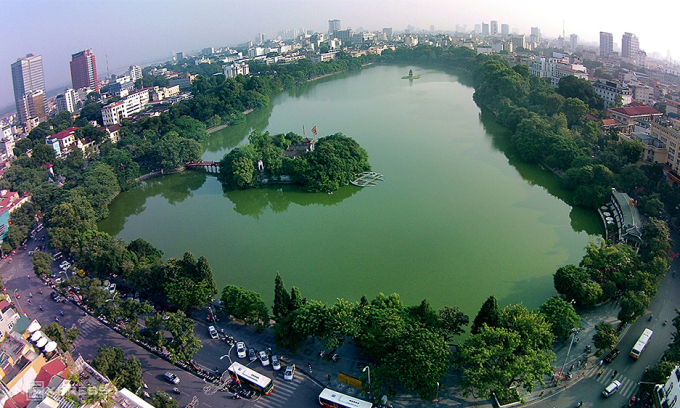
The area surrounding Ho Guom Lake is set to be designated as a pilot low-emission zone starting July 1, 2026. Photo by Read/Giang Huy |
In the Old Quarter and Hoan Kiem Lake areas in Hoan Kiem and Cua Nam wards, passenger vehicles with 16 seats or more must meet the Euro 4 emission standards. These larger vehicles, excluding public buses and school shuttles, are also restricted from the roads daily during peak hours: 6:00 a.m. to 9:00 a.m. and 4:00 p.m. to 7:30 p.m.
Public buses, school shuttles, and fossil-fuel vehicles with fewer than 16 seats are permitted but must adhere to Euro 4 emission standards.
For Phase 2 (Jan. 1 – Dec. 31, 2027), the city will expand the pilot zone to cover Hoan Kiem and Cua Nam wards. This expansion encompasses the Phase 1 core zone and 14 peripheral streets: Nguyen Du, Han Thuyen, Tran Hung Dao, Tran Khanh Du, Tran Quang Khai, Tran Nhat Duat, Hang Dau, Cua Dong, Ly Nam De, Ton That Thiep, Dien Bien Phu, Hang Bong, Cua Nam, and Le Duan.
Phase 3 in 2028 and 2029 will extend the low-emission zone across the entire Ring Road No.1 area, covering nine wards bounded by major roads such as Hoang Cau, De La Thanh, O Cho Dua, Xa Dan, Dai Co Viet, Tran Khat Chan, Nguyen Khoai, Tran Quang Khai, Yen Phu, Nghi Tam, Au Co, An Duong Vuong, Lac Long Quan, Buoi, and Cau Giay.
The plan is based on Resolution No. 57 of the city People’s Council, which sets a road map for low-emission zones in Ring Road 1.
City authorities said air quality has deteriorated at times in recent years, particularly in central urban areas with high population density, heavy traffic and intense economic activity.
Studies by the Ministry of Agriculture and Environment have found that PM2.5 pollution sources in the city include transport (25%), construction and road dust (20%) and open burning (12%).
An emissions inventory shows direct transport emissions account for 59%.
Authorities said the low-emission zone would serve as a foundation for coordinated measures such as restricting high-emission vehicles in central areas, expanding public transport and clean-energy vehicles and strengthening monitoring and enforcement using technology.
It would also help assess the effectiveness before expanding the model to other areas in later phases, they added.
Hanoi has around 6.9 million motorbikes, including some 450,000 within Ring Road 1.
Comments are closed.