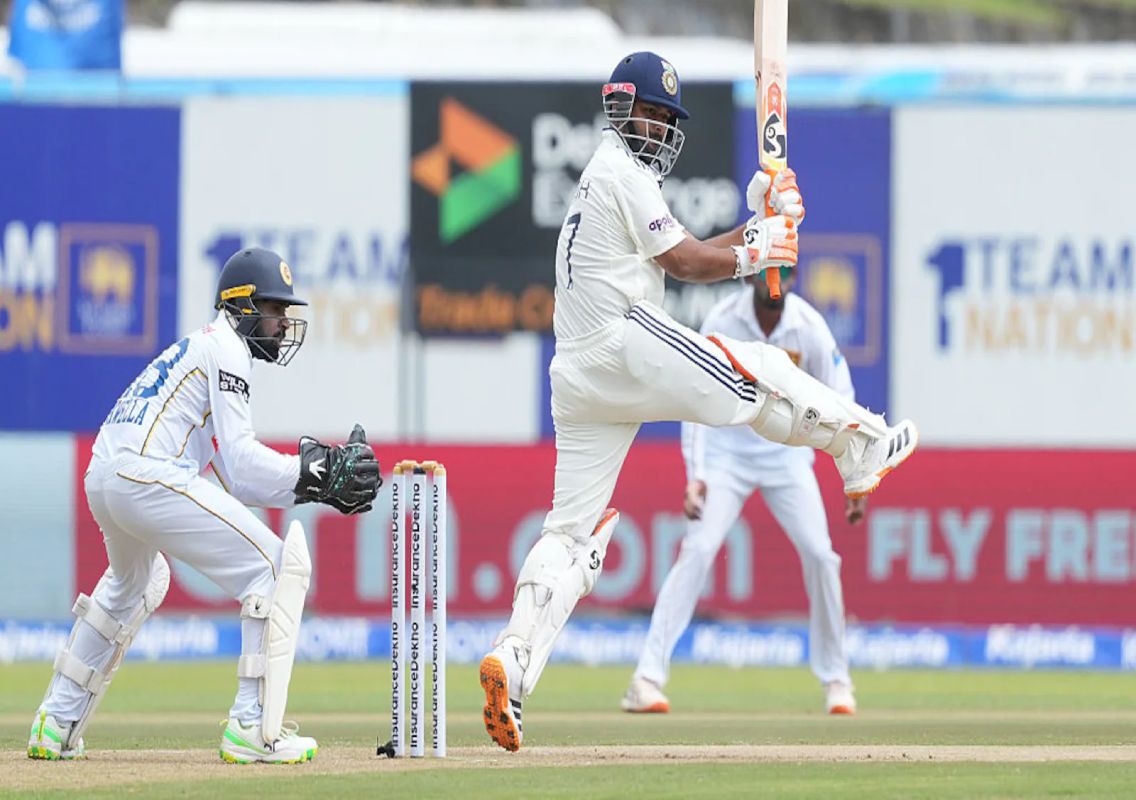
Galle: India’s approach in the second innings of the first Test against Sri Lanka has come under scrutiny after renowned commentator Harsha Bhogle questioned the team’s batting strategy on Day 4. India eventually set Sri Lanka a target of 372, but Bhogle felt the visitors may have used valuable time without adding enough runs.
India had started their second innings with a 178-run first-innings lead. However, their batting progressed relatively slowly during the early part of the innings. With rain a potential factor in the match, Bhogle argued that India should have prioritised giving their bowlers as much time as possible to dismiss Sri Lanka.
His criticism came as India were attempting to force a result in Galle, where Sri Lanka needed 372 runs for victory.
Harsha Bhogle questions India’s approach
Bhogle’s main concern was not the size of India’s eventual target but the amount of time consumed while building it.
He questioned India’s approach during the final 40 minutes of the innings, particularly because the weather was uncertain and rain could potentially reduce the amount of playing time available on the final day.
The commentator argued that India could have benefited from declaring earlier or scoring at a faster rate, thereby giving their bowlers more time to take 10 wickets.
His assessment effectively centred on the balance between runs and time.
In a Test match where a team is pushing for victory, adding another 20 or 30 runs is useful only if there is sufficient time left to dismiss the opposition. If weather interruptions become a factor, those additional runs can come at the expense of valuable bowling time.
India were all out for 193
India eventually finished their second innings on 193having started the innings with a 178-run advantage.
That left Sri Lanka with a target of 372 runs.
Rishabh Pant was India’s leading scorer, making 66 from 69 deliveries. Devdutt Padikkal and KL Rahul were the only other Indian batters to make double-digit scores in the innings, according to the report.
India’s innings therefore combined periods of caution with bursts of attacking batting, particularly from Pant.
The total was substantial enough to put Sri Lanka under serious pressure, but Bhogle’s argument was that India could potentially have achieved a similar target while leaving themselves more overs to bowl.
Rain threat made time management important
The weather was one of the biggest reasons behind Bhogle’s criticism.
The possibility of rain meant India could not assume that the final day would provide a full day’s play.
In such circumstances, the value of every over increases.
India needed to dismiss Sri Lanka twice in the Test only if the match situation required it, but once Sri Lanka began their fourth-innings chase, India’s objective was clear: take 10 wickets before the available playing time ran out.
Bhogle noted that ground staff were already prepared with covers, highlighting the possibility of interruptions.
India still put Sri Lanka under pressure
Despite the criticism, India’s strategy had produced a strong position by the end of Day 4.
Sri Lanka were set 372 and lost four wickets during their chase.
At the start of Day 5, the match situation showed Sri Lanka on 175/6 at lunchwith the hosts requiring 197 more runs and India needing four wickets.
That development demonstrates why India’s decision to build a substantial target was not without merit.
The visitors had created a winning opportunity, even though the time-management aspect of their batting remained open to debate.
Rishabh Pant provides the attacking spark
Pant was the standout batter in India’s second innings.
His 66 off 69 balls gave the innings much-needed acceleration and also produced a major personal milestone.
Pant became the first Indian batter to hit 100 sixes in Test cricketjoining Ben Stokes, Brendon McCullum and Adam Gilchrist in the exclusive group of batters to reach the landmark.
His aggressive batting helped India push the lead towards the 372-run mark.
Pant’s ability to score quickly was particularly valuable because India needed to balance the requirement for a sizeable target with the need to leave enough time for their bowlers.
Devdutt Padikkal makes an immediate impact
While Pant provided the aggression, Devdutt Padikkal emerged as another major positive for India.
Playing his first Test in nearly two years, the Karnataka batter made 167 and 44 in the match, according to the report.
His performance has strengthened his case for a longer run in India’s Test side.
Padikkal explained after the day’s play that Test cricket remains his ultimate goal and that he has consciously tried to maintain his red-ball skills while moving between white-ball and red-ball formats.
Padikkal explains his technical adjustments
Padikkal acknowledged that switching between formats is difficult.
He explained that his white-ball setup allows him to play more shots, whereas his red-ball technique requires him to tighten his approach and keep his hands closer.
The batter said he has become better at mentally making that transition.
His comments are particularly relevant given the demands on modern international cricketers, who frequently move between Test, ODI and T20 cricket.
India had a difficult start to the second innings
India’s second innings did not begin smoothly.
Yashasvi Jaiswal was dismissed early, while KL Rahul and Padikkal then attempted to stabilise the innings.
Rahul made 35 before being dismissed, while captain Shubman Gill was removed for eight.
That left Pant with an important role in accelerating the scoring.
His 66-run innings helped India regain momentum and establish the sizeable target that Sri Lanka eventually had to chase.
Sri Lanka’s resistance keeps Test alive
Although India were in control for much of the match, Sri Lanka’s batting resistance ensured the Test remained competitive.
The hosts had to negotiate a difficult fourth innings against India’s pace and spin attack.
Manav Suthar made a particularly strong impact, while India’s other bowlers also contributed important wickets.
Sri Lanka’s ability to reach 175/6 by the lunch interval on Day 5 meant India still had work to do despite their strong position.
The debate over declaring early
The central question raised by Bhogle is one that frequently emerges in Test cricket: when is enough runs enough?
A captain must assess several factors before declaring or accelerating an innings.
The target needs to be large enough to put the opposition under pressure, but every extra run can consume time.
The calculation becomes even more complicated when weather threatens.
India’s target of 372 was undoubtedly challenging for Sri Lanka. However, Bhogle’s criticism suggests that the visitors might have benefited from sacrificing some runs in exchange for additional overs.
India needed to maximise bowling time
The biggest advantage of an earlier declaration would have been additional time for India’s bowlers.
Sri Lanka’s fourth innings was always likely to be difficult, especially as the Galle surface progressed and India had quality spin options.
An additional 30 or 40 minutes could potentially have provided more opportunities to take wickets before bad weather intervened.
That was the strategic concern behind Bhogle’s comments.
The criticism does not necessarily mean India’s approach was fundamentally wrong. Instead, it highlights a tactical choice that could have been handled differently.
India’s bowling attack remains key
With the match moving into its final stages, India’s bowlers became more important than their batters.
Jadeja, Suthar and the pace attack needed to exploit every opportunity.
India’s strong position meant they could attack with close catchers rather than simply defend the target.
The challenge was to prevent Sri Lanka from settling into long partnerships.
A fine balance between aggression and caution
India’s batting approach illustrates the difficult balance involved in Test match strategy.
Bat too aggressively and a team risks losing wickets quickly.
Bat too slowly and it may run out of time to take 20 wickets.
India ultimately set Sri Lanka a target that offered them a strong chance of victory, but Bhogle believed the visitors could have managed the time element more effectively.
The importance of that decision would become clearer depending on the final result.
Day 5 turned the criticism into a talking point
The criticism gained greater significance as Sri Lanka continued to resist on the final day.
At lunch, Sri Lanka were 175/6 and needed 197 more runs for victory, while India required four wickets.
That equation showed that India remained firmly in control, but it also meant the visitors could not afford to waste further time.
Every over became important.
If Sri Lanka survived deep into the day, Bhogle’s concerns about India’s use of time would appear more justified.
If India completed a comfortable victory, the criticism would carry less weight in the final assessment.
Conclusion
India’s batting approach in the second innings of the Galle Test has sparked a tactical debate after Harsha Bhogle questioned why the team spent significant time without adding enough runs during the final stages of their innings.
India were eventually bowled out for 193 and set Sri Lanka 372 runs to win. Rishabh Pant’s 66 off 69 balls provided the major acceleration, while Devdutt Padikkal continued his impressive comeback with another important contribution.
Bhogle’s criticism centred on the possibility of rain. With uncertain weather and ground staff preparing for interruptions, he felt India should have maximised the time available to their bowlers rather than using valuable minutes to add relatively few runs.
The criticism, however, needs to be viewed alongside India’s strong position. Sri Lanka were reduced to 175/6 by lunch on Day 5 and still needed 197 runs, leaving India four wickets away from victory.
Ultimately, the Galle Test offered a reminder that Test cricket is not only about runs and wickets. Time management, weather conditions and the timing of an innings declaration can be equally important when a team is chasing victory.