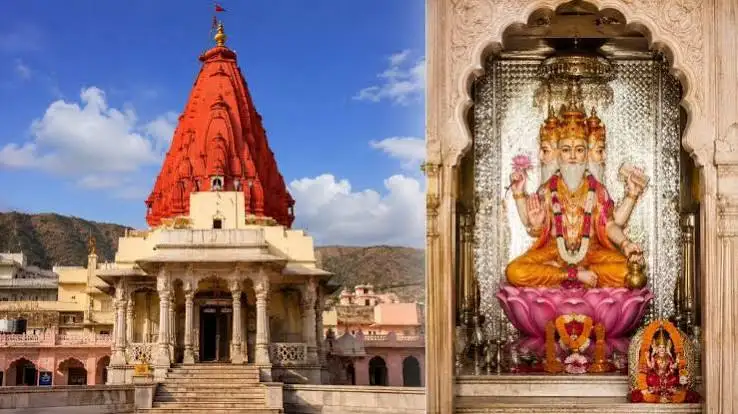
Pushkar, located in the Ajmer district of Rajasthan, is one of India’s most ancient and famous pilgrimage sites. Surrounded by the Aravalli Hills, this religious town is known for the sacred Pushkar Lake, the Brahma Temple, and the internationally renowned Pushkar Fair. Pushkar is considered a highly sacred place in Hindu mythology. Most notably, it houses a famous temple dedicated to Lord Brahma, considered one of the world’s most prominent and rarest temples dedicated to Lord Brahma.
The Pushkar Legend is Connected to Lord Brahma
According to mythology, Lord Brahma once threw a lotus flower while searching for a suitable place for a yagna. Where the lotus flower fell, a stream of water burst forth, forming Pushkar Lake. Lord Brahma chose this very spot for the yagna.
According to another legend, Brahma’s wife, Savitri, failed to arrive on time during the yagna. Seeing the auspicious time approaching, Brahma married a girl named Gayatri and completed the yagna. Upon Savitri’s arrival, she cursed Lord Brahma, stating that his worship would be limited to a limited number of places on earth. Folklore connects this story to the significance of the Brahma Temple in Pushkar.
The Religious Significance of Pushkar Lake
Pushkar is also known for its 52 ghats. Devotees take holy baths at these ghats. Religious belief holds that bathing in Pushkar Lake bestows merit and absolution from sins.
Special religious ceremonies are held here on the occasion of Kartik Purnima. Devotees from across the country visit Pushkar, bathe in the lake, and then pay their respects to Lord Brahma.
Why is the Brahma Temple so special?
The Brahma Temple in Pushkar is one of the most famous temples dedicated to Lord Brahma. A four-faced idol of Lord Brahma is enshrined within the temple. Goddess Gayatri is also worshipped alongside him.
The temple’s current structure is believed to be the result of construction and reconstruction over several centuries. The temple’s red-colored spire and the silver decorations on its entrance give it its distinctive identity.
An important point to note here is that while it is a popular belief that Brahma is the “only temple in the world,” this is factually incorrect. There are numerous smaller temples and temple complexes dedicated to or associated with Brahma in India and other parts of the world. However, the Brahma Temple in Pushkar is considered the most famous and prominent temple dedicated to Lord Brahma.
Three Major Places in Pushkar
Pushkar holds special religious significance due to three major sites—the Brahma Temple, the Pushkar Lake, and the Savitri Temple. Situated on the Aravalli Hills, the Savitri Temple offers a spectacular view of the Pushkar town and the lake.
Pushkar also boasts the Varaha Temple, the Rangji Temple, and several other ancient religious sites, which enrich its religious and architectural heritage.
The Pushkar Fair is also world-famous
Pushkar’s identity is not limited to religious tourism alone. The Pushkar Fair, held annually in the month of Kartik, is one of the most famous cattle fairs in the country. Along with the buying and selling of camels, horses, and other animals, cultural programs and religious events are also held here.
Today, Pushkar is one of the major tourist destinations in Rajasthan for tourists from both India and abroad. Foreign tourists visit the lake, temples, ghats, colorful markets, and desert culture.
A Center of Thousands of Years of Faith
Pushkar’s significance is not limited to just one temple. Here, mythology, ancient pilgrimage traditions, temples, ghats, and fair culture coexist. This is why Pushkar is considered one of Rajasthan’s most important religious cities.
The rare tradition associated with the worship of Lord Brahma and the sacred Pushkar Lake give this city a special place among India’s major pilgrimage sites. This confluence of history and faith makes Pushkar a major center of attraction for both devotees and tourists.