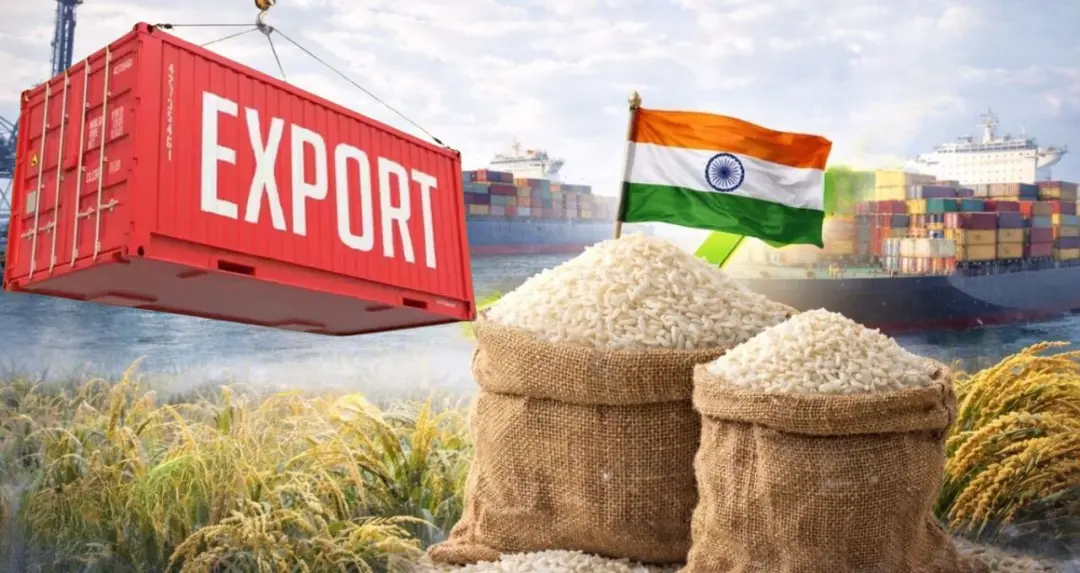
The European Union (EU) market is increasingly becoming a major challenge for Indian rice exporters. Many consignments of Indian rice are not meeting the strict quality and food safety standards of the European Union, increasing the problems of exporters.
Business News: The European Union (EU) market seems to be a new challenge for India Rice Export. Regulatory alert registered on 52 consignments of Indian rice in the year 2025 under European food safety standards. The main concerns in these cases are pesticide residues and food safety standards. This has highlighted the need for Indian rice exporters to strengthen quality control and certification mechanisms in the European market.
According to a working paper by the Indian Council for Research on International Economic Relations (ICRIER) published in July 2026, India exported about 4.74 lakh tonnes of rice to the EU in 2025. During the same period, 52 consignments of Indian rice were caught in the EU surveillance system. Among major rice exporting countries, alert was registered on 55 consignments of Pakistan, while India stood second in this list.
Problem on a consignment of about 9,100 tonnes
Based on available data, approximately one consignment out of every 9,100 tonnes of export quantity of Indian rice was found to have a problem during regulatory inspection. In comparison, the number of such consignments from major supplier countries like Cambodia, Myanmar and Thailand was much less. These data are linked to the European Union's Rapid Alert System for Food and Feed (RASFF).
This system is used to share information about potential risks related to food and animal feed. Such alerts do not prove that a country's entire exports are unsafe, but recurring problems can certainly become a matter of concern for exporters and regulators.
Questions on responsibilities of APEDA and EIC
The ICRIER study also raises questions about the roles of APEDA and the Export Inspection Council (EIC) in India's export monitoring system. APEDA plays an important role in promoting export of agricultural and processed food products and arranging traceability. On the other hand, EIC is involved with the inspection and certification process.
However, some responsibilities of both the institutions overlap with each other. Having both roles in areas such as standards, training of exporters and laboratory networks could create problems regarding clear lines of accountability. Exporters say they have to coordinate with multiple entities to complete the approval and certification process at different levels. This can complicate the export process and also increase time and cost.
Out of 126 authorized labs, only 50 are capable of testing rice.
According to ICRIER report, APEDA has authorized 126 laboratories in the country. Of these, there are only about 50 labs which are capable of testing rice. Of these, 47 laboratories are notified at the level of the Indian Food Safety Regulator. The report suggests that a nodal agency be created to monitor rice exports. This can improve end-to-end traceability of the entire supply chain from production, processing, testing, certification and the final stages of export.
Pesticide residue became a major reason
The main reason for the action on some consignments of Indian rice in the EU is due to residues of pesticides which are under strict restrictions or lower maximum residue limits in the EU, while in some cases their use continues in India. Additionally, deficiencies in storage, post-harvest processing, and handling of rice can also lead to fungus or other quality problems. There has been a demand from exporters to control the use of such pesticides and develop production processes as per European standards.
92% business depends on Basmati
The biggest strength of India's rice business in the European market is Basmati rice. According to available data, about 92 percent of Indian rice trade to EU is related to Basmati. Import duties also vary for different varieties of rice in the EU. The duty on milled rice is said to be around 200 euros per tonne and on non-Basmati brown rice to be around 30 euros per tonne. Whereas Basmati brown rice gets the benefit of a different system in terms of import duty.