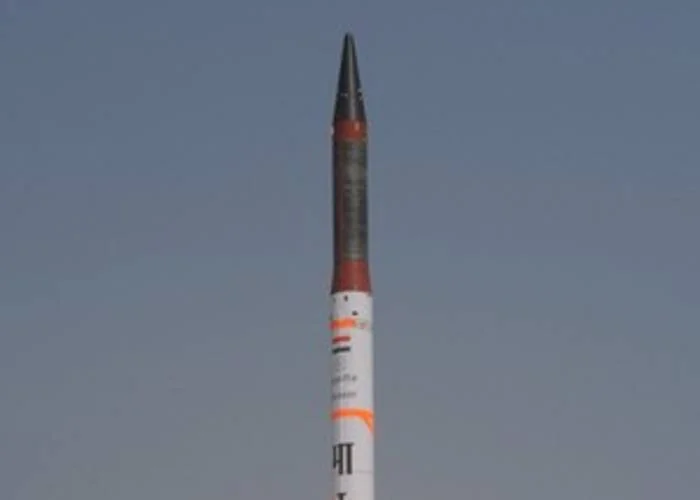
India on Thursday successfully conducted the test-firing of the Medium Range Ballistic Missile (MRBM) Agni-4 from the Integrated Test Range (ITR) at Chandipur in Odisha, the Ministry of Defence said.
The launch was carried out under the aegis of the Strategic Forces Command (SFC) and successfully validated all operational and technical parameters of the missile, according to a Defence Ministry official.
The successful test further strengthens India’s strategic missile capabilities. The Agni series comprises long-range, nuclear-capable surface-to-surface ballistic missiles developed to enhance the country’s defence preparedness.
The Agni-4 missile had earlier undergone successful trials, including a launch from the Integrated Test Range in Chandipur on September 6, 2024, during which all mission objectives were achieved.
India has continued to expand its indigenous missile development capabilities through coordinated efforts of the Defence Research and Development Organisation (DRDO) and the Strategic Forces Command.
Earlier, on April 4, 2024, India successfully conducted the flight test of the new-generation Agni-Prime ballistic missile. The test was carried out by the SFC in collaboration with DRDO.
In another major missile development, DRDO successfully tested the indigenously developed Long Range Land Attack Cruise Missile (LRLACM) on June 15 this year from Dr APJ Abdul Kalam Island off the Odisha coast.
According to DRDO, the LRLACM test met all objectives, with data collected through multiple tracking systems deployed by the Integrated Test Range, Chandipur confirming the successful demonstration of critical technologies and long-range precision strike capabilities.
The launch was witnessed by senior DRDO officials and representatives of the Indian Navy and Indian Air Force. Defence Secretary and Secretary, Department of Defence (R&D), along with DRDO Chairman Rajesh Kumar Singh, monitored the proceedings.
Defence Minister Rajnath Singh had congratulated DRDO scientists and industry partners following the successful LRLACM test and appreciated the efforts of all teams involved in the development programme.