
International student enrolments slump 24% across Big Four destinations, with US and Canada hardest hit

The Global Enrolment Benchmark Survey report, based on responses from 254 universities across 36 countries, including 49 in the U.S., 24 in the U.K., 13 in Canada and nine in Australia, found that the “Big Four” destinations experienced contractions in both undergraduate and postgraduate enrolments compared to the same intake period last year.
The survey, conducted by Studyportals, international education platform NAFSA: Association of International Educators, and partner organizations, said the downturn was driven largely by tightening visa policies, political uncertainty and rising living costs.
The U.S. and Canada recorded some of the sharpest drops. International student enrolment at U.S. universities for the 2026 spring semester fell 20% year-on-year for bachelor’s programs and 24% for master’s programs. In Canada, the respective declines were 24% and 19%.
The U.K. followed with an 11% drop in undergraduate enrolments and a 15% decline at postgraduate level.
Australia recorded a 1% fall in new international undergraduate enrolments for spring 2026, while new postgraduate enrolments dropped 16%.
Average change in new international enrolments vs. same intake last year. Graphic by The Global Enrolment Benchmark Survey |
Visa barriers and costs bite
Visa restrictions and government policy changes emerged as the dominant concern globally. Nearly three-quarters of universities surveyed described restrictive policies or visa difficulties as a significant issue, up from 62% in the first half of 2025.
Affordability pressures also intensified, with 49% of institutions citing tuition fees and living costs as major barriers for students, compared to 46% a year earlier.
Cara Skikne, head of communication and thought leadership at Studyportals, told Read International that “the current restrictive policy environment is accelerating a longer-term structural trend away from the Big Four destinations. We’ve seen this trend intensify rather than stabilize in recent years.”
Among universities surveyed, 69% of Canadian institutions, 62% of American institutions, 44% of Australian institutions and 42% of U.K. institutions reported lower undergraduate enrolments.
The Trump administration has introduced travel bans affecting more than a dozen countries, alongside tighter student visa restrictions and screening measures, with Chinese students facing particularly strict scrutiny.
Between May and August last year, the number of F-1 student visas issued fell 36% from the same period in 2024, according to U.S. State Department data. The administration has also tightened requirements and increased costs for obtaining H-1B visas, the most widely used visa for skilled foreign workers, making career opportunities in the U.S. appear less attractive.
Since late 2023, Canada has introduced stricter rules for international students to curb immigration pressures. Changes include raising the required proof of funds to more than CA$20,600 (US$14,978), requiring master’s and PhD applicants to obtain provincial or regional study endorsements, and imposing higher English- or French-language standards for Post-Graduation Work Permit applicants.
Canada has also ended the Student Direct Stream program, which had provided faster visa processing and eased financial requirements for students from 14 countries and territories, including Vietnam.
Over the past two years, Australia has steadily tightened student visa rules as part of efforts to curb immigration following a post-Covid-19 surge that pushed the number of international students to nearly 1.1 million in 2024.
Post-study work rights have been reduced from four to six years to two to three years, while English-language and financial requirements have been tightened. The required proof of funds has also been raised by 20% to A$29,710 (US$21,400). Student visa application fees have meanwhile increased to A$2,000, among the highest in the world.
Starting in January next year, the U.K. will shorten the post-study stay period for international bachelor’s and master’s graduates from two years to 18 months. The government has also raised financial proof requirements for student visa applicants, who must now show between £1,171 and £1,529 (US$1,560 – 2.036) per month in living support, depending on where they study.
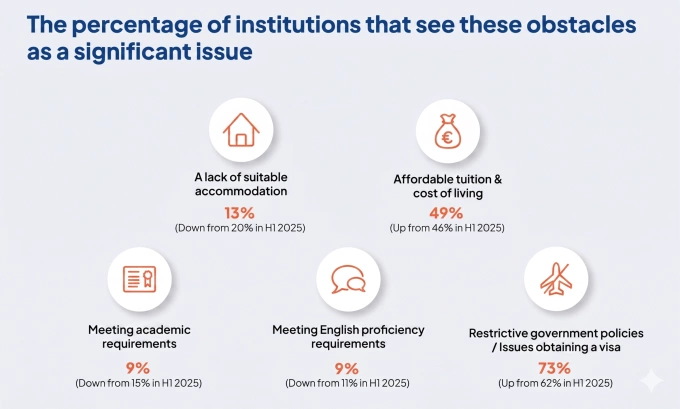 |
Obstacles to attracting international students, according to a survey of 254 universities across 36 countries. Graphic by The Global Enrolment Benchmark Survey |
New study hubs gain ground
The report contrasted the declines in the “Big Four” with growth in other regions.
Among Asia-Pacific institutions excluding Australia, 82% reported undergraduate enrolment growth and 55% recorded higher postgraduate enrolments. In Europe, 47% of universities saw undergraduate growth while 43% posted postgraduate gains.
“The enrolment winter facing the Big Four destinations has intensified to a ‘blizzard’, and emerging markets are capturing the window of opportunity it brings,” Studyportals CEO Edwin van Rest told Read International.
The survey suggested universities are increasingly trying to offset the downturn through institutional strategies rather than relying on improvements in external conditions. Introducing new programs, expanding into new recruitment markets and increasing marketing efforts were among the most commonly cited drivers of enrolment growth.
“Despite an increasingly uncertain policy environment, the survey shows that institutions willing to innovate and adapt can still create meaningful pathways for student success and access. Therefore, student flows depend on both institutional resilience and policies that enable, rather than restrict, global talent mobility. Institutions can and must exercise greater agency to counter serious external forces,” Fanta Aw, executive director and CEO of NAFSA, was quoted as saying in the report.
Many universities also indicated they were preparing for further financial strain over the next 12 months. Budget cuts were among the most anticipated responses in Canada, Australia and the U.K., while diversification into new student markets ranked as the top strategy overall.
However, Skikne, who is also one of the report’s authors, warned that “students making multi-year educational investments are risk-averse, and once trust in a destination erodes, rebuilding it takes far longer than losing it. Even if policies improve, some institutions may need years to rebuild lost capacity.”
Comments are closed.