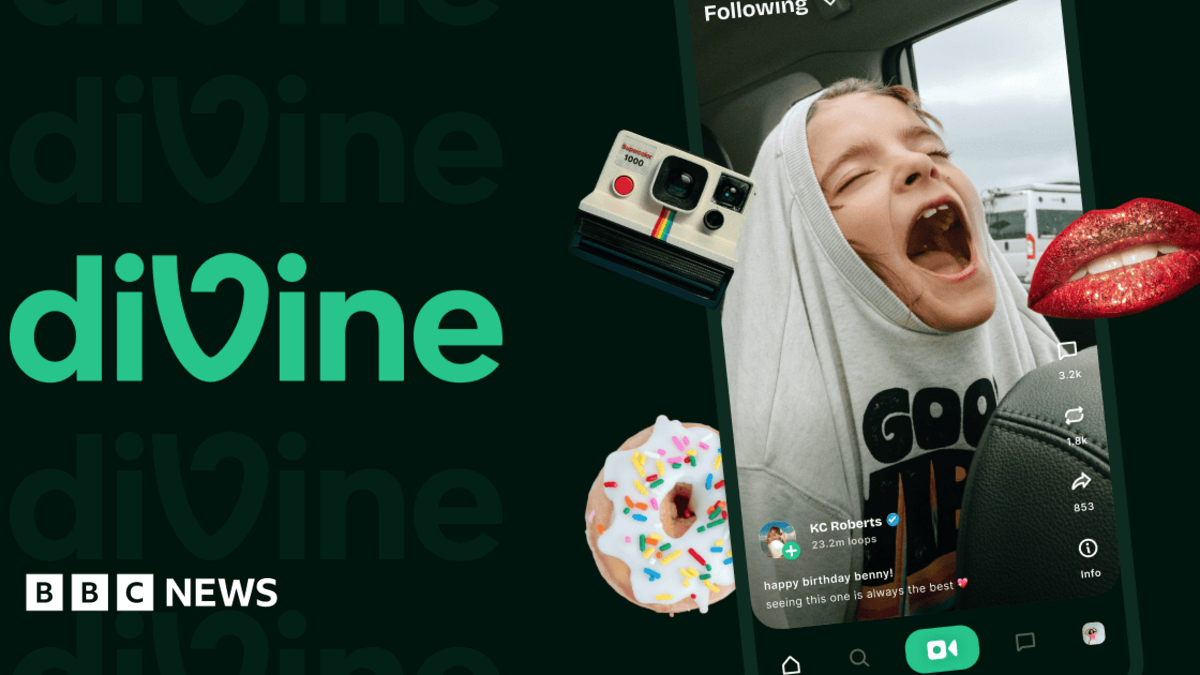
A new app seen as a spiritual successor to short-form video service Vine has been released to the public.
Much like the original, Divine lets users create and share videos which are just six seconds long and repeat on a loop.
The new app also hosts more than two million original Vine videos and – in a bid to further distance itself from other platforms – bans content made by AI.
Divine’s founder, former Twitter employee Evan Henshaw-Plath, told the BBC he wanted to create the app because he felt social media needed “a reset”.
“I want to see it rival other apps because I think we have gone awry,” he said in an interview a few weeks before the public launch.
He said it was important that there was no AI-generated content on Divine, adding he was “sick and tired of seeing videos and not knowing whether it was real”.
“I want to be able to have fun and not have to second guess these things,” he said.
At its peak, Vine had more than 200 million monthly active users and helped launch the careers of some of the internet’s biggest stars.
Jake Paul and Lele Pons are two of those who made their names on the platform before it was shut down by its owner Twitter in 2017.
Divine is backed by Twitter co-founder Jack Dorsey, who had a senior role at the social media platform when it purchased the Vine in 2012.
It is built on a decentralised system called Nostr, meaning it is not controlled by a single company in the same way as platforms such as TikTok or Instagram.
This means users can potentially take their accounts and content with them to other services that use the same system, rather than being locked into one platform.
A similar approach has been used by X rivals Bluesky and Mastodon.