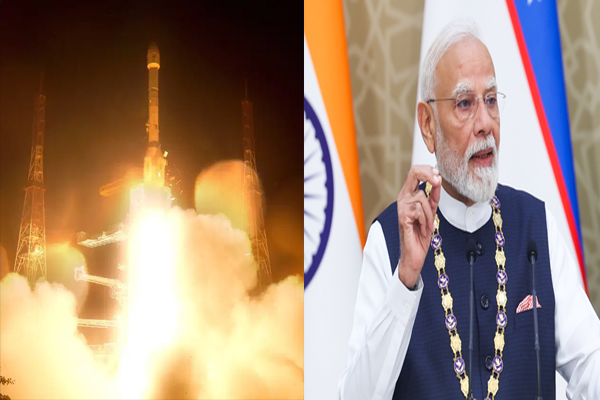
New Delhi. Amidst the ongoing discussions on social media regarding the news of privatization of the Indian Space Research Organization (ISRO) and limiting its role, the space agency has clarified the situation. ISRO has completely rejected these claims and said that it will continue to play a central role in India's space program.
In fact, there were discussions on social media that the government is preparing to reduce the role of ISRO or privatize it in the name of promoting private companies in the space sector. ISRO termed these claims as baseless and clarified that the increasing participation of the private sector does not mean weakening ISRO.
ISRO itself clarified the whole matter
ISRO clarified the rumors related to privatization through its official social media account. According to the agency, the Government of India is working towards developing an ISRO-led National Space Ecosystem.
In this model, the responsibility for large-scale production and commercial use of space-related technologies, which are now fully developed and established, can be given to private companies, startups and public sector companies.
Its objective is not to establish private companies in place of ISRO, but to increase the country's overall capacity in the space sector manifold.
ISRO will move ahead with routine work
The increasing contribution of private industry will provide an opportunity to ISRO scientists and engineers to focus more on cutting-edge and future technologies.
ISRO has many big goals for the coming years. Among these, the main target is to establish an Indian space station by 2035 and send Indian astronauts to the Moon by 2040.
Apart from this, work is also going on on deep-space missions, re-usable launch vehicles and new generation space technologies for planets like Mars and Venus.
Space station in 2035, Indians on the moon in 2040
India's space program is no longer limited to just launching satellites. The country's ambition in the coming years is to move towards human spaceflight and deep-space exploration.
The Indian Space Station of 2035 could bring a big change in India's space capability. After this, the plan to send Indian astronauts to the Moon by 2040 makes this program more ambitious.
For this, many capabilities like launch vehicle, human space flight, life support system, docking and re-usable space technology will have to be developed.
Space economy target of $8.4 billion to $44 billion
The Indian government is eyeing not only scientific achievements but also developing the space sector as a big economic engine.
According to the given data, India's current space economy is around $8.4 billion. The target is to increase it to $44 billion by 2033.
To create such a large space economy, relying on government institutions alone will not be enough. For this reason, private companies and startups are being given more opportunities in the space sector.
More than 450 space startups
The private space sector in India has grown rapidly in the last few years. While the number of space startups in the country was very limited in 2020, now more than 450 space startups are claimed to be active.
These companies are working on satellite, launch system, space application, ground system and other technologies.
That is, the government's strategy is that ISRO should focus on the development of cutting-edge and strategic technologies, while commercial expansion of already successful and established technologies should be done through private industry.
ISRO has command of critical missions
Despite increased private sector participation, the role of the government and ISRO will remain important in projects of national security and strategic importance.
In this sense, instead of privatization in the space sector, it is being seen as a public-private partnership and expansion of the national space ecosystem.
The clear message is that there is no preparation to end the role of ISRO. Rather, ISRO is being prepared for bigger and challenging missions by partnering with private industry. In the coming years, the space station of 2035 and the lunar mission of 2040 can prove to be two major milestones that will decide the direction of India's space program.