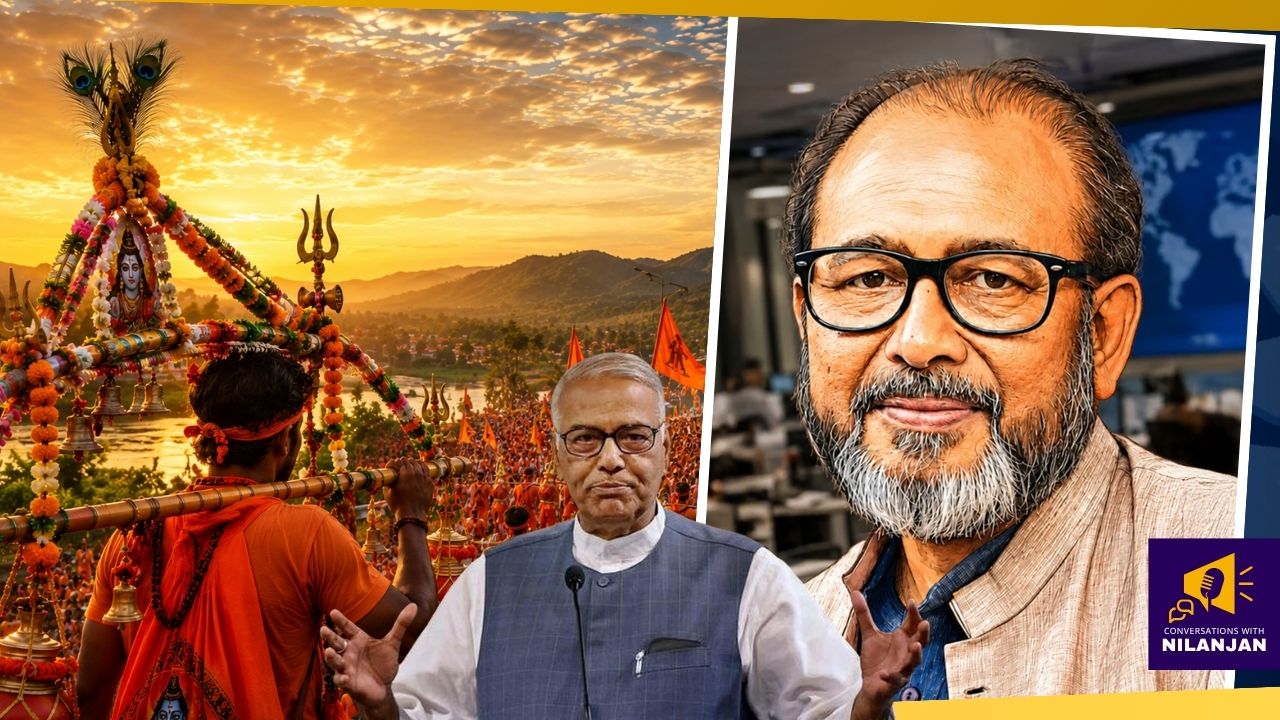
Every year, during the Hindu month of Shravan (July-August), lakhs of Shiva devotees undertake the Kanwar Yatra, collecting Ganga water and carrying it to Shiva temples, with the Haridwar route and the Sultanganj-Deoghar route among the most prominent.
Yashwant Sinha, a former IAS officer who served as principal secretary to former Bihar Chief Minister Karpoori Thakur in the late 1970s, personally undertook the Sultanganj-Deoghar Kanwar Yatra for five consecutive years. He later served as Union finance and external affairs minister.
But in recent decades, the yatra has moved far away from the quiet, personal act of devotion that once defined it, believes Sinha. What was once a journey marked by discipline, equality and spiritual purpose has, in parts of North India, become increasingly aggressive and politicised, he argues.
The Federal spoke to Sinha about his personal experience of the pilgrimage, how the yatra has changed, the role of governments in facilitating religious journeys, and what he sees as the growing politicisation and lumpenisation of religion. Edited excerpts from the interview:
You undertook the Kanwar Yatra for five consecutive years in the late 1970s. What was the spiritual ethos, social decorum and code of conduct among pilgrims then, and how different is that from what we see today?
As I have explained in my book, when I undertook my first Kanwar Yatra from Sultanganj to Baba Dham, I was posted as principal secretary to Karpuri Thakur. The first yatra was not spiritual for me. I just wanted some respite from the almost 24×7 job working with Karpuri Thakur. A friend once told me that they were going on a Kanwar Yatra. Without knowing much about it, I said I would join them.
He told me they were going to leave the next week. There was a group of about 20 hefty, strong people from the village who were used to walking barefoot. He said, “If you want to join, then start making preparations. First of all, take leave.”
Also read: How Kanwar Yatra, once a quiet walk of piety, has taken a riotous turn
I said, walking barefoot was something I could not do. My mother, who was alive then, intervened. She told me that I had made a commitment that I would go and that I should not break it. So we picked up four more people from the city who were our friends.
One was an IAS officer, another worked with him in the Commercial Taxes Department, one was a geologist in the Bihar government, and another was a lawyer. All of them were city people. There were 20 village people, and the five of us joined them. We reached Sultanganj.
That walking journey was a very meaningful experience. I learnt many lessons… One was the story of the Muslim khansama. Then we got an opportunity to understand what humility is.
Why is Sultanganj important to the pilgrimage?
Sultanganj is important because the Ganga flows northward there. There are very few places in our country where the Ganga flows north, against its general direction of south. Varanasi is one of the other places. Haridwar is one, and then Sultanganj. Despite its Islamic name, it is a very pious place for Hindus. There is also the Ajgaibinath temple there.
From the ghat, a person takes water and puts it in the Kanwar and then starts walking the 100 kilometres to Baba Dham. That is the tradition. We did not know much about it, but we started walking.
Our village friend Shyam Narayan Singh was leading us. On the first day, we got up comfortably and did not hurry. We reached the Ganga ghat quite late, around 11 am, and picked up the water.
Then we started walking. It was very difficult. We had planned to stop at a place about 18 km away. All of us city people became so tired after walking 10 to 12 km that we said we could not go any further. So we stopped for the night. There was a dak bungalow there, and since there were two IAS officers, getting a place there was not difficult. Everyone stayed there.
The next morning, our village friends told us to get up at 4 am and leave. We said we could not do it. Our bodies were aching and we could not undertake the journey. Our car was accompanying us, so we said we would come by car and asked them to go ahead.
After they tried to persuade us and we still refused, they left. We got up comfortably later because we had decided to break our commitment. We told the khansama, the caretaker of the dak bungalow, to make omelettes for us and that we would have breakfast and then go comfortably by car.
Also read: Over 50 years, religiosity ebbed out of Kanwar Yatra, replaced by macho Hinduism
He was a Muslim, Khan Sahib. When we told him what we wanted, he advised us that we had undertaken a commitment to take the water to Baba Dham, so he would not give us any eggs. Omelette, everything was stopped. He told us to go, slowly if necessary, but to walk.
All five of us felt very guilty. Here was a Muslim man telling us not to break our commitment, while we were Hindus saying we would break it and eat omelettes. We learnt a lesson in secularism from him.
The Kanwar Yatra in which we participated was a great equaliser because everybody had to wear the same kind of clothes. There was no rowdiness… But what happens today has no religion or spirituality in it. There is commotion.
After that, feeling ashamed, we picked up our Kanwars and started walking again. We reached late. Our village group reached in three days, while we took five or six days, but we reached by walking.
That walking journey was a very meaningful experience. I learnt many lessons, which I have mentioned in my autobiography.
One was the story of the Muslim khansama. Then we got an opportunity to understand what humility is. What had begun almost as a joke became a very serious experience. It became a spiritual journey. After that, we went continuously for five years carrying Ganga water.
You have written that after your first yatra, you reported to Karpuri Thakur about the poor condition of the route and the lack of facilities. What happened then?
When I returned from my Kanwar Yatra, Karpuri Thakur asked me what my experience was like. I told him that the government was conspicuous by its absence along the route.
Then he asked me what should be done. I said facilities should be provided to the Kanwar pilgrims. He said I should prepare a plan.
We sat down and prepared a plan. There were seven or eight dharamshalas along the route, including government and private ones, but they were inadequate. We proposed government dharamshalas with proper toilet and bedding facilities. There would also be police arrangements so that there was no rowdiness on the route.
We took the proposal to the Cabinet. There was opposition. People said we were a secular government, so why should we do this? Then somebody said that if we did it for Haj, we could do it here as well.
The point was that whatever the government did, it should do it only because of the government’s role. The government should not encourage people to undertake a Kanwar Yatra. It should not encourage religiosity. But if people were going, the government had a responsibility to make the journey as comfortable as possible. Whatever facilities were necessary should be provided.
Also read: ‘No provocative slogans, display of weapons’: UP CM’s directives for Kanwar Yatra, Muharram
For example, when you carry a Kanwar on your shoulder, you cannot put it on the ground. It has to be kept on a stand. So wherever we built a dak bungalow, we made a large number of Kanwar stands. We also made places for bathing. People got a lot of relief from this.
There used to be so much filth along the route that I cannot describe it to you. The first time I went, I was disturbed by the filth. People would sit along the roadside and relieve themselves, and you would pass right beside them.
Once proper toilet arrangements were made, everybody got a lot of relief. That much is the government’s responsibility.
The Hindutva-oriented people have less to do with Lord Shankar. They have less to do with the Kanwar Yatra. They have turned it into a means of promoting Hindutva and increasing their vote bank.
How do you compare that experience with the increasingly aggressive form of the Kanwar Yatra seen on the Haridwar route today?
I have been watching the Haridwar Kanwar Yatra for some years and I am completely dismayed. You mentioned two powerful IAS officers undertaking this yatra for five years. It is unthinkable now.
We behaved like ordinary people. I believe that the Kanwar Yatra in which we participated was, in fact, a great equaliser because everybody had to wear the same kind of clothes. Everybody chanted “Bol Bam”.
There was no high and no low. There was no rowdiness there. Everybody undertook the Yatra with decency and maintained it until they had offered the Ganga water to Lord Shankar in Baba Dham.
But what happens today has no religion in it. There is no spirituality in it. There is commotion. It has become so aggressive. The Hindutva-oriented people are now issuing orders about shops. They say the shop must have a nameplate; if it is a Muslim shop, close it. Non-vegetarian shops are being closed. Meat shops are being closed. Restaurants are being told they cannot serve non-vegetarian food.
When we used to go many years ago, the practice was that we would not even eat garlic and onion. Along the route, there were special dhabas and eateries where this kind of food was available. But there were others also. We ate only at those special dhabas and stayed there.
But there was no question then about whose shop it was, what name was written outside or what your religion was. There were no such restrictions.
Now the Hindutva-oriented people have less to do with religion. They have less to do with Lord Shankar. They have less to do with the Kanwar Yatra. They have turned it into a means of promoting Hindutva and increasing their vote bank.
Also read: Digvijaya Singh’s ‘One country, two laws’ post on Kanwar Yatra sparks row
There are special arrangements for Kanwariyas, and they start feeling so special that their sense of entitlement rises. We saw an incident this year where they started beating up an Army jawan.
Do you see a connection between the degeneration of the Haridwar Kanwar Yatra and the rise of Hindutva politics, particularly after the Ram temple movement?
I have absolutely no hesitation in saying that in the northern region, especially from Haridwar towards Gurugram and wherever the other Yatras go, it has been completely politicised.
They are dropping flowers on them from helicopters. This politicisation of religion is the hallmark of the present-day BJP. They are trying to take political and vote-bank advantage of religious festivals and practices like the Kanwar Yatra.
Do you think the clashes on roads and the sense of power among some Kanwariyas can be countered through better regulation, including separate routes?
I believe firmly that it is the responsibility of the government, whether the state or the Centre, to ensure that Kanwar pilgrims are provided facilities and safety and security. At the same time, ordinary citizens must also have the same security and the same facilities.
I live in Noida and often, when I am travelling back to my house, I come across these yatris. I am scared that something may happen. Even if nothing happens, the slightest scratch or any kind of incident involving a Kanwar pilgrim can result in somebody taking offence and starting to beat me up or destroying or breaking my car.
The vast majority of society is not being given security, while a handful of Kanwar pilgrims, who, I do not know with what motivation they are undertaking the Kanwar Yatra, are being given all this state protection.
How can civil society counter political patronage and the growing lumpenisation of religion?
Not only in the Kanwar Yatra but in various religious festivals, I would say that this kind of lumpenisation and aggression should be stopped.
I come from Hazaribagh, which is well known for its Ram Navami celebrations. It extends over three or four days, and every year there are two or three murders. So what is happening? That is also the politicisation of religion. The present dispensation in power is doing exactly this: Use religion for vote-bank politics.
Somehow, the people of India will have to unite, stand up and ensure that this kind of vote-bank politics is stopped. I think we have crossed all limits.
You have been an administrator, a politician and a minister. What signs do you see that people may be pushing back against this confrontational politics?
I see two or three things. One is the Cockroach Janata Party demonstration, which forced the government to submit to their wishes.
Also read: Kanwariyas vandalise highway dhaba in UP over onion in food
Then there is the fact that political parties in the Opposition have taken up the excesses committed by the government and the Home Ministry, particularly on July 20 against the protesting students.
The third is the general feeling among people that enough is enough. That has been reflected in the recent Assembly by-elections in Bihar, Madhya Pradesh, and Gujarat.
If there was one safe seat for the BJP in Bihar, which they had occupied for 30 years, it was Bankipur. They lost it by nearly 20,000 votes. So the vote bank has shifted.
The politicisation of religion is the hallmark of the present-day BJP. They are trying to take political and vote-bank advantage of religious festivals and practices like the Kanwar Yatra
Datia, again, was a seat Congress had won earlier. The BJP tried its best, but they lost. In Gujarat, there has been a vast reduction in the vote share of the BJP candidate who won.
These three by-elections have sent a clear signal. The youth of the country is now excited by the power that protests can hold and the results that they can achieve.
Therefore, I think a trend has started, which will also get reflected in the coming days and in future election results. I think Narendra Modi and Amit Shah must be very worried men today, looking at these trends.
Can the spiritual character of the Kanwar Yatra be restored after decades of politicisation and aggression?
It will take time. What we are witnessing today with regard to the Kanwar Yatra did not start yesterday. It started some time ago, some decades ago, because the governments of the day, in the state and at the Centre, promoted this. They promoted lumpenisation. Now we are seeing it in full play.
Similarly, if there is a trend away from it, it will take time. Ultimately, it will happen if the state and central governments are strict about it.
Are you hopeful that the current character of the Kanwar Yatra can actually be reversed?
There will be pushback. I personally feel that the pushback has started, and the process will take its natural course. I think I am a better Hindu than most people in the BJP today, but I am very, very secular in my outlook.