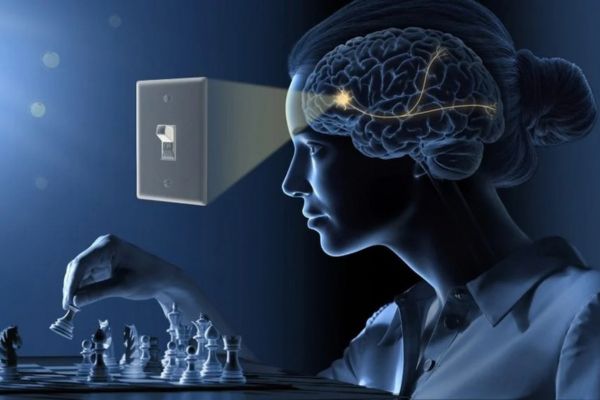
A small algae raised a question in the scientist's mind. This question led to the discovery of light-cleavable proteins. This protein reached the neurons and the light that reached the neurons ultimately became a new path towards the secrets of the human brain.
This sounds like science fiction, but the scientist awarded the 2026 Nobel Prize in Medicine and Physiology has made this a fact. Imagine that out of the millions of neurons in your brain, scientists had to select only a certain type of neurons and then with the help of light, they had to turn them on and off as per their wish! It seems as if a small electric switchboard has been installed inside the brain. This amazing technology is called optogenetics. The 2026 Nobel Prize has been awarded to Carl Deiseroth, Peter Hegemann and Georg Nagel for discoveries that allow scientists to turn specific neurons and neural circuits on and off in the living brain with the help of light.
The brain is perhaps the biggest mystery of the human body. How does this organ of about 1.3 kilograms control memory, thoughts, emotions, fear, joy, sleep, appetite and our behavior? How does an old childhood memory suddenly come back after decades? Why do we feel happy seeing someone? Why do we feel afraid of some event? What happens in the brain when we sleep that we become almost cut off from the outside world for hours? Scientists have been studying the brain for years to find answers to such questions.
In the twentieth century, scientists obtained many important information about the functions of different parts of the brain. But there was a big problem. The number of neurons in the brain is extremely large and the network of their connections with each other is extremely complex. Imagine that the entire city is in front of you and you know where the hospital, school, market and police station are in different areas of the city. But now you have to know what is really going on in a particular house. So what to do now? An amazing scientific journey starts from here.

It started with a small algae. In the early 1990s, German scientist Peter Hegemann became interested in a small unicellular organism. His name was Chlamydomonas. This small creature that looked like green algae could move towards the light. If you shine light from one side, it starts floating towards it. The question was very simple, but how do these tiny creatures recognize light? Hagman started research on it. They found out that after light falls, electrical signals are generated very quickly in this organism. So fast that this process was much faster than the process of converting light into electrical signal in the human eye. Hegeman thought that perhaps there might be some special protein in this algae that could convert light directly into electrical signals. But finding such protein was not easy.

After years of research, they found two genes that could be responsible for light-sensitive proteins. Now the help of Georg Nagel was taken to test this gene. Nagele inserted this gene into the egg of Didka. And here came a wonderful moment of science. Due to this gene, proteins started being produced in the egg cells of the cockroach which opened when light fell on them. These proteins worked as ion channels. They were named – Channelrhodopsin.

In simple language, channelrhodopsin is a kind of light-opening door. There are ions outside and inside the cell. When this channel opens, ions pass and due to this an electrical signal is generated in the cell. Now think, what if such light-opening doors could be installed in the neurons of the brain? Then the neuron can be activated with a flash of light! And from here began a new revolution in the study of the brain. American scientist Carl Deisrothe understood the power of this discovery. He obtained the DNA responsible for channelrhodopsin from Georg Nagel and started experimenting with introducing it into neurons. The experiment was successful.
DesRoth's team created channelrhodopsin in rat neurons. Then, when specific light was shone on these neurons, the neurons immediately became active and a nerve signal was generated. If this seems small then stop for a moment and think. There are billions of neurons in the brain. Select one of those specific types of neurons and say “Come on.” And then give light. Neuron activated! If you switch off the light then its activity can be stopped. This is optogenetics. A method of controlling the activity of specific neurons using a combination of light and genetics.

In 2006, this new approach became known as “optogenetics,” and in 2007, Deisseroth's team used it in live mouse brains to activate specific neurons in the motor cortex with light. As a result, the movement of the rat's whiskers could be controlled. But the matter does not stop here. Scientists used this technology in neurons associated with sleep. By shining light on certain neurons, the sleeping rat woke up. This helped scientists understand which neurons play a role in the process of staying awake.
Then came perhaps the most exciting experiment of memory. Can light restore memory? In 2012, Carl Deisserothe and Susumu Tonegawa studied rat memory. During an event that made rats feel fear, scientists identified neurons that were associated with memories. Later, when the same neurons were reactivated with the help of optogenetics, the rat again showed a fear response. When there was no real danger to him at that time. This experiment enabled scientists to show for the first time which neurons are necessary for a specific memory. That means now the brain did not have to guess just by looking at it from outside. Now we could activate a particular neuron and see, “What happens if I activate this neuron?” This is the biggest revolution of optogenetics. With the help of this technology, specific neural circuits associated with many processes such as pain, social behavior, craving, food intake, reward, attention and the body's daily biological clock are being studied.
Let us understand this again with a simple example. Believe that the whole of Ahmedabad is one big brain. In the old method you could see which area of Ahmedabad has more traffic. But if you want to know from which house in a particular street the traffic problem starts, then it would be a problem. Optogenetics seems to give you the keys to a special house in the entire city. You don't shut down the entire city. You don't put your entire brain in the dark. You simply select a specific neuron or a specific neural circuit and activate it with light. Then see what changes in the brain and body? Due to this, the process of understanding the wiring of the brain has become very precise. Now there is hope for treatment. This technology is still primarily a powerful research tool, but there is also hope for future treatments based on it.
Optogenetics has provided important information in understanding neurological and mental diseases such as depression, anxiety, schizophrenia, Alzheimer's and Parkinson's. Apart from this, preliminary clinical efforts have also been made towards eliminating blindness. In a disease like retinitis pigmentosa, the light sensitive cells of the eye are destroyed. Researchers have attempted to restore sensitivity to light by using proteins such as channelrhodopsin. With the help of special illuminating glasses, the patient has shown the ability to recognize and hold objects.
Perhaps in the future, this technology will also be useful in understanding and precisely correcting some of the defects in the wiring of the brain. With this discovery, scientists now have a wonderful “light switch” tool in their hands to help us understand the brain. Perhaps in the coming years, we will be able to understand memory, sleep, fear, joy, addiction and many mental-neurological diseases better. And perhaps one day we will understand the wiring of the brain with the same accuracy with which we understand the circuits of computers today. This is the most amazing thing about optogenetics.
*****
