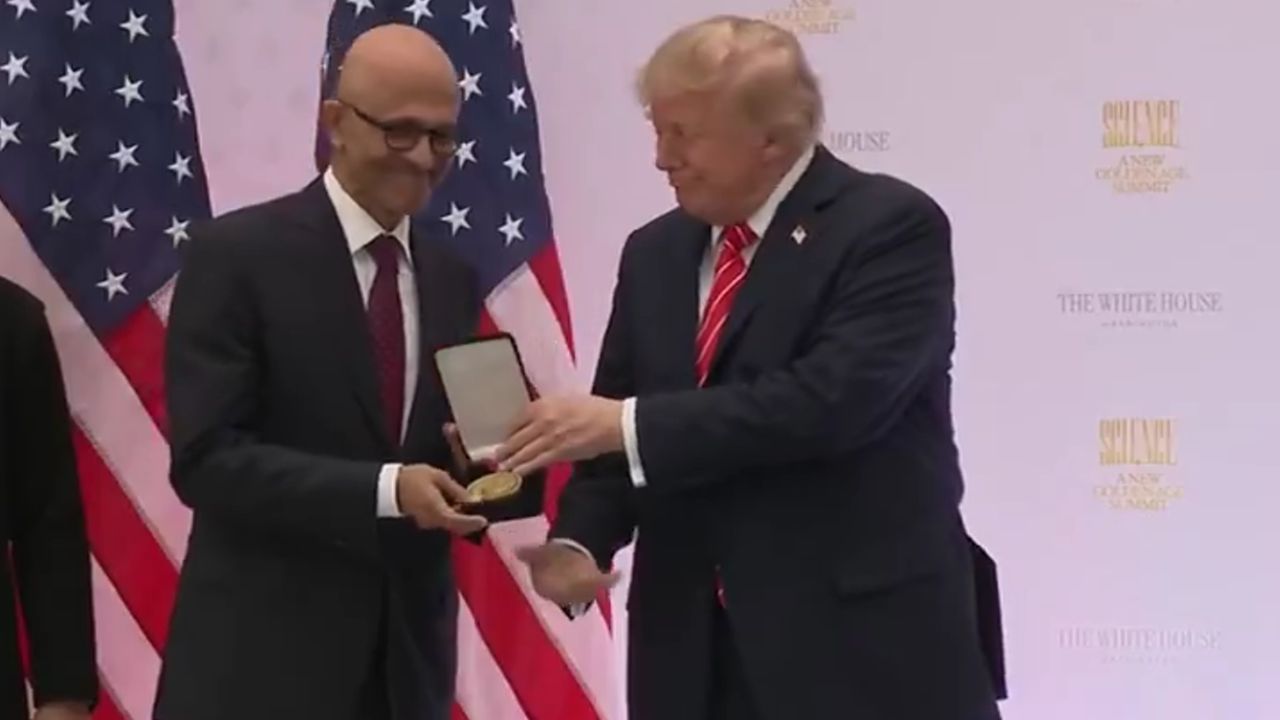
Washington: US President Donald Trump praised immigrant technology executives for their contributions to American innovation, even as his administration tightens immigration pathways to use skilled foreign workers. The contrast came into light on Thursday when Trump presented Microsoft CEO Satya Nadella with the National Medal of Technology and Innovation. This happened hours after Vice President JD Vance announced the suspension of Microsoft and several other technology companies from a key employment-based green-card program.
This raises questions about how the US plans to balance its efforts to protect domestic workers with its reliance on international talent to maintain its technological supremacy.
Trump Praises Nadella’s Contribution To US Technology
Praising Nadella’s contribution to the technology industry, US President said, “For more than three decades, Satya Nadella has been a key figure in the transformation of Microsoft,” recognizing his leadership in cloud computing and artificial intelligence.
Born in India, Nadella moved to the United States to pursue his career before becoming the head of one of the world's most influential technology companies. Responding to the honor on
Thank you, @POTUS, for this incredible honor today. I’m humbled to stand beside so many giants of American innovation and looking forward for what we can continue to do together to advance technology and drive American prosperity.
— Satya Nadella (@satyanadella) October 8, 2026
Nadella was among six technology leaders honored at the ceremony at the White House. The other recipients included Elon Musk, Google co-founder Sergey Brin, Nvidia CEO Jensen Huang, AMD CEO Lisa Su and Dell Technologies CEO Michael Dell. Among them five of the six were born outside the United States. This shows how international talents have contributed to the US’ technology industry.
Also Read: TCS Breaks Silence on US Green Card Freeze, 15,000 Jobs Still on Track
Trump And Pichai Exchange Remarks At White House
Recently in a White House gathering of technology giants on September 29, the US president turned to Google CEO Sundar Pichai and said, “This guy is a monster, and nobody knows him,” before adding, “All you have to know is — SUNDARR! Sundar is his name.”
Pichai responded with humor, “Hopefully a better tagline than I'm a monster!”
The exchange took place during discussions on artificial intelligence and the risks associated with it. It offered another example of Trump’s public praise for executives leading companies central to America’s technology ambitions, even as his administration scrutinises the employment of foreign professionals.
Microsoft And Indian IT Firms Face PERM Suspension
On Thursday, the US Department of Labor announced the suspension of Microsoft, Adobe, Cognizant, Infosys, Tata Consultancy Services, Wipro, HCL Technologies and Capgemini from participating in the Permanent Labor Certification, or PERM, program.
PERM is a key step in many employer-sponsored green-card applications. According to it companies generally must demonstrate that qualified American workers are not available for the positions and that hiring foreign employees will not adversely affect domestic wages and working conditions.
Also Read: US Green Card Freeze: What Happens to Indian H-1B Workers at TCS, Infosys and Wipro?
Labor Secretary Keith Sonderling said the department would stop accepting new applications and processing pending cases involving the named companies.
The Trump administration has defended the move as an effort to protect American workers. Vance accused Microsoft of laying off 6,000 American employees last year while benefiting from 6,300 H-1B visas and nearly 3,000 green cards.
“There has been no company in the United States, unfortunately, that has abused the system more than Microsoft,” Vance said.
Microsoft countered that approximately 80 percent of its H-1B applications in the previous fiscal year were intended to extend or change the status of existing employees, not to bring in new workers. The company also said that H-1B employees receive compensation comparable to colleagues performing similar work.
H-1B visas allow eligible foreign professionals to work temporarily in the US, while PERM supports many applications for permanent residency. The suspension does not automatically cancel existing H-1B visas.
Indian Professionals Could Face Greater Uncertainty
The restrictions have particular impacts for India, given the presence of several major Indian IT services companies on the list. Those awaiting permanent residency in the US could face uncertainty.
The wider impact will depend on how the suspensions are implemented and how long they remain in place. However, uncertainty over employment-based immigration could complicate efforts of companies to recruit and retain skilled professionals at a time when there are competition between countries.
Also Read: 24 Hours to Jantar Mantar 'Season 2': What to Expect From CJP's Protest Against CEC
There is also a challenge for the United States to enforce employment rules while sustaining an industry that relies on global expertise.
The suspensions could leave companies and skilled workers in the lurch, forcing both to reconsider staffing strategies and career plans. At the same time, Washington remains focused on maintaining American leadership in artificial intelligence and other advanced technologies.