
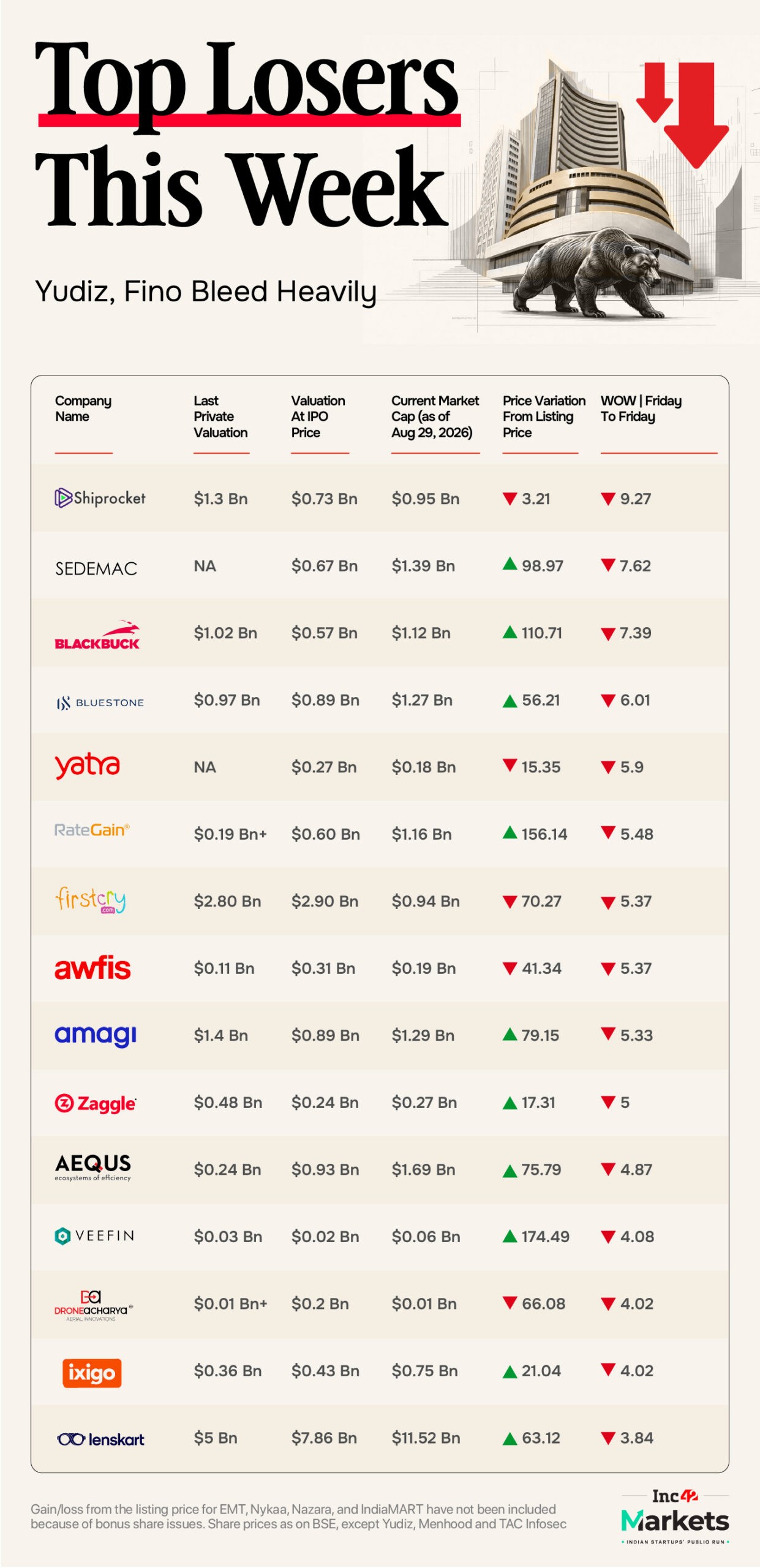
Shiprocket emerged as the biggest loser among new-age tech stocks this week, while SME-listed Klassroom led the gainers
The mixed performance came amid continued weakness in the broader equities market and heightened volatility during the monthly derivatives expiry
Of the 62 new-age tech stocks under Inc42’s coverage, 36 ended the week lower, while 26 gained
Investor sentiment towards new-age tech stocks remained subdued this week even as the IPO pipeline continued to expand.
Shiprocket, LEAP India, and Klassroom made their stock market debuts in recent weeks. Meanwhile, the IPO of cloud and data centre company ESDS Software Solutions was fully subscribed on its opening day yesterday. Pernia’s Pop-Up Shop parent Purple Style Labs raised nearly ₹306 Cr from anchor investors ahead of its public issue opening on Monday (August 31).
The 62 new-age tech companies under Inc42’s coverage commanded a combined market capitalisation of $166.91 Bn at the end of the week, largely unchanged from $166.84 Bn last week.
However, a majority of these stocks ended the week in the red. While 36 stocks declined between 0.13% and over 9%, the remaining 26 gained between 0.02% and over 25%.
BSE SME-listed Klassroom was the biggest gainer, with its shares surging 25.2% to end the week at ₹218.
Five new-age tech stocks – Ather Energy, Turtlemint, Zelio E-Mobility, Paytm, and Lenskart – touched fresh 52-week highs during the week. On the other hand, IndiaMART InterMESH hit a fresh 52-week low of ₹1,723.80 on Monday (August 24).
Swiggy, PhysicsWallah, Honasa Consumer, EaseMyTrip, Groww, and BlueStone were among the other stocks that declined during the week.
With that, let’s look at some of the key developments from the week:
- Bulk And Block Deals Galore: Several institutional investors and VCs pared or exited their holdings in listed new-age tech companies during the week. Alpha Wave Ventures exited Aye Finance, Qualcomm Ventures sold shares in Shadowfax, Ribbit Capital pared its stake in Groww, and Y Combinator offloaded shares in Meesho.
- Urban Company Sues Kent: Urban Company filed a defamation and disparagement suit against Kent RO Systems over advertisements questioning the safety and performance claims of the former’s Native water purifiers.
- Peak XV Exits Capillary: Capillary Technologies’ promoter entity sold around 4% of the company to facilitate Peak XV Partners’ exit from the promoter entity. In a disclosure on Tuesday (August 25), the company clarified that the transaction did not represent an exit by its founders.
- Honasa Calls Off Fluence Pharma Buyout: The beauty and personal care company scrapped its proposed ₹135 Cr acquisition of a 58% stake in Fluence Pharma after certain closing conditions under the share purchase agreement were not met. It did not specify the unfulfilled conditions.
- Smartworks Proposes Share Capital Reduction: The managed office space provider proposed using the balance in its securities premium account to write off its accumulated FY26 losses. Subject to shareholder and NCLT approvals, the move will not alter its shareholding structure, the number or face value of its shares, or involve any payout to shareholders.
- CarTrade Sees Top-Level Exit: CarTrade Tech’s CEO of consumer business, Banwari Lal Sharma, left the company after a nearly seven-year stint. Sharma was the founder of CarWale and joined CarTrade following the latter’s acquisition of the automotive platform in 2015.
- Fractal Expands India Business: The AI company launched a dedicated India business unit to help large enterprises accelerate business transformation through its agentic AI platform Cogentiq and other products.
- More Incentives For Ola Electric: The E2W maker received a sanction order for ₹95.81 Cr under the PLI-Auto scheme from the Ministry of Heavy Industries for FY27. This marks the third fiscal year for which Ola Electric has received the incentive, after ₹73.74 Cr for FY24 and ₹366.78 Cr for FY25.
With that, let’s take a look at the broader market trends during the week.
Caution Continues To Grip Indian Equities
Caution continued to weigh on Indian equities, with the Nifty 50 declining 0.31% during the week to close at 24,175.65. The Sensex fell 0.35% to 77,264.51, extending the market’s corrective phase to around a month.

Yesterday’s session offered some respite, with the Sensex gaining more than 330 points as IT stocks rallied on positive global technology cues. The sector received a boost after NVIDIA’s strong results and upbeat guidance reinforced expectations of sustained AI-led technology spending.
Global monetary policy remained a key driver of sentiment. Comments from US Federal Reserve chair Kevin Warsh at the Jackson Hole symposium kept investors focussed on the trajectory of interest rates, while uncertainty around US inflation and bond yields continued to weigh on foreign flows into emerging markets.
Crude oil prices offered some relief, with Brent falling more than 4% to around $88 a barrel amid expectations of improved shipping conditions through the Strait of Hormuz and shifting global interest-rate expectations. However, elevated geopolitical risks continued to leave the energy market vulnerable to renewed supply disruptions.
On the domestic front, the Closing Auction Session (CAS) for F&O stocks remained in focus. Sharp price movements during the monthly derivatives expiry raised concerns about heightened short-term volatility and potential price dislocations, particularly in heavyweight stocks.
“Indian equities remained resilient despite global volatility, supported by softer crude, a firmer rupee and lower US yields,” said Vinod Nair, head of research at Geojit Investments. “Going ahead, markets will track the Fed’s stance, US jobs data and India’s GDP print for further direction.”
The broader market displayed some resilience, with mid-cap and small-cap stocks outperforming their large-cap counterparts on stronger earnings visibility and their domestic focus.
With the Q1 FY27 earnings season ending on a healthy note, investors are likely to turn their attention to the sustainability of earnings growth amid an evolving global macroeconomic environment.
Against this backdrop, let’s take a closer look at the performance of Ather Energy and Shiprocket.
Ather Energy Touches Record High
Ather Energy was the biggest gainer among the new-age tech companies listed on the mainboard during the week. Its shares touched an all-time high of ₹1,629.15 yesterday before closing at ₹1,612.
The stock gained 10.38% over the five trading sessions and is now trading at more than five times its BSE listing price of ₹321.
While the stock remained on an upward trajectory throughout the week, the biggest jump came yesterday, when it surged nearly 10%. The rally followed Hero MotoCorp’s purchase of an additional 1.18 Cr shares, or around a 3% stake, in the electric two-wheeler maker for ₹1,758 Cr through an open-market transaction.
This was Hero MotoCorp’s second major investment in Ather in about a month. The auto giant, which is also a promoter of Ather, had earlier announced an investment of up to ₹1,000 Cr in the EV maker as part of the latter’s ₹2,500 Cr fundraise.
Ather raised ₹200 Cr by allotting 16.26 Lakh equity shares at ₹1,230 apiece, the company disclosed earlier this week. It also allotted 79.37 Lakh convertible warrants worth ₹1,000 Cr.
Ather plans to use the funds to expand its manufacturing capacity, strengthen R&D, and develop new products.
Today, Ather launched its mass-market Konarc escooter at a starting price of ₹99,999. Besides four claimed range options of 100 km to 200 km, the scooter comes with a 450 W onboard charger and supports an additional portable charger for faster combined charging.
Shiprocket Falls Below Listing Price
Profit booking dominated Shiprocket’s first full week as a listed company, with the stock surrendering a sizeable portion of the gains made during its strong market debut.
The ecommerce enablement company’s shares fell 9.27% during the week to close at ₹125.40 yesterday. This made Shiprocket the biggest loser among the new-age tech stocks under Inc42’s coverage.
Shiprocket made its stock market debut on August 19, listing at ₹129.50 on the BSE against its IPO price of ₹97. The stock climbed to an intraday high of ₹155.50 on its debut and closed at ₹143.50, with more than 2 Cr shares changing hands during the session.
The momentum continued on August 20, when the stock touched a fresh high of ₹156.90. However, it reversed its gains to close 1.25% lower at ₹141.65.
The stock subsequently entered a sustained decline. After slipping marginally to ₹140.81 on August 21, Shiprocket fell 4.36% on August 24 to ₹134.67.
The selling continued during the subsequent sessions. It saw the sharpest decline yesterday. The stock opened at ₹132.10, fell to an intraday low of ₹124, and closed 5.1% lower at ₹125.40.
Shiprocket is now trading 3.2% below its BSE listing price. However, the stock remains around 29% above its IPO price of ₹97, leaving IPO investors in the green.