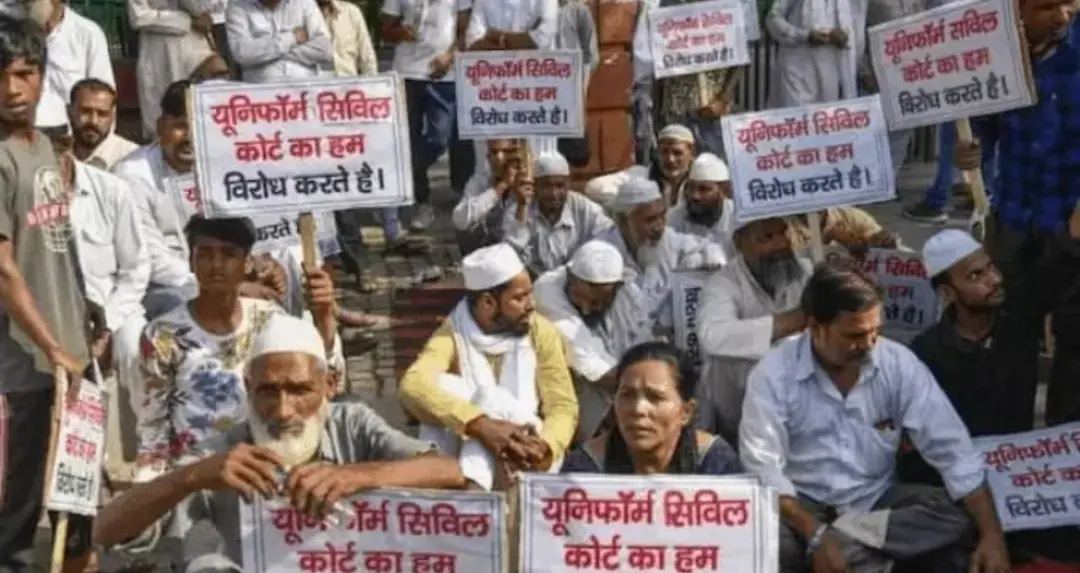
Different stances have emerged in the NDA regarding the Uniform Civil Code. TDP, Shinde faction’s Shiv Sena and HAM have supported UCC, while JDU has said that despite support at the national level, it will not be allowed to be implemented in Bihar.
New Delhi: Different views have started emerging within the NDA regarding the Uniform Civil Code (UCC). The NDA’s three allies—Telugu Desam Party (TDP), Shinde faction’s Shiv Sena and Hindustani Awam Morcha (Secular)—have expressed support for the UCC. At the same time, Janata Dal (United) i.e. JDU has made it clear that it will not allow UCC to be implemented in Bihar. This situation has come to light after the statement of Union Home Minister Amit Shah, in which he had said on September 13 that UCC will be implemented in 21 BJP-NDA ruled states before the 2029 Lok Sabha elections.
Target to implement UCC in 21 states by 2029
According to Amit Shah’s statement, a target has been set to implement Uniform Civil Code in 21 states ruled by BJP and NDA before the 2029 Lok Sabha elections.
According to the given details, at present there is NDA government in 22 states in the country. Among these, UCC is applicable in Uttarakhand from January 2025. In this context, the target has been stated to implement it in the remaining 21 states.
The objective of the UCC is to provide a uniform legal system for citizens in matters related to marriage, divorce, succession and other personal laws. However, there are different opinions at the political and social level regarding its nature and process of implementation.
Resolution passed in Gujarat, Assam and Madhya Pradesh
As per the details given, the proposal to implement UCC in Gujarat, Assam and Madhya Pradesh has been passed by the Assembly.
Now the further process in these states is to wait for the President’s approval and issuance of notification. To implement a law in a state, after the completion of the legislative process, necessary constitutional and administrative formalities also have to be completed.
Apart from this, Maharashtra, West Bengal and Chhattisgarh have formed committees to prepare laws related to UCC.
TDP said to support UCC
TDP leader in Lok Sabha Lavu Krishna Devarayulu has said that his party will support UCC. However, he also clarified that discussions will be held with all concerned parties before implementing it.
He said that at present there has been no discussion on this issue. Thus, despite TDP’s support coming forward, the party has stressed the need for comprehensive discussions.
This stance is also important because TDP and JDU have earlier opposed the law related to UCC. Before TDP joined the NDA after the 2024 Lok Sabha elections, Chandrababu Naidu had said that the party would stand with the Muslim community on the issue of UCC.
JDU’s different stance in Bihar
The clearest different stand regarding UCC within the NDA has come from JDU. JDU leader Shyam Rajak said that the party supports UCC at the national level, but will not allow it to be implemented in Bihar.
He said that JDU is firm on its stand. It has also come to light that JDU leader Sanjay Jha met Amit Shah regarding this issue.
It is clear from this stance that both support for UCC at the national level and opposition to its implementation in Bihar are part of the current position of JDU.
In Bengal, BJP said to start the process soon
There are indications of increasing political activities regarding UCC in West Bengal also. Bengal BJP President Shamik Bhattacharya has said that the process of implementing UCC in the state will start soon.
However, BJP’s ally NCPI has not yet taken its decision on this issue. After the proposal comes from the party, it has been said that it will be discussed.
This shows that there is no uniform stance on UCC among different NDA allies and the approach may differ depending on the political circumstances at the state level.
Shiv Sena supported UCC
Shinde faction’s Shiv Sena in Maharashtra has also made its position clear in support of UCC. Party leader Shrikant Shinde described the Uniform Civil Code as a matter related to equality, justice and national unity and supported it.
His stance further strengthens the support that has emerged in favor of UCC within the NDA.
HAM also in support
Hindustani Awam Morcha (Secular) i.e. HAM President Santosh Kumar Suman has also welcomed Amit Shah’s statement.
He talked about supporting UCC. Thus, TDP, Shiv Sena and HAM have joined the NDA allies which have expressed their stance in favor of Uniform Civil Code in recent statements.
Muslim organization protested in Kerala
On the other hand, Kerala Muslim organization Samastha Kerala Jam-Iyatul Ulama is opposing the UCC.
President of the organization Mohammad Jifri says that not only Muslims, but also people of Christian, Buddhist and Jain communities will not be able to accept the Universal Civil Code.
According to him, in the Muslim community, issues like marriage, divorce and inheritance are part of the religious system and the rules prescribed for them are followed.
Will UCC apply to all religions?
The biggest question regarding UCC is related to its scope. Its basic objective is said to be to enforce uniform civil law for all citizens.
As per the details given, Scheduled Tribes may get special exemptions under the Constitution. However, the actual arrangement will be clear depending on the provisions of the laws being proposed or drafted in individual states.
Will religious customs end?
UCC mainly deals with civil matters. Its direct objective is not to control religious worship or belief.
An important part of this debate is to create a uniform legal system for civil matters such as marriage, divorce and inheritance and to differentiate between religious belief and practice.
How will UCC be implemented in the state?
To implement UCC in a state, legislative and constitutional processes have to be completed. Under this, the law will come into effect after the bill is passed by the Assembly, approved by the Governor and then after the necessary notification is issued.
At present, both support and opposition voices are coming out within the NDA regarding UCC. While some allies are supporting it linking it to equality and national unity, JDU has opposed its implementation in Bihar.
In the coming time, it will become clear from the state committees, assembly processes and decisions of the central and state governments in how many states the UCC is implemented and in what form.