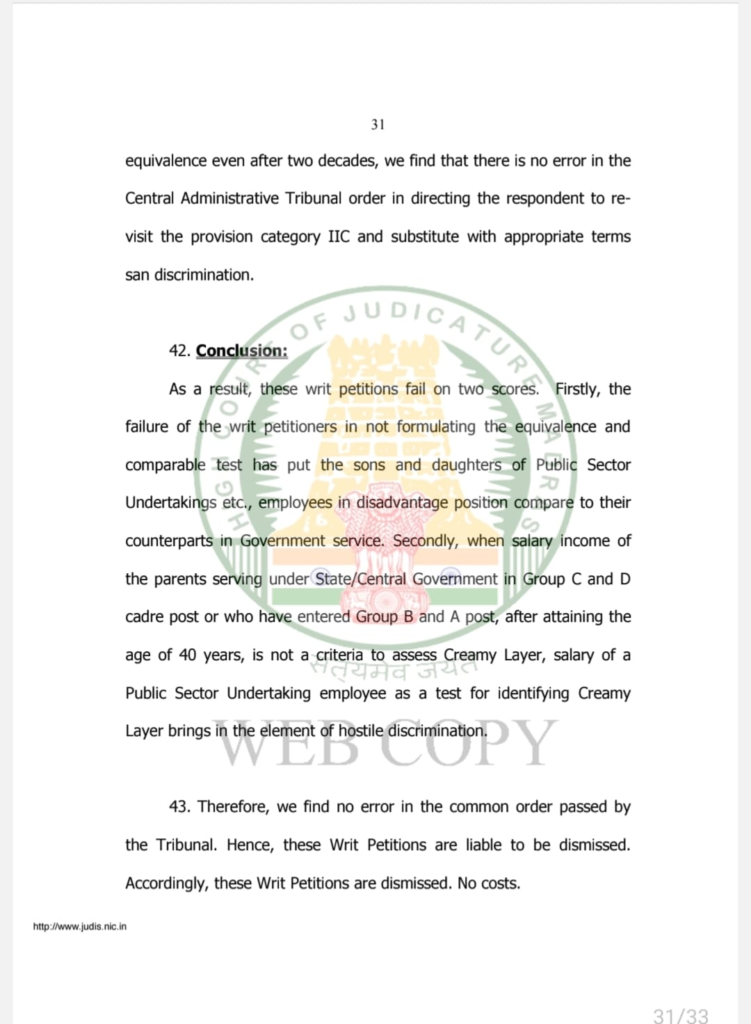
New Delhi: The issue of creamy layer for OBC candidates is once again before the Supreme Court. The reason is the decision of March 11, 2026, in which the apex court had said that an OBC No Creamy Layer candidate cannot be declared under the creamy layer on the basis of parents' salary income alone. The issue was particularly relevant to children of parents working in PSU, banks and private sector, where the question was raised on treating income differently for government employees and non-government or PSU employees.
The Central Government has sought instructions from the Supreme Court that the decision of March 11, 2026 should not be implemented retrospectively. That is, on the basis of this, the already completed selection process, appointments, service allocation, cadre allocation, seniority or the admissions made under the laws, rules, instructions and eligibility conditions applicable at that time should not be reopened.
The Center says that implementation of the decision of March 11, 2026 can have an impact on a large scale. Under this, those candidates whose parents' income is higher can also be considered as non-creamy layer. According to the Centre, this is different from the idea of creamy layer given in different previous decisions of the Supreme Court.
The Supreme Court on Tuesday agreed to consider constituting a special bench to hear the Centre's plea seeking application of its March 11 verdict on OBC creamy layer criteria to CSE 2025 candidates.
OBC In Creamy Layer But the Supreme Court 11 march 2026 what did you say to?
- Union of India v. Rohith Nathan Supreme Court bench comprising Justice P.S. Narasimha and Justice R. Mahadevan clarified that the creamy layer cannot be determined on the basis of income alone.
- The court, read together with the OM of 1993 and the instructions issued thereafter, said that the social status of the guardian and the nature of his position are also important.
- The top court said that determining the creamy layer status only on the basis of income bracket, without mentioning the category of post and status parameters, is clearly unsustainable in law.
- The court also said that differential treatment of OBC candidates with similar status may go against the principle of equality enshrined in Articles 14, 15 and 16 of the Constitution.
- This case was related to those candidates of Civil Services Examination who had claimed reservation under OBC Non Creamy Layer category. Parents of many candidates were employees in Public Sector Undertakings (PSUs), banks or organizations at this level.
Center asked for two years time
The Center has demanded from the Supreme Court to give a reasonable time of two years. During this time, the necessary process of determining the equivalence of those posts, whose equivalence has not been decided yet, can be completed. For this, it has been said to discuss with all the concerned parties, including all the states and union territories, and prepare an appropriate and uniform policy or system to decide the status of OBC creamy layer.
The Center has also sought permission that during the pendency of this application filed in the Supreme Court, the service allocation of CSE-2025 candidates recommended by UPSC can be finalized immediately and subject to the final decision of this application. The Center has said that any further delay in service allocation till the decision on this application is taken could have serious consequences.
Talk about impact on recruitment and higher education
The Center has said in its application that if the decision of March 11, 2026 is implemented without a proper policy, it will have a wide-ranging impact on the government recruitments and admissions in higher education institutions that have been done or are currently going on by the Central Government as well as 18 states and union territories. The Center said that the result of Civil Services Examination is only a part of the entire system of competitive examinations. Large examination bodies and employers like railways, banks, postal departments and paramilitary forces may face lakhs of applications and cases, which will have to be considered in different circumstances.
These matters may be affected
According to the Centre, the decision of March 11, 2026 could have wide-ranging implications and create serious practical and administrative problems. These include retrospective service allocation to new candidates from previous Civil Services examinations from 2012 onwards, re-allocation of service to candidates already in any service through previous Civil Services examinations from 2012 and cadre re-allocation of some candidates already in IAS/IPS.
Apart from this, it may also affect the recruitments in major institutions like Railways, Banks, Postal Department and Paramilitary Forces, admissions in higher educational institutions and the ongoing examinations and recruitment processes after March 11, 2026. The Center has said that 18 states and union territories also follow DoPT's OM dated September 8, 1993, so the recruitments and admissions done there may also be affected. Also, sufficient time is needed to decide on a new policy to correct the situation pointed out by the Supreme Court in its judgment of March 11, 2026.
What does the petitioner's lawyer say?
Petitioner's lawyer Varun Thakur said that on one hand the government is giving a statement that we are implementing it, on the other hand it is saying that there are difficulties in it. He told what difficulties the government has shown in its affidavit. Varun Thakur said that first let me brief you a little about what this matter is. After Indira Sawhney regarding the creamy layer, the Supreme Court had given direction to the Central Government as to how to make the criteria for the creamy layer. A committee was constituted regarding that and a committee gave directions. It was working accordingly and the creamy layer was defined according to the posts, in which Gazetted posts, Class One posts and Constitutional posts were counted in the creamy layer. But it was refused to count the salaries of Class II and other employees.
He said that the file filed by the government regarding all this is unfortunate. They are asking for time and the children are selected candidates, who have been waiting for a long time. Some have been doing this since 2016. There will be between 50 and 100 people who have been selected. The government should think about them also. This case was mentioned before the Chief Justice in the Supreme Court for speedy hearing and the Chief Justice said that he will soon constitute a new bench in this case, which bench will hear this case.