Ajay Dayal, Haldwani
Little children, what is there in your grasp…! This song, heard in childhood, suddenly stands before us today with new meanings. It was an innocent song then. This is the question today. The question is not only for the ruling party but also for the opposition. The question is about the institutions that run democratic systems. We will also have to find the answer to this question whether the new generation of the country has started criticizing more those people who claim to take decisions about its future?
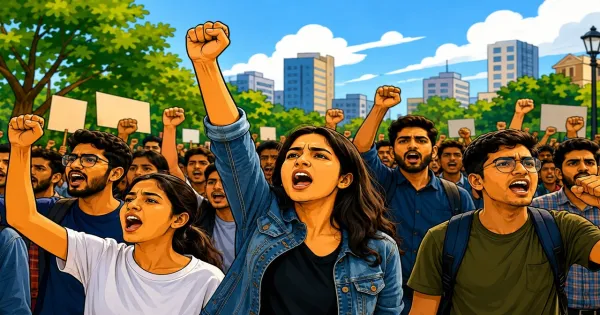
In fact, Gen-Ji has not merely shown a mirror to Indian politics. It has also forced the four pillars of democracy to wonder whether they have been left behind by the society they claim to serve and represent. This is not a question of any one government or any one political party. This is a test of the entire system. The youth are not just angry. He is restless. He is asking questions. He wants to be sure about his future. He asks- If you get education then where is the employment after that? If you get a degree, where are the opportunities? If someone works hard, is the system ready to recognize him or not? And if he asks questions, will it be considered a problem rather than a disagreement?
These are the situations where the greatest distance is visible between the old politics and the new generation. Old politics often remembers the young at election time. The new generation wants to be heard even in the five years between elections. This difference will decide the direction of politics in the future. Today the four pillars of democracy need to stand in front of a mirror.
The legislature should be asked – are the debates in Parliament and Assemblies giving voice to the restlessness of the youth who are worried about their future? Is the political discourse revolving strongly enough around issues like employment, education, technology, climate, mental freedom and equality of opportunity? The question to the executive is – how fast are the policies moving from paper to the lives of citizens? Is the government system becoming a system that facilitates the youth or is it entangling them in the web of procedures and certificates?
The question before the judiciary is different but equally important – the dignity of justice will be maintained only when the common citizen gets justice in a timely, accessible and reliable manner. And journalism? Perhaps the most difficult mirror is in front of him. If the same journalism from which the public expects to ask questions to power becomes the voice of political camps, then the fourth pillar of democracy weakens. The job of journalism is not to topple or save any government, but to question power and communicate with society. Journalism that has lost confidence, no matter how loudly it speaks, its credibility keeps on diminishing.
In fact, youth have shaken the political and social system in many countries of the world. Somewhere voices were raised against unemployment and corruption, somewhere for political accountability, and somewhere for democratic rights and a better future. The results of these movements were not the same everywhere.
Somewhere the system had to bow down, somewhere the policies changed, somewhere the leadership changed and somewhere the movement could not reach its goal, but one thing remained the same almost everywhere – the system realized that it is not easy to ignore the youth.
Today, a youth does not just have a mobile phone in his hands, he also has information, communication, the ability to organize and a medium to convey his message to the world. Therefore, it would be the biggest mistake to look at today's generation through old political lenses.
The law of nature is also the same – balance. Nature does not allow any one power to dominate indefinitely. If the population of any one species increases excessively in the forest, the entire ecological balance gets disturbed. Then nature activates another element and gradually a new balance is formed.
To be honest, democracy also works on this principle. If the government is strong, the opposition creates balance. If the questions to the government are weak, then the public answers in the elections. When institutions are weak, civil society raises its voice. When trust in the media decreases, alternative media emerge and when the old political language fails to understand the restlessness of the new generation, the youth create their own language. This is the natural balance of democracy.
Trying to suppress it by calling it a rebellion is as dangerous as considering every protest as a revolution.
The voice of the youth has to be heard, but the youth also have to understand that democracy is strengthened not just by slogans on the street, but by institutions, constitution, facts and responsible citizenship. We have to understand that every youth is not an opponent. He is only interested in his future. Parties will also have to understand that not every youth is their natural supporter.
Our destiny is in our hands – It's time to read this line again today. Because this time it is not just the fate of the children that is in our hands. It also contains the next political, social and democratic direction of India. The new generation is asking – When will decisions be taken in our name? How long will our future be discussed without us?
These questions have to be answered by all the institutions running democracy and ultimately by the entire society. Because democracy is not just a structure of institutions. Democracy is the trust of the people. Today's Genji is standing in front of us with a new measure of that trust. Now the question is not what the youth wants. The real question is whether the system is ready to change itself so much that the youth can see their future in it?