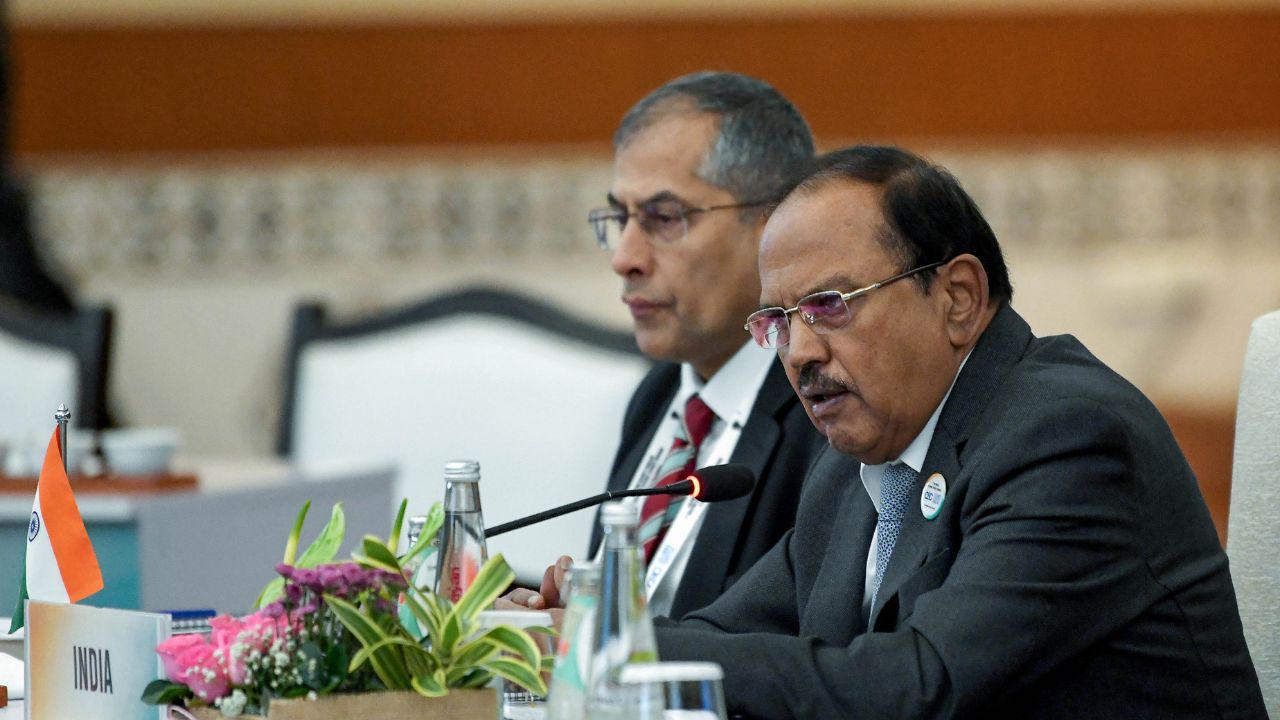
National Security Advisor Ajit Doval has reached Beijing for the 25th talks of Special Representatives on the India-China border dispute. During this, he will meet China’s Foreign Minister and Special Representative Wang Yi. In this meeting to be held amid the dispute related to the 3,488 km long border, issues like stability on LAC, reducing tension and restoration of trust between the two countries are going to be important.
Doval’s visit is taking place at a time when efforts are on to gradually restore normalcy in the relations between India and China. Besides, eyes are also on the possible visit of Chinese President Xi Jinping to India before the BRICS summit to be held in September. In such a situation, the conversation between Doval and Wang Yi is being considered important for the upcoming India-China diplomatic contacts.
Know in 8 points why this tour is important?
1. The most important discussion in the meeting is expected to be regarding the current situation on LAC. Both sides can consider measures to maintain peace and stability on the border and prevent any new conflict. After the 2020 military clash in Galwan Valley, tension on the border between the two countries had increased considerably.
2. Efforts made to reduce border tension after 2020 may also be reviewed between Doval and Wang Yi. Both countries can discuss reducing military confrontation and keeping existing mechanisms related to border management effective. The situation on the border after October 2024 and further steps may also be important in the agenda of talks.
3. The issue of border patrolling between India and China has also been sensitive for a long time. In such a situation, both the representatives can discuss further possibilities regarding patrolling arrangements and rights in the respective areas. Along with this, emphasis can also be laid on strengthening the various mechanisms present for border management, so that any local incident can be prevented from turning into a major military tension.
4. The important objective of the talks is to find a framework to resolve the India-China border dispute. Both sides can look at the ‘Political Criteria and Guiding Principles for the Resolution of the India-China Boundary Question’ decided in 2005 as the basis for further talks. However, the final solution to the border dispute is extremely complex.
5. The Doval-Wang talks are taking place at a time when news has come to light regarding China’s activities in Arunachal Pradesh. In such cases, it will be important for both sides to ensure that any new activity on the border does not increase tension. China and India have different claims regarding Arunachal Pradesh. Therefore maintaining peace and stability can be a sensitive part of the talks.
6. Mechanisms related to WMCC can also be discussed in the talks. This system is an important medium of communication between the two countries in border related matters. Apart from this, possibilities of cooperation at the expert level can also be considered to take forward the initial process of boundary determination in appropriate areas.
7. The timing of Doval’s visit to Beijing is making it more important. The BRICS summit is proposed in India in September and there is discussion about the possibility of Chinese President Xi Jinping attending it. If Xi Jinping comes to India, the way may also open for his possible meeting with Prime Minister Narendra Modi. In such a situation, the meeting between Doval and Wang Yi can play a role in creating a positive environment for high-level contacts between the two countries.
8. The talks are likely not to be limited to military tensions only. Talks can also move forward on issues like trans-border rivers, exchange of water-related information, border trade and other practical cooperation. With this, both the countries can explore such areas along with border disputes where it is possible to maintain cooperation on a limited level.