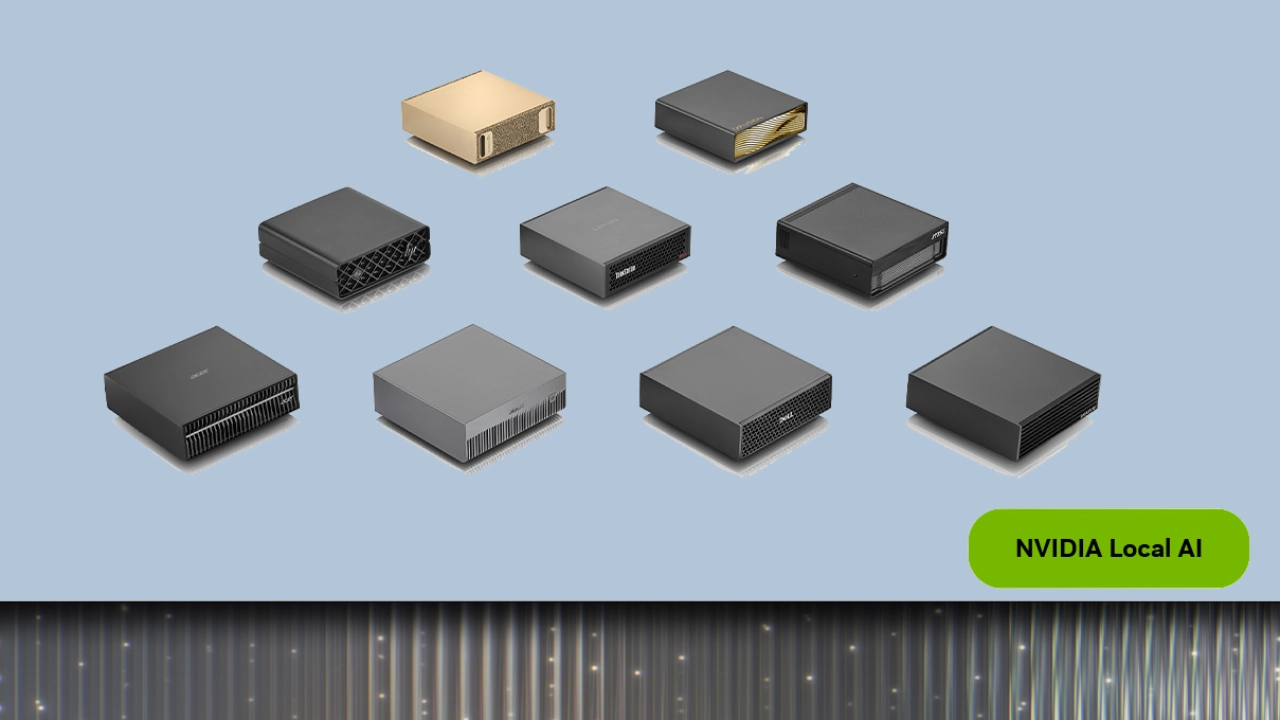
NVIDIA has introduced a 64GB unified-memory configuration of its NVIDIA DGX Spark personal AI system. Starting Friday, October 23, the systems will ship exclusively through Acer, ASUS, Dell, Gigabyte, HP, and MSI. According to the company, the starting price is $4,999.
The box keeps the same GB10 Grace Blackwell Superchip, DGX OS, and full NVIDIA AI software stack found in the existing 128GB DGX Spark model. NVIDIA states it can run models of up to 100 billion parameters entirely on the device. Two units linked through the built-in ConnectX-7 networking can pool memory to 128 GB, and NVIDIA says it supports models up to 200 billion parameters.
However, the 64GB configuration arrives as memory prices have pushed the larger model higher. Reports indicate the 128GB systems now list well above earlier MSRPs.
NVIDIA lists the new 64GB systems starting at $4,999. NVIDIA’s 128GB Founders Edition listing, priced at $6,950, is currently shown as out of stock on NVIDIA’s U.S. marketplace, and other 128GB OEM configurations are priced separately and vary by channel.
The difference is partly that the 64GB systems are OEM partner configurations, while the $4,699 figure belongs to NVIDIA’s Founders Edition. Partner systems can vary in storage, design, and support, so a simple price-per-gigabyte comparison would be misleading.
What the Nvidia DGX Spark 64GB Actually Delivers for Local AI Work
The Nvidia DGX Spark is a small desktop machine from NVIDIA running Grace Blackwell compute, unified memory, and ConnectX-7 networking. It is built for local AI workloads, including inference, fine-tuning, data science, and edge development, reducing the need to rely on cloud instances for every task.
The 64GB configuration provides 273 GB/s of memory bandwidth.
The preinstalled stack includes NVIDIA’s Agent Toolkit, CUDA-X libraries, Nemotron models, Ollama, vLLM, and PyTorch with CUDA. Developers can also download additional frameworks, including llama.cpp. NVIDIA says a prebuilt downloadable Blender installer for the platform is coming soon.
The preconfigured software stack is designed to reduce setup time for local AI development.
Scaling With NVIDIA Sync Cluster Assistant
Two 64GB systems can be clustered to pool 128GB of memory for supported workloads.
NVIDIA says the Sync Cluster Assistant detects the connected systems, validates the configuration, and automatically sets up networking.
NVIDIA says the same software stack runs on every node, so the environment does not need to be reconfigured when scaling from one unit to two.
In NVIDIA’s own Qwen 3.8 27B test, two clustered 64GB systems delivered up to 1.7x the performance of a single system, and that figure comes from NVIDIA’s internal testing; independent verification of the specific result has not yet appeared in published third-party reviews. NVIDIA says the two-node cluster delivers twice the aggregate memory bandwidth of a single system.
The NVIDIA Sync Model Launcher is scheduled to arrive at the end of October. NVIDIA says Sync Model Launcher will download and launch Qwen3.8 27B on one system or a cluster, configure it across connected devices, and make it accessible from a user’s laptop.
How the 64GB and 128GB Configurations Compare
| Feature | DGX Spark 64GB (partner systems) | DGX Spark 128GB |
| Superchip | GB10 Grace Blackwell | GB10 Grace Blackwell |
| Unified memory | 64GB | 128GB |
| Memory bandwidth | 273 GB/s (NVIDIA) | 273 GB/s (NVIDIA) |
| NVIDIA-stated model support (single unit) | Up to 100 billion parameters | Up to 200 billion parameters |
| Clustering | Two units → 128GB pooled | Two units → 256GB pooled |
| Starting price/availability | $4,999 from Oct. 23 via Acer, ASUS, Dell, Gigabyte, HP, MSI | $4,699 on NVIDIA’s U.S. marketplace (currently listed out of stock); OEM pricing varies. |
| Networking | ConnectX-7 (200 GbE) | ConnectX-7 (200 GbE) |
Practical Workflows NVIDIA Highlights
NVIDIA highlights several ways developers can use the NVIDIA DGX Spark 64GB configuration with three example workflows.
A coding or research agent can stay running around the clock on one unit. Language or image models can run on the Spark while a laptop or desktop handles the interface. When a task outgrows a single system, two 64GB units connected through Sync Cluster Assistant pool memory without changing the software stack.
Playbooks for agentic work, including NemoClaw, OpenClaw, and OpenShell, are available on the NVIDIA site. Additional guides for serving with vLLM and connecting multiple Sparks are listed as coming soon for the 64GB devices.
What Buyers Will Need to Weigh
The 64GB DGX Spark configuration keeps the full software stack and the ability to grow into a two-node cluster.
For supported models that fit within the 64GB system within NVIDIA’s stated 100-billion-parameter ceiling and workloads that fit the system and benefit from CUDA tooling, it offers a new entry point.
Reasons a developer might still choose the 64GB model include partner-specific designs or support packages, workloads that stay under NVIDIA’s 100-billion-parameter ceiling, or the flexibility to start with one unit and later cluster two.
Developers who need the larger single-system capacity NVIDIA claims for the 128GB NVIDIA DGX Spark (up to around 200 billion parameters) may prefer to stay with the existing configuration when stock and pricing allow.
The decision, as always, depends on the developer’s pipeline.