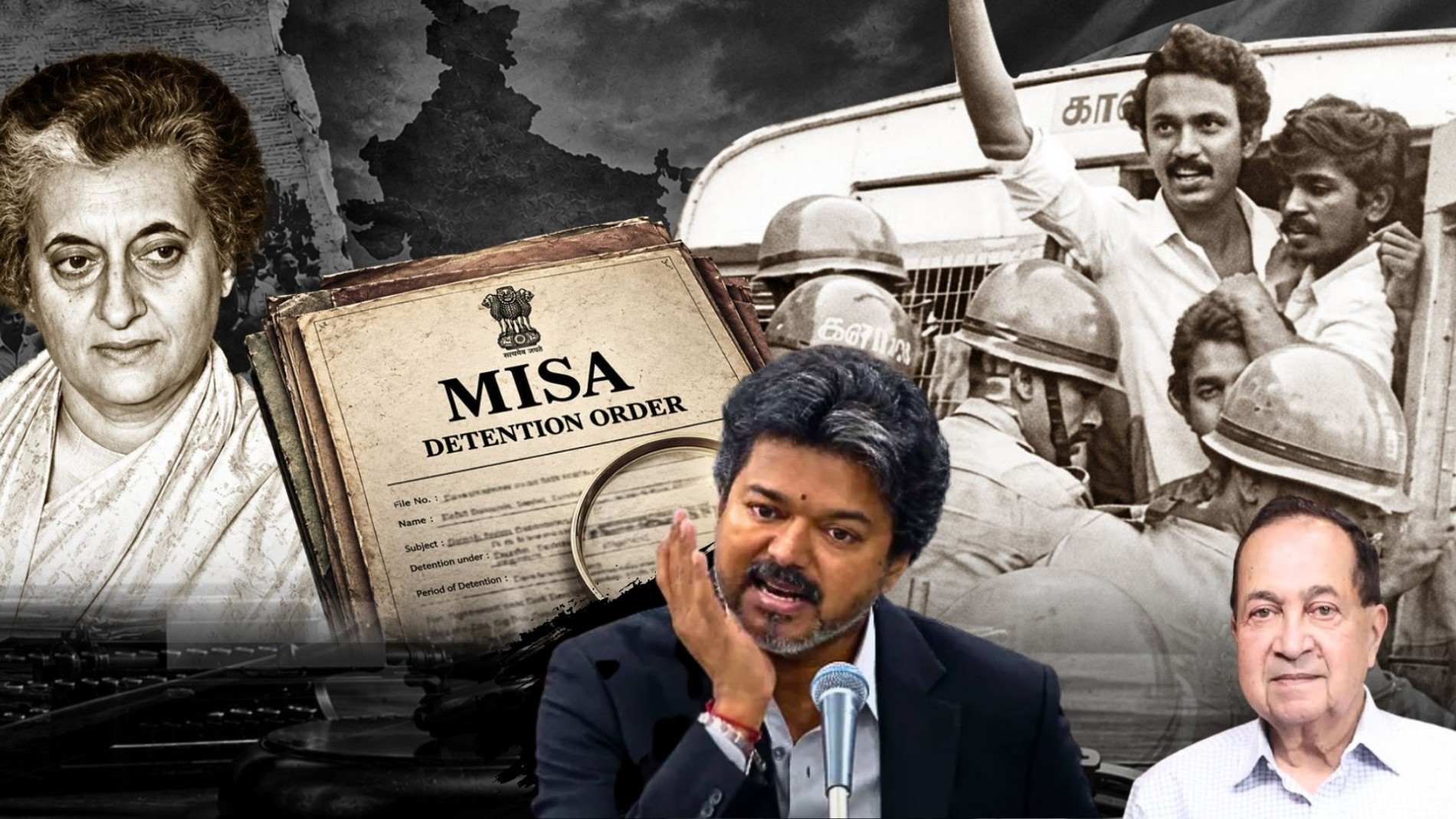
“MK Stalin did not buckle under detention like some other leaders who gave letters of apology to come out; there was no question of any apology from him,” asserted veteran journalist N Ram, Director of The Hindu Group, reflecting on the former Tamil Nadu Chief Minister’s imprisonment during the Emergency.
As political debates resurface in Tamil Nadu over Maintenance of Internal Security Act (MISA) detentions and the Sarkaria Commission, following Tamil Nadu Chief Minister C Joseph Vijay’s scathing remarks in the Assembly last week, The Federal spoke with Ram to recall the events of 1975–77.
Edited excerpts:
What is the background behind the arrest of MK Stalin and the enactment of MISA during the Emergency?
I was 30 when the Emergency was promulgated, so, I wasn’t too young to understand it. MISA was one of the most notorious laws enacted by the Parliament of India under Congress rule. Even before that, after Independence, you had the Preventive Detention Act, which was famously challenged by MK Nambiar (KK Venugopal’s father, a great constitutional lawyer) in the landmark AK Gopalan case. In 1969, that law was repealed, and then MISA was enacted in 1971.
Its lifespan was from 1971 to 1978, and it became notorious during the Emergency.
As many Gen Z people might not know, the DMK government headed by M Karunanidhi was in office at that time. The DMK had come to power in 1967 and maintained good relations with the Congress. It saved Indira Gandhi’s government after the Congress split by extending support, so it was seen as close to the Congress at that time, although the Congress had a very minor role in Tamil Nadu.
On June 27, 1975—two days after the Emergency was declared—the DMK executive formally adopted a resolution against the Emergency. It was drafted carefully under Karunanidhi because he didn’t want to provoke the Centre and get dismissed immediately. The dismissal came later, on January 31, 1976.
I am glad that The Federal is trying to find out the truth. Fact-checking is important.
Murasoli Maran (former MP, DMK leader and journalist), for example, had to function under censorship, but they found many clever ways around it. The DMK executive adopted a resolution condemning the direction in which the country was moving and demanding the restoration of democratic rights.
Almost all of them had been detained without any charge or cause under the pretext of national security or public order under MISA. Political leaders were detained on a large scale initially. Very well-known journalist Kuldip Nayar was also detained under MISA.
Karunanidhi continued his opposition, and perhaps the Centre was watching how a former ally would perform. He took a clear stand against the Emergency.
Stalin was very young and known as a youth leader. He had been married for less than six months when he was arrested. The reason for his arrest was his activism. He was not very well known nationally, but there would have been no reason to arrest him had he not been active. My main contact was Murasoli Maran, as the person in charge of (Tamil daily) Murasoli at that time.
Stalin was detained under MISA along with Arcot N Veerasamy, TR Baalu and famously C Chittibabu, former Mayor of Madras and a sitting MP of the DMK. It is clear that they were badly treated and maltreated by the prison authorities. Chittibabu died later, reportedly due to the beatings he endured during an intervention to save the limbs and life of Stalin at that time.
Later on, my friend David Selbourne wrote a famous book, An Eye to Indiawhich gave extensive material based on underground literature during the Emergency. People mostly circulated information through cyclostyled news sheets. There was no internet or modern technology available in those days, so it was cyclostyled and distributed.
Tamil Nadu was a haven and sanctuary for national leaders at that time. George Fernandes, who was highly wanted in the Baroda Dynamite case, came to Tamil Nadu, and I met him. LK Advani came as well, and I met him at the house of a friend.
During this period, Tamil Nadu was definitely opposed to the Emergency. They did so not in a highly adventurous way, because they also had to run a government, but they took a clear political stand.
What did Stalin go through in prison, and why did his arrest under MISA become a pivotal chapter in his political history?
He became nationally known as a result of his detention under MISA and the harsh treatment that he and other DMK leaders received. Remember that they were not detained in the immediate first phase of the Emergency; Indira Gandhi’s government was watching how they would react, perhaps hoping they would support it.
Once they took a clear stand, and Murasoli began to publish material indirectly opposing the Emergency, information circulated about the DMK cadres and leaders arrested. We don’t know the exact final figures, but there were many hundreds.
It was not just MISA that was used; there were other ways of detaining people, but MISA was the most notorious. Tall leaders on the Right like Atal Bihari Vajpayee, Advani, Jayaprakash Narayan, and Morarji Desai, as well as several Left leaders, were detained. Many leaders worked underground.
Politicians today—I am not going to name names—should be responsible and look at facts. You cannot fabricate information or say things in ignorance, particularly those who hold high office. There is a lot of social media content, Instagram reels, and rubbish that comes out. If somebody in authority or in a prominent political position doesn’t look at these facts and dig them up—even if you were too young or not around in politics at that time—that is totally wrong and must be condemned.
I am glad that The Federal is trying to find out the truth. Fact-checking is important. Even if you consult AI tools you will get this information. Did the DMK pass a resolution opposing the Emergency two days after its declaration? Yes. Were hundreds of DMK workers detained under MISA? Yes.
What was the Sarkaria Commission, and why was it constituted following the dismissal of the DMK government?
To justify their attack on the DMK government and its dismissal on January 31, 1976, they concocted these charges. I am not saying there was no corruption, but corruption is an endemic part of the Indian political system.
I have written a book titled Why Scams Are Here to Stay: Understanding Political Corruption in Indiawhich includes a chapter on Tamil Nadu. Is corruption limited to Tamil Nadu? Go to Telangana, Andhra Pradesh, Uttar Pradesh, or Bihar—corruption has become endemic across the board, otherwise how do candidates contest elections? Has the Congress government been clean, or the BJP government for that matter?
They suddenly brought up these charges, but the whole thing fizzled out. It was not pursued once the political situation changed. The Sarkaria Commission, like the Shah Commission report, fizzled out, and nothing came out of it. There was no prosecution at the end. It was seen merely as a late justification for an anti-democratic, authoritarian act.
How did surviving detention under MISA shape Stalin’s identity as a politician and impact the DMK?
He did not buckle under detention like some other leaders did; some gave letters of apology and came out. There were individuals in other parties and organizations who did so, including some in Tamil Nadu, but not in the DMK or the Left. There was no question of any apology from him; that is absolutely clear.
In fact, Karunanidhi told his son to be prepared. Stalin could have tried to go underground; he was in Maduranthakam and not at the Gopalapuram residence when the police arrived. He returned the very next day because his father told him that if he wanted to enter politics, he must be ready for political sacrifice.