
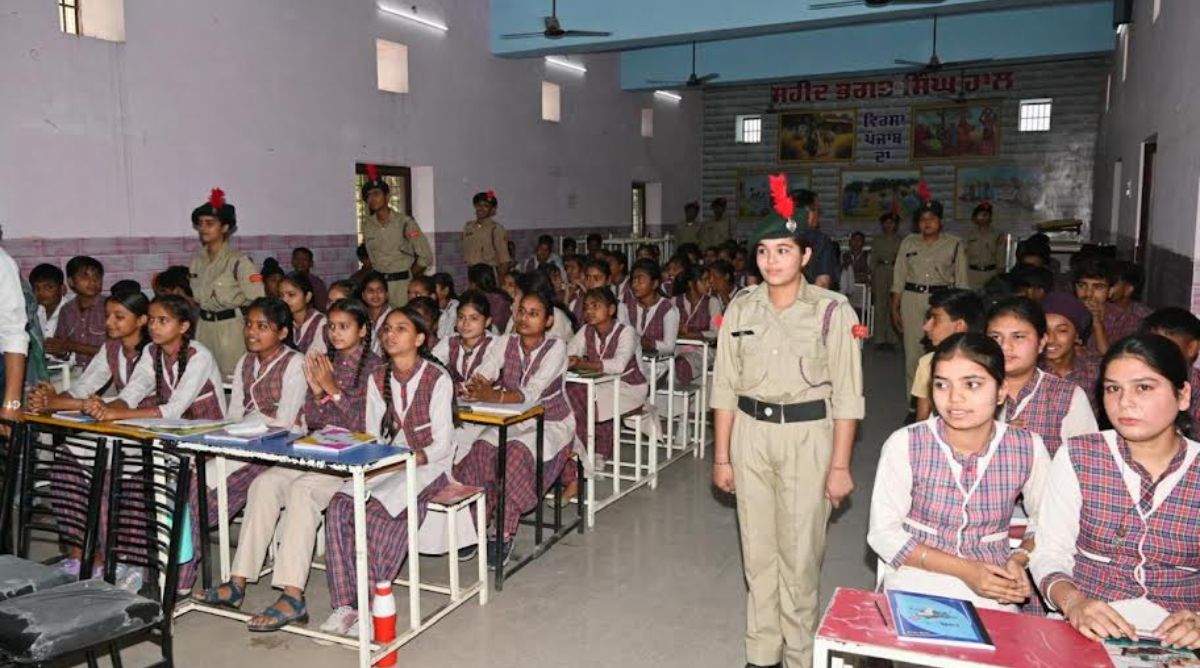
Punjab Police’s ‘Student Police Cadet’ program gets huge support, around 11,200 students from 280 schools across Punjab are benefiting

Punjab Police: The ‘Student Police Cadet (SPC)’ program conducted under the ‘Youth Connectivity’ initiative of Punjab Police is receiving widespread support and encouraging response from educational institutions across the state. So far, a total of 1,965 indoor and 698 outdoor classes have been conducted under this programme.
This program, started with the objective of creating responsible citizens, developing leadership qualities, increasing social awareness and providing a platform for dialogue between students and police, has received extremely positive response from the school students. Chief Minister Bhagwant Singh Mann had launched this program on 22 August 2023. Under the leadership of Punjab Director General of Police (DGP) Gaurav Yadav, about 11,200 students from 280 selected schools of the state are taking advantage of this program.
DGP Gaurav Yadav said, “Under this programme, one indoor and two outdoor classes are organized every month for the students of class 8th and 9th, with the aim of developing responsible citizens. Apart from this, SPC students are also given the opportunity to visit DC and SSP offices, police stations, evening centres, State Police Academy and other places of educational importance.”
He said that under this project, about 450 SPC cadets visited the Punjab Police Academy, where they participated in sessions on the outline of the SPC program and cyber security, participated in discussions and visited important sites like the Museum, Library and Phillaur Fort.
Gurpreet Kaur Deo, Special Director General of Police (Community Affairs and Women’s Affairs), said, “Such educational programs open up new possibilities for the students and inspire them to better understand the environment around them and take right decisions in life. This increases the self-confidence of the students. They start understanding and respecting the police system. Such programs help in the intellectual development of the youth and acquaint them with the functioning of the government and the police system. This helps in reducing the fear of the police.” ends and builds confidence to approach government agencies when necessary.”
He said that recently a one day session was organized at Punjab Police Academy, Phillaur for SPC students, teachers of selected schools and officials of Sanjh Centers of Punjab, which included tour of Maharaja Ranjit Singh Fort and various facilities of the Police Academy.
SPC students participated in the Republic Day parades organized in 11 districts of Punjab—Amritsar, Bathinda, SAS Nagar, Barnala, Hoshiarpur, Sangrur, Malerkotla, Patiala, Fazilka, SBS Nagar and Gurdaspur. 40 students from each district participated with full enthusiasm and displayed confidence, team spirit and dedication, making this initiative extremely beneficial for their all-round development. Uniforms were also provided to a total of 440 SPC students who participated in the parade.
Gurpreet Kaur Deo said, “The youth often get attracted towards wrong activities due to peer pressure and lack of proper guidance from parents. To prevent them from going astray and motivate them towards social responsibility, school students are given the opportunity to participate in social programs related to the deprived and needy sections of the society. Through this program, Punjab Police has provided them a platform to realize their true potential and communicate openly with the police, where the police plays the role of their guide.”
The police department works closely with the education department under the SPC initiative. Under this, introduction and awareness programs are organized for district education officers, principals, teachers and police officers posted in evening centres. Saanjh centers are community policing units of Punjab Police. This initiative is also strengthening the ‘War on Gangsters’ campaign of the Punjab Government, as through this the youth are being engaged in positive activities and developing a sense of responsible citizenship among them.

Comments are closed.