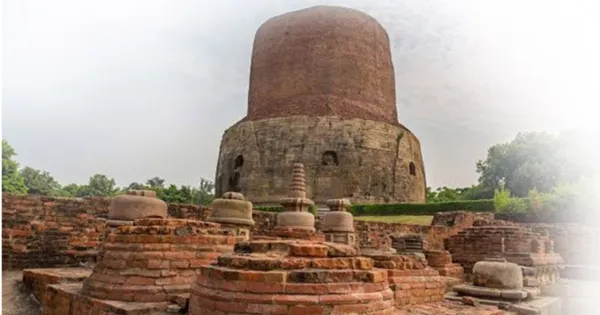
India's historical sites are not just buildings or structures made of bricks and stones, but they are shining symbols of an intact and vibrant cultural heritage that is gaining acceptance on the global stage. Sarnath is one such living reflection of India's priceless cultural heritage. This is the land where Siddhartha, who attained enlightenment after renouncing royal glory, gave his first sermon after attaining enlightenment and inaugurated a new chapter of compassion, middle path and non-violence in human history.
Recently, the inclusion of Sarnath in the World Heritage List in the 48th session of the World Heritage Committee organized by UNESCO in Busan, South Korea is not just an honor for an archaeological site, but a global acceptance of those universal human values, which the entire world needs today more than ever. This recognition received after waiting for almost twenty-eight years is an important achievement in the cultural history of India. With this, Sarnath has become the 45th UNESCO World Heritage Site of India and the fourth of Uttar Pradesh.
World Heritage status not only gives international recognition to a site, but also opens doors to new possibilities for its conservation, promotion, cultural revitalization and sustainable development. With the 'Dharmachakra Pravartan' of Gautam Buddha, such life philosophy and values emerged, which deeply influenced the culture, art, literature, architecture and philosophy of life of the vast area of Asia. Sarnath is still a center of reverence and inspiration in China, Japan, Korea, Thailand, Sri Lanka, Myanmar, Vietnam, Mongolia and many other countries. In other words, Sarnath is not only the heritage of India but also a common heritage of humanity throughout the world. In Buddhist tradition, this place is known by different names – Rishipattan, Ishipattan, Mrigadava etc. All these names point to the same sacred place where the Buddha came in the sixth century BC and gave his first sermon, known as the 'turning of the wheel of Dharma' (Dharmachakra Pravartana). This incident marked the beginning of the Buddhist Sangha and the establishment of the principles of the Eightfold Path.
Today, when the world is facing many serious challenges like war, terrorism, religious intolerance, climate crisis and social division, the message of Sarnath becomes extremely relevant. Let it be known that Buddha neither established any empire nor adopted the path of displaying any power. He told the whole world the way to identify the inner turmoil of man and remove it. Sarnath shows humanity the path to co-existence, peace and self-realization by giving the message of compassion in place of vengeance, prudence in place of fanaticism and middle path in place of extremism. It is noteworthy that this philosophy is not limited to any one religion or community, but is the basis of universal human consciousness.
The honor given to Sarnath by UNESCO is in fact a global reaffirmation of these human-centric values. Undoubtedly, after being included in the World Heritage List, Sarnath will gain recognition as an attractive global center of religious and cultural tourism.
– Shishir Shukla, Assistant Professor