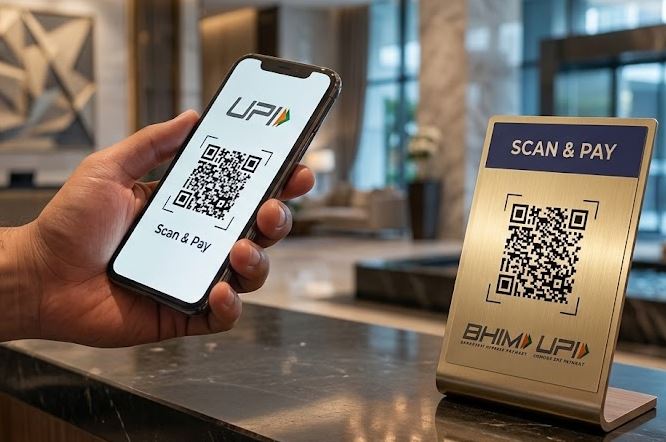
New Delhi: Supreme Court will Monday hear a plea challenging the Centre’s decision to impose a Merchant Discount Rate (MDR) on specified UPI person-to-merchant transactions of over Rs 2,000.
Ending nearly six years of fully free UPI payments, the government has introduced a 0.4 per cent fee on transfers worth over Rs 2,000 made to merchants through the UPI platform from October 15 while explicitly ring-fencing everyday person-to-person transactions and small payments from any charge.
The MDR will be capped at Rs 300 for payments of Rs 75,000 and above.
Essential and thin-margin sectors — railways, telecom, insurance, fuel and agricultural inputs — will pay a flat MDR of Rs 5 per transaction above Rs 2,000.
Payments into mutual funds, securities and through stockbrokers and dealers will attract 0.02 per cent MDR, also capped at Rs 300.
Person-to-person (P2P) transfers — which make up 37 per cent of UPI’s transaction volume and 70 per cent of its transaction value — will continue to attract zero charges, irrespective of size.
According to the apex court’s cause list of September 28, the plea would come up for hearing before a bench of Chief Justice of India Surya Kant and Justices Joymalya Bagchi and V Mohana.
The public interest litigation (PIL) filed by advocate Anjan Datta has challenged the Centre’s September 14 notification and the MDR framework announced on September 15, which is stated to come into effect from October 15.
The plea alleged that the levy has been introduced without adequate statutory safeguards, transparency or public consultation.
It challenges the constitutional validity of the amended Section 10A of the Payment and Settlement Systems Act, 2007, alleging that it gives unguided powers to the executive to decide which electronic payment modes would receive the no-charge protection.
“Declare that no MDR or analogous compulsory charge may be imposed or recovered merely on the strength of a press release or FAQs absent a duly authorised, authenticated and published statutory instrument,” it said.
The petitioner has also questioned the distinction between UPI transactions and RuPay debit card payments, pointing out that the notification continues the no-charge protection for RuPay debit cards without a monetary ceiling.
The plea alleges that the framework is arbitrary and discriminatory, and may adversely affect merchants, particularly those with low margins, while also raising concerns over possible indirect consumer burden and digital exclusion.
It has sought the quashing or suspension of the framework insofar as it imposes an MDR on UPI transactions of above Rs 2,000.
Alternatively, it has sought a reconsideration of the framework after transparent consultation, publication of empirical data and an impact assessment, besides safeguards for micro and small enterprises.
“Direct that any future MDR classification be based on relevant considerations including merchant turnover, statutory MSME status, actual margins, geography and ability to bear the cost, and avoid cliff-edge treatment unsupported by evidence,” the plea said.
It has made the Centre and others, including the Reserve Bank of India, as party respondents in the matter.