
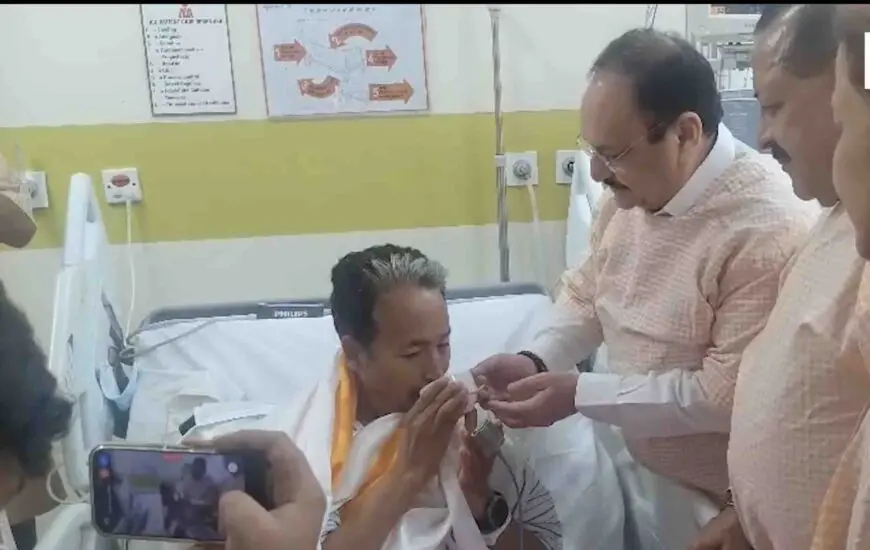

Gurugram: Activist Sonam Wangchuk broke his indefinite hunger strike late on Thursday at Medanta Hospital in Gurugram, where he had been admitted amid deteriorating health.
The decision followed Prime Minister Narendra Modi’s commitment to stringent action against examination paper leaks and written assurances conveyed by Union Ministers JP Nadda and Dr Jitendra Singh during their visit to the hospital.
Wangchuk, who joined the youth-led protests at Delhi’s Jantar Mantar on June 28 and began fasting the same day, ended his fast in the presence of the two ministers, his wife Gitanjali Angmo, and supporters, including Cherring Dorjay Lakruk, co-convenor of the Leh Apex Body.
According to Lakruk, the government provided written commitments that cases against non-violent student protesters would be withdrawn and that authorities would consider compensation for families of students affected by the crisis, including suicide victims.
The development came shortly after PM Modi shared a video message emphasising that preventing paper leaks is a “national responsibility” and a “grave sin.” He announced that the Union Cabinet would discuss tougher measures, including fast-track courts and stricter punishments, at its meeting on Friday, with plans to introduce a related Bill in Parliament the following week. “Those who try to harm the future of our youth will not be spared,” Modi stated, signalling a proactive government response to longstanding demands from the protesters.
The Cockroach Janta Party (CJP)-led agitation, which began on June 20, has centered on demands for accountability over alleged irregularities in competitive exams such as NEET-UG 2026, systemic education reforms, and the resignation of Union Education Minister Dharmendra Pradhan.
Wangchuk quickly emerged as a prominent face of the movement, amplifying calls for justice for affected students. The ministers’ intervention and PM Modi’s announcements appear to have addressed key concerns, paving the way for de-escalation while the broader movement continues to press for lasting reforms in India’s examination system.

Comments are closed.