Indonesia’s Energy and Mineral Resources Minister Bahlil Lahadalia told reporters recently that remained open to exporting electricity but would prioritize domestic needs if buyers were unwilling to meet its price terms.
“As long as the price is right, follow our prices, that is possible. But if the price is not right, we will prioritise domestic needs,” he said, according to state news agency Between.
Bahlil, who also serves as coordinating minister for downstreaming and energy transition, said his ministry had calculated a proposed export price. He did not disclose the figure or say when exports could begin.
|
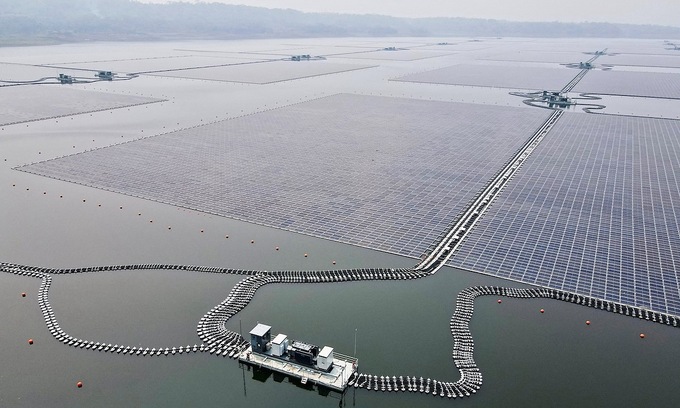
Floating solar power plant in Cirata, Indonesia. Photo by AFP |
His latest comments come amid recent tensions between Singapore and Indonesia over transboundary haze and natural gas supplies. The two countries are working to bring energy projects online by 2035, but pricing remains a key sticking point.
On Monday, Bahlil said Indonesia, the largest economy in Southeast Asia, would not export electricity in the near future because it needed the power for domestic consumption.
“I have announced that Indonesia will not be able to export electricity in the near future. We still need electricity,” he said at the Mineral and Coal Convention and Exhibition in Jakarta, as reported by The Straits Times.
Indonesia and Singapore are working to implement a major bilateral energy initiative announced in June 2025, when Bahlil and Tan See Leng, then Singapore’s minister-in-charge of energy and science and technology, signed three memorandums of understanding in Jakarta.
The agreements covered cross-border electricity trade, carbon capture and storage, and development of a sustainable industrial zone in Indonesia’s Riau Islands.
At the Singapore-Indonesia Leaders’ Retreat in July 2026, Prime Minister Lawrence Wong and President Prabowo Subianto reaffirmed their commitment to accelerating cross-border electricity trade. Jakarta designated Danantara to spearhead the initiative.
Singapore’s Energy Market Authority had granted conditional licenses to import 2GW of electricity from Indonesia and conditional approvals for another 1.4GW, bringing the planned total capacity to 3.4GW.
The proposed electricity trade would help Singapore reduce its reliance on fossil fuels while attracting investment in renewable power generation and supporting infrastructure in Indonesia.