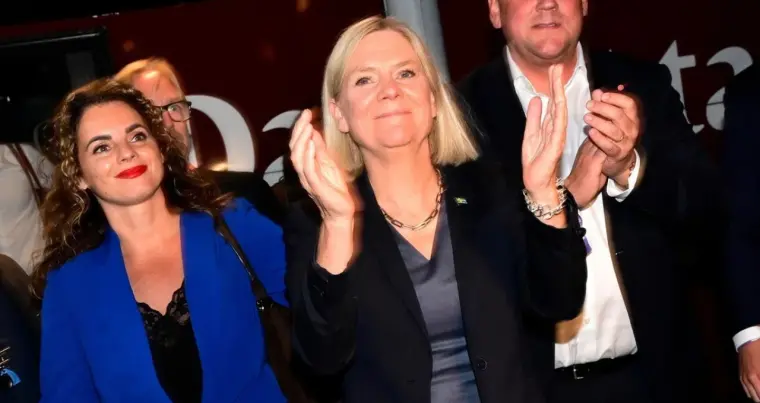
The opposition alliance has got a slight lead of three seats after more than 90 percent of the votes were counted in Sweden's general election. Magdalena Andersson and Ulf Kristersson are both preparing to form a government, while final results are still pending.
Stockholm: The initial results of the general elections in Sweden have made the picture regarding power very exciting. After counting of more than 90 percent of the votes, the Left opposition is maintaining a slight lead, but the final form of the government has not been decided yet. Prime Minister Ulf Christerson and opposition leader Magdalena Andersson have both indicated readiness to form a government.
Opposition got a slight lead
According to the figures released so far, the four opposition parties led by Social Democratic leader Magdalena Andersson were three seats ahead of the right-wing coalition led by Prime Minister Ulf Christerson in the 349-member parliament. Kristersson's coalition also includes the anti-immigration Sweden Democrats. However, this lead is very small and the balance of seats may change after the final vote counting and re-verification.
Addressing his supporters, Andersson said that his coalition is currently in the lead and if this position holds in the final results, Sweden will get a new government. 59-year-old Andersson has been the first female Prime Minister of Sweden between 2021 and 2022.
Challenge for social democrats too
Despite the opposition alliance gaining ground, there are signs of decline in the performance of the Social Democrats. The party has been at the center of power in Swedish politics for most of the 20th century and is still the country's largest party.
However, according to the available vote counting, the party seemed to be getting around 28 percent votes. This marks his worst performance in more than a century. It is clear from this that despite the opposition camp's lead in the elections, the Social Democrats also face a political challenge.
Christerson admitted that forming a government would not be easy.
Prime Minister Ulf Christerson's Moderate Party had received 19.9 percent of the votes counted so far. He indicated that if the current result stood in the final form, he would respect Anderson's attempt to form a government.
However, Christerson also pointed to the serious differences that exist between the four opposition parties. According to him, especially the differences between the Left Party and the Center Party are so significant that it may be difficult for them to agree on a common government program.
Christerson said that even if the current result stood, he would still look at whether there was a viable possibility of forming a government within a non-Socialist parliamentary majority.
He told his supporters that the question of which government would rule Sweden in the coming years was still open.
Sweden Democrats got a big blow
One of the most significant developments of the election was the decline in support for the anti-immigration Sweden Democrats. The party, which entered Parliament in 2010, faced a decline in its support for the first time.
The party was seen getting 17.6 percent votes, whereas in the 2022 elections it had got 20.6 percent votes. That means its vote share has declined compared to the last election.
Party leader Jimmy Akanson said at an election night event that the final results were not yet known, but the party had lost a few percentage points compared to four years ago.
However, he emphasized on a different aspect of the party's support. According to Åkesson, there has now been an increase in the number of people in the country who do not feel uncomfortable openly expressing their support for the Sweden Democrats.
The change is significant for a party that has long been seen as an isolated political force in Swedish politics.
Final results may take several days
The final outcome of Sweden's election is not likely to be immediately clear. Many party leaders have indicated that it may take a few days for the complete picture to emerge.
Municipal election officials will begin counting Wednesday the votes that did not reach their destinations by election night. Even after this the process does not end.
In Sweden all votes are automatically recounted by regional county administrative boards. This process establishes the final election result. Generally this entire process may take about a week.
Therefore, the lead of three seats found in the initial vote counting cannot be considered as the final parliamentary picture.
Minority coalition government for four years
Ulf Kristersson has been leading a minority coalition government for the past four years. This government has received the support of the Sweden Democrats in Parliament.
In return, the Sweden Democrats gained influence over government policies. This arrangement reflects the growing role of right-wing and anti-immigration forces in Swedish politics.
Kristersson also promised during the election campaign that if the right-wing coalition won the election, important cabinet positions would be given to the Sweden Democrats.
Now the decline in the party's support in the election results can affect this equation.
Election picture changed in the last days
For most of the election campaign, opinion polls had shown the left opposition in a clear lead. But in the last days of voting, this difference kept on decreasing and both the parties reached almost equality.
For this reason, even after the initial results come, it is difficult to consider the victory of any one camp as certain. A narrow seat gap in parliament, differences among coalition partners and a decline in the Sweden Democrats' performance—all three factors could influence the government formation process.
Now all eyes are on the final counting of votes and the recounting at the regional level. If the opposition's lead continues, Anderson will face the challenge of forming a government by bringing together four parties. On the other hand, Christerson could explore the possibility of an alternative arrangement within a non-socialist parliamentary majority.
In this way, Sweden's election currently appears to be moving towards a complex government formation situation rather than giving a clear winner. Only the final result will decide which political alliance will come to power in the country.