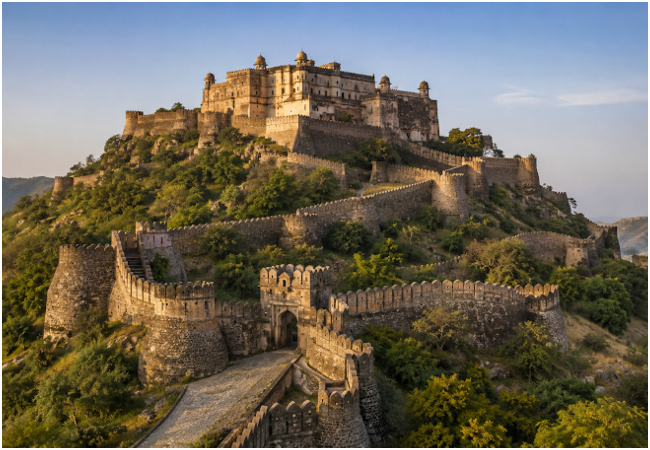
Rajsamand. Whenever the world's longest wall is mentioned, the first thing that comes to mind is the Great Wall of China, but very few people know that the second longest wall of the world is not located in any other country but in India itself. The wall of the historical Kumbhalgarh Fort located in Rajsamand District of Rajasthan is known as 'The Great Wall of India'. This huge wall built amidst the beautiful and high hills of Aravalli is a wonderful example of Indian Architecture and Military Strategy.
Read:- Iranian President Pejeshkian supported the American deal, said – this is the only way out of the war.
History and creation
This grand fort and its impenetrable wall was built by the famous ruler of Mewar, Maharana Kumbha in the 15th century. According to historical documents, it took more than 15 years to complete this huge structure. At that time, this fort used to be the main center of security of Mewar state. Due to its location on the high peaks of the Aravalli ranges and its strong siege, this fort was considered almost impossible for the enemies to conquer. History is witness to the fact that in its entire tenure this fort fell into the hands of the combined forces only once, and that too due to water crisis.
A unique example of design and engineering
This wall of Kumbhalgarh Fort is about 36 kilometers long. Its width is so high that eight horses can run simultaneously on its upper part. According to local legends and architectural experts, the wall is approximately 15 to 20 feet thick. Keeping in mind the security of the entire fort, many huge entrance gates (poles), watch towers and security posts were built in it, from where the soldiers kept an eye on the activities of the enemies from a distance.
Read :- Mukesh Khanna again reiterated 'Jana Gana Mana cannot be the national anthem of my country', he wants Vande Mataram to become the national anthem of India.
Rich history inside the fort
Kumbhalgarh is not limited to just a protective wall, but has an entire history housed within its expansive complex.
Ancient Temple: There are more than 300 ancient temples located inside the fort. Of these, about 300 temples belong to Jainism, while the remaining temples are dedicated to Hindu deities.
Birthplace of Shiromani Maharana Pratap: This fort is also the birthplace of the great warrior Maharana Pratap, due to which its historical importance increases further.
Read :- Viral Video: The plane got hit by a strong storm at Italy airport and overturned like a toy, there was no loss of life.
Changed Palace: 'Badal Mahal' is built at the topmost part of the fort, from where a breathtaking view of the surrounding hills and desert landscape is visible.
International identity and tourism
In view of its unique architecture and historical importance, UNESCO has declared Kumbhalgarh Fort as a World Heritage Site. It is included in the category of 'Hill Forts of Rajasthan'. Today this place has become a major attraction for tourists from India and abroad. History lovers, photographers and tourists come every year in lakhs to visit this Indian heritage.
This wall of Kumbhalgarh is not just a structure of stones, but it is a living symbol of India's ancient skill, unwavering courage and rich cultural heritage.
Report: Deepanjali Mishra