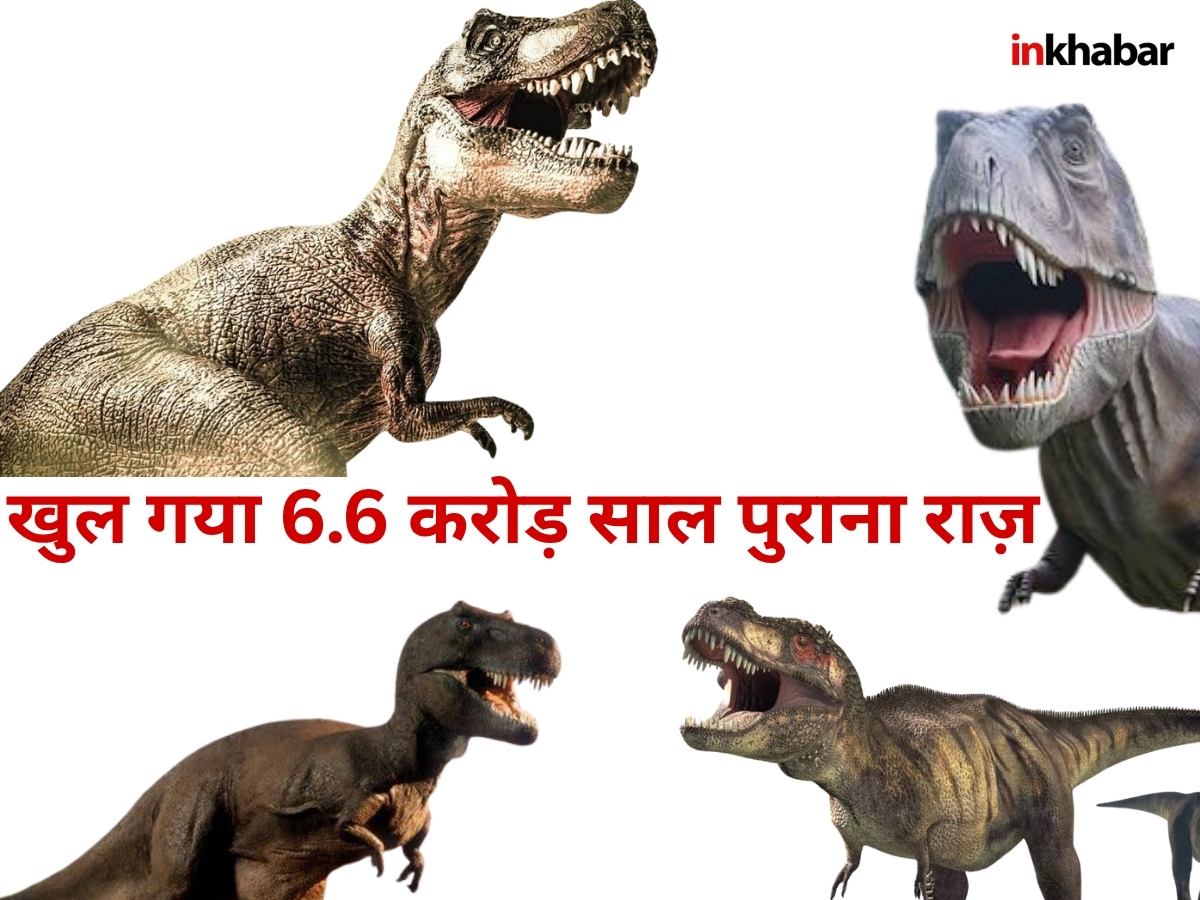
Tyrannosaurus rex death mystery: How did the world's largest T. rex (Tyrannosaurus rex literally means king of cruel lizards i.e. dinosaur) die 66 million years ago? After years of hard work, a stunning reconstruction has revealed how a 42ft long dinosaur named 'Scotty' died after suffering a broken rib. Scientists have discovered that the largest Tyrannosaurus rex ever discovered had a badly broken rib shortly before its death. At the same time, with the help of a wonderful new reconstruction, researchers have been able to look inside the fossil and understand in detail the process of healing the dinosaur's injury.
The new reconstruction depicts Scotty (a dinosaur), a 42 feet (12.8 m) long predator that roamed what is now Saskatchewan, Canada, about 66 million years ago. It is also being speculated that after attacking Triceratops, another member of the herd hit the horn next to T. rex, due to which the horn tore its skin and muscles and broke its rib bone. This became the reason for his death. At the same time, information has been received about Tyrannosaurus Rex that it was a very big and most dangerous predator (Apex Predator). It lived in western North America during the Late Cretaceous period, about 68 to 66 million years ago. In Greek and Latin languages its name means king of cruel lizards.
Could not recover completely after injury
On close examination of the fossilized bone, a network of blood vessels was seen inside it. Scientists believe that these vessels formed when Scotty's body was trying to heal the fracture and iron-rich blood was flowing into the damaged area. It is a different matter that the healing process was never completed because the giant dinosaur died before the ribs could heal completely.
someone from the herd attacked
Mauricio Barbi, a physics professor at the University of Regina (U of R) in Saskatchewan, said it's like winning the lottery. Scotty's ribs contain a vast network of mineralized blood vessels, never seen before in any fossil. After attacking Triceratops, T. rex was attacked on one side of its body by another member of the herd with its horn; The horn tore through his skin and muscles and broke his rib bone. Let us tell you here that according to the search done on the internet, Triceratops was a giant and famous herbivorous dinosaur which lived in western North America during the Late Cretaceous period about 69 to 66 million years ago.
The horn had torn the skin and muscles
Now it has been told that after attacking Triceratops, another member of the herd attacked T. rex with its horn on one side of its body. The horn tore through his skin and muscles and broke his rib bone. Scotty's remains were found in 1991 in Saskatchewan's Frenchman River Valley, one of the richest sites for dinosaur fossils in North America. There are also speculations that T. rex died in a salt marsh after being injured. This swamp slowed the decomposition of his body and helped preserve the delicate network of blood vessels.
The team at Oak Ridge National Laboratory in Tennessee used powerful neutron imaging to create detailed three-dimensional (3D) pictures of the fossil without damaging it. With the help of this technique, they were able to perform a kind of 'prehistoric medical scan', which showed the structures hidden inside the hard bone. Neutrons are very sensitive to hydrogen, so they can also detect signs of soft tissue that are difficult to see with normal X-rays. The result was that we got an amazing glimpse into the last chapter of the life of one of the most famous hunters to ever walk the earth.
Scotty died in the salt marsh
Researchers say that the presence of blood vessels shows that the injury had started healing. When the bone broke, blood rich in iron started flowing in that part, which formed blood vessels that helped in wound healing. Scientists believe that when Scotty's body tried to heal the fracture, blood vessels formed and iron-rich blood started flowing to the damaged area. The T. rex then died after being injured in a salt marsh, which slowed the body's decomposition and preserved its delicate network of blood vessels.
Scotty, what scientists say about T. rex
The world's largest identified T. rex, 'Scotty', weighed up to 33,000 pounds (15,000 kg) and stood more than 42 feet (12.8 m) long. This skeleton has also been identified as the oldest T. rex ever found, which lived for more than 30 years. An old study showed that when Scotty roamed the earth, his weight could have been up to 33,000 pounds (15,000 kg). This weight is more than two elephants or a London double-decker bus, and 70 percent more than previously thought. Researchers at the Canadian Museum of Nature in Ottawa created a model to estimate the maximum size of this prehistoric creature.
The post Rex became extinct 66 million years ago, what is the 'swamp' connection to the death of the 42ft long dinosaur appeared first on Tezzbuzz.