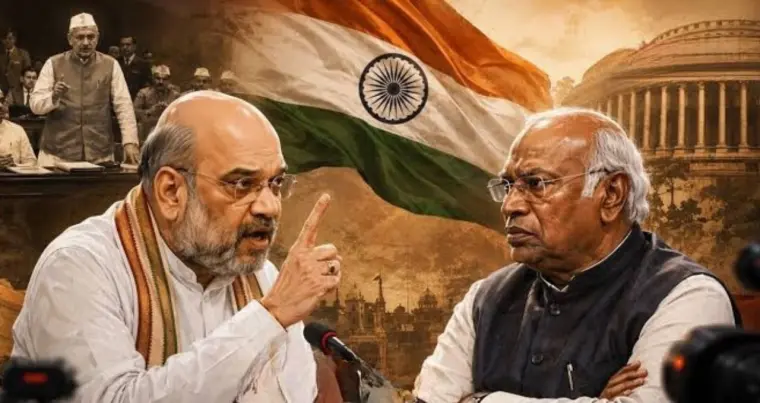
The political dispute between Congress and BJP regarding Vande Mataram has intensified. Union Home Minister Amit Shah has reacted sharply to the decision of the Congress in which the party has decided to sing only two paras of the national anthem in its programs.
Vande Mataram Controversy: Once again a heated debate has erupted in Indian politics regarding the national song 'Vande Mataram'. Bharatiya Janata Party and Congress are at loggerheads after the Central Government changed the legal provisions related to the national anthem. The controversy mainly centers on the question of how many parts of 'Vande Mataram' should be sung in Congress programs and what decision was taken by the Congress Working Committee in 1937.
In its recent proposal, Congress has cited the historical decision of 1937 and said that only the first two verses of 'Vande Mataram' will be sung in the party programs. On the other hand, BJP has presented this stand of Congress as disrespect towards the national anthem and the new legal provisions related to Parliament.
Amit Shah targeted Congress
Union Home Minister Amit Shah has criticized Congress's decision regarding 'Vande Mataram'. He alleged that Congress has distanced itself from full singing of the national anthem due to political and vote bank compulsions. Amit Shah says that even in 1937, Congress had limited the singing of 'Vande Mataram' under the pressure of Muslim League and even today the party is carrying forward the same political thinking.
Accusing Congress of indulging in appeasement politics, he said that BJP will present the party's stand on this issue before the public. However, Congress has rejected these allegations of BJP and said that the 1937 decision was taken keeping in mind the historical circumstances and sentiments of various communities.
Congress's emphasis on 1937 proposal
Congress argues that in 1937, the Congress Working Committee had considered the first two verses of 'Vande Mataram' as suitable for public and national events. According to the party, the later parts of the song contain religious references which some communities might object to. Congress leaders say that at that time prominent leaders like Mahatma Gandhi, Jawaharlal Nehru, Subhash Chandra Bose, Sardar Vallabhbhai Patel and Rabindranath Tagore were active in the national movement. Therefore, looking at the 1937 decision only from the perspective of appeasement in today's political context would be presenting history in a one-sided manner.
After all, what was the proposal of 1937?
The Congress resolution of 1937 stated that 'Vande Mataram' was not intended to be used against any community. The proposal also acknowledged that there is nothing in the first two verses of the song that could cause widespread objection. However, some Muslim leaders raised objections to the religious and demigod references in the later verses.
Keeping these objections in mind, the Congress Working Committee had recommended the singing of the first two verses of the song in national meetings. This proposal remains the main basis of the current stand of Congress today.
Reference is also found in the letters of Gandhi and Nehru
After the decision of 1937, differences regarding 'Vande Mataram' did not end. Mahatma Gandhi had mentioned the discontent and controversy over this issue in a letter to Jawaharlal Nehru in November 1937. The correspondence also reveals that some leaders, including Subhash Chandra Bose, were trying to resolve the differences arising out of this decision.
Nehru had also mentioned the objections of the Muslim community regarding some parts of the song in a letter written to Subhash Chandra Bose. His argument was that due to some religious context of the song, only those parts which could be easily accepted by all communities should be played in national events.
Did Muslim leaders ever sing the full 'Vande Mataram'?
Another aspect of history also comes to the fore in this controversy. There are examples of participation of Muslim leaders and singing of 'Vande Mataram' in various sessions of Congress. According to historical records, Muslim Congress leaders played a role in the Calcutta session of 1896, the Karachi session of 1913, the Bombay session of 1918 and the Nagpur session of 1920.
Examples of Maulana Abul Kalam Azad and other Muslim leaders participating in programs related to 'Vande Mataram' are also given. However, after 1937, political and community differences over full or partial singing of the song became more pronounced.