The three rank as mainland China’s best universities in Times Higher Education’s 2026 World University Rankings. Tsinghua places 12th globally, Peking 13th and Fudan 36th.
“I applied just to test myself, so when the results came I was both surprised and happy,” Phuong, 18, said. “I think I was lucky, but I’m also proud that the effort paid off.”
Phuong started learning Chinese in grade 6 at her parents’ urging. She had not settled on it as a long-term path then, she said, and studied only casually.
It was at the start of grade 9, when she decided to sit the entrance exam for a specialized Chinese class, that she began working at it seriously.
In her first lessons with Nguyen Thi Hong Nhan, a university lecturer in Chinese, she could not read a single character, got every grammar exercise wrong and mispronounced the words she did know.
Nhan eventually raised with the family whether she should continue. Phuong’s mother asked for a three-month trial before they looked at other options.
“What I was lucky about is that my mother never passed on the teacher’s worries, or the family’s, so I just thought I was a little behind my classmates and kept going to class carefree and confident,” Phuong said.
Over the following weeks she made fewer mistakes and began drawing praise for her pronunciation. She cleared the trial and stayed with the language.
In the summer of 2023 she won a place in the Chinese stream at the Foreign Language Specialized School, a selective public high school in Hanoi run by Vietnam National University. Her score in the specialized subject was nearly 8.5 out of 10.
There she drilled past papers, practiced speaking, built vocabulary and listened to podcasts daily.
In grade 10 she passed HSK 6, the top band of the standard six-level Chinese proficiency test. In grade 12 she took second prize in the national Chinese contest for gifted students.
“Seeing older students at my school get into top Chinese universities, I decided to try. I thought I would fail, so I was reluctant for people to know and applied quietly,” she said.
|
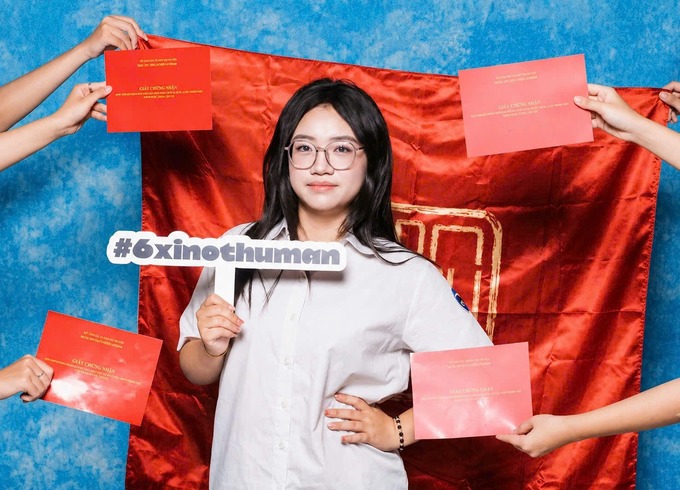
Phung Minh Phuong in her yearbook photo at the Foreign Language Specialized School in Hanoi. Photo courtesy of Phung Minh Phuong |
Her application essay described watching her father run the family business in gemstones and feng shui stones. On trips to the shop he showed her how to market products and keep faith with customers, experiences she said pushed her toward business, economics and finance.
International applicants must also sit the China Scholastic Competency Assessment, a standardized entrance exam China established in 2025 to replace a patchwork of transcript and language requirements.
The first sitting was held in December 2025, and the test becomes mandatory for all international undergraduate applicants by 2028. Mathematics is compulsory for every candidate, including humanities applicants, and an HSK certificate cannot substitute for it.
The new requirement worried her, Phuong said, until she worked through the test structure and realized she could prepare on her own using material available online.
That stretch overlapped with her preparation for the national contest, her end-of-term exams, and a separate entrance exam at Peking University. Each carried its own difficulty, she said, forcing her to keep adjusting how she studied and how she allocated her time.
The Peking University interview ran as a debate, with each group of five candidates defending a position while demonstrating their command of the language.
Candidates cannot memorize answers or drill to a template in that format, Phuong said, and need vocabulary and fast reflexes instead.
At Tsinghua, examiners questioned her directly and ranged well beyond the finance program she had applied to. She was tense at first but steadied herself, breaking each question into parts and answering point by point.
Three years of work as a teaching assistant and Chinese tutor during high school, she said, trained the delivery and composure that carried her through both.
Bui Quynh Van, a lecturer in the Chinese department at Hanoi University who has advised Phuong since grade 10, said her student’s Chinese and mathematics were both exceptional.
The hardest stretch came while preparing for the Tsinghua interview and the Peking entrance exam, Van said, given the sheer volume of material to cover.
“What you do may work out or it may not, but if you don’t try, there definitely won’t be a result,” Phuong said of her decision to apply.