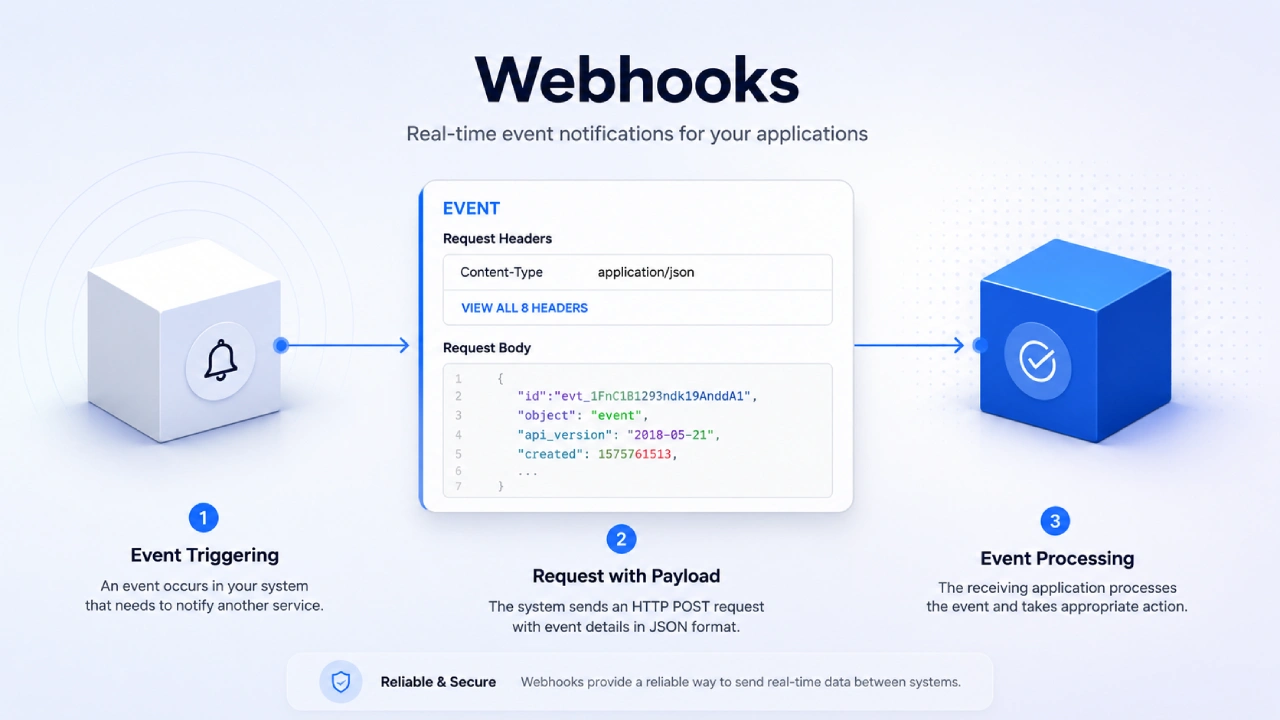
This webhooks guide starts from a simple reality: people don’t really build systems that sit alone anymore. For example, a payment service may need to notify an online store that a transaction actually went through. At the same time, a code repository might want to start a deployment right after new code is pushed. Constantly asking another service whether anything has changed yet is just wasteful. That is why webhooks exist, and they are useful in that scenario. In other words, webhooks give an event-driven conversation method. One application can notify a second application automatically whenever something meaningful occurs. They are now a core piece of modern backend systems, especially when teams want near-real-time coordination and automation between separate services.
Webhooks Guide: What Is a Webhook?
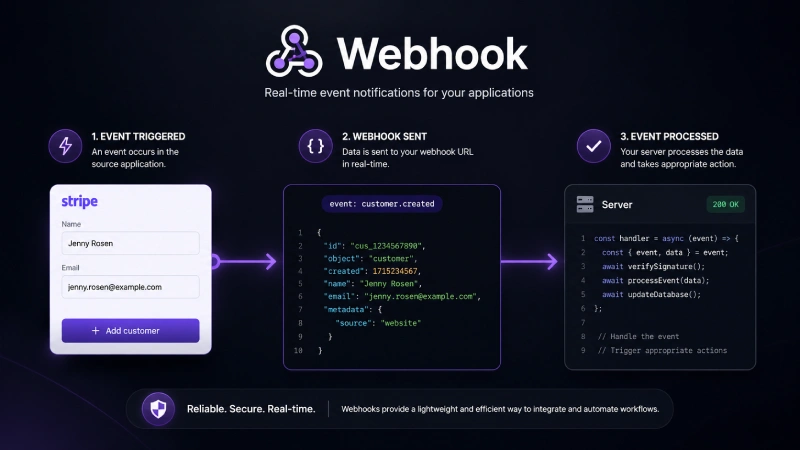
A webhook is basically an HTTP callback that fires when an event occurs. Imagine an application has to detect when a customer finishes a payment. Rather than repeatedly requesting the provider’s API to “check” the status, the app can set up and register, an endpoint for the webhook. Once the payment succeeds, the provider performs an HTTP call, usually a POST request, toward that endpoint. The call includes details about what happened, and when it happened. The basic workflow is kinda like this:
Event happens → Provider notices the event → a webhook request gets sent → the receiving server handles it → the application then takes action
This rough structure helps different applications talk to each other, without needing constant manual checks every few minutes or so.
Webhooks vs. API Polling
Webhooks and APIs are closely related, but the way data moves around is a bit different.
With polling, an application keeps making API requests over and over again, basically asking “is there something new yet?” Like, a system might check every minute to see if an order payment status changed. But a lot of those calls end up returning nothing. So it wastes network bandwidth and computing power, even when there is no change. Webhooks flip the whole thing. Instead of the receiver asking repeatedly, the source side sends the information only when an event occurs.
Because of that, webhooks are especially handy for time-critical events, and they can cut down a lot of unneeded API traffic.
Still, polling has its uses. For instance, if an application needs information on demand, or the external service just does not offer webhooks. That’s why many backend systems end up using both styles together.
Common Webhook Use Cases
Webhooks show up all over modern software infrastructure, more than people sometimes expect. Payment processing is one of the best-known examples. Payment providers can emit webhook events when a transaction succeeds, fails, gets refunded, or hits a dispute. E-commerce platforms can also rely on webhooks to keep things aligned, like order inventory and shipping updates.
Development teams often use them for CI/CD automation. For example, a push to a repository can trigger a webhook, and that can start automated tests or even deployment workflows. Messaging platforms, CRM systems, email services, and automation tools also use webhooks to link separate applications, even when they would otherwise remain isolated and disconnected.
Building a somewhat reliable webhook endpoint
Getting a webhook to work might seem as easy as exposing an HTTP URL, but in production you want extra guards, and not just “it runs”. Usually the receiving server should acknowledge the request right away, instead of doing slow work before sending a response back. The event can be dropped into a queue, then handled asynchronously, kinda later. That way, slow operations don’t make the sender decide delivery has failed. It also helps if you validate incoming payloads before any real processing. Unexpected, malformed, or simply odd data should never be trusted blindly, even if it “looks right”.
Authentication and Webhook Security
A webhook endpoint that is publicly reachable can turn into a security problem if anyone can fire requests at it. One typical protection is signature verification: the sending service generates a cryptographic signature using a shared secret, then the receiver independently checks that signature before accepting the event. HTTPS should be used as well, because it keeps the webhook data protected while it travels between systems. Other measures might include timestamp validation, rotating secrets on a schedule, and, when it makes sense, IP filtering. Also, sensitive credentials should not be exposed directly in the webhook payloads, like not even “temporarily”.
Retries and Delivery Failures
Even with everything configured nicely, networks fail. Servers can be temporarily unavailable, and requests sometimes just time out. A reliable webhook setup has to assume that some deliveries will go sideways. Many webhook providers retry unsuccessful requests, often with exponential backoff, meaning the waiting time between repeats slowly stretches out. On the receiving side, the application should keep solid logs: which events arrived, which ones succeeded, and which ones failed. For critical flows, events that keep failing may be moved into a dead-letter queue, for later review or reprocessing, instead of getting stuck forever.
Monitoring Webhook Systems
Webhook reliability doesn’t really stop once an endpoint is pushed live. Backend teams should keep an eye on delivery success metrics, response time behavior, processing failures, how often retries are happening, and the queue depth. And yeah, like, detailed logging helps a lot when an integration goes sideways, because troubleshooting gets less guessy. Also consider payload shifts over time, because webhook payload structures will change, even when the docs look calm. Using versioning , plus schema validation that’s actually strict, can stop a surprise external API update from breaking your integration all at once.
Final Thoughts
Webhooks offer an uncomplicated approach to a real backend challenge: letting applications talk to each other when something happens. Their event-based style makes them a great fit for payments, notifications, software deployments, e-commerce, plus automated workflows. Still, going into production with webhooks takes more than just creating an endpoint.
Authentication, signature verification, retry policies, idempotency handling, async processing, logging, and monitoring all matter, and they all add up to dependable communication. If those practices are put in place the right way, webhooks can act like a solid bridge between separate services and turn into a core building block for scalable backend automation, without turning everything into a messy tangle.