Emis, a French tourist who recently visited Ho Chi Minh City, said she was impressed by Vietnam’s safety and the friendliness of its people amid global instability.
“Vietnam is very safe. I feel safe walking on the streets and comfortable talking to locals,” she said.
She also praised the country’s relaxed visa policies and modern infrastructure in HCMC.
Vietnam climbed seven places to 52nd among 110 economies in the World Economic Forum’s 2026 Travel and Tourism Development Index, its highest ranking since the Covid-19 pandemic.
Industry insiders attributed the improvement to several factors, including visa reforms, infrastructure upgrades, expanding tourism offerings and reputation for safety.
“Vietnam’s improvement is the result of several developments coming together rather than one single factor. Visa reform has certainly been one of the most important,” Martin Koerner, commercial director of The Anam Group, a chain of luxury resort hotels in Vietnam, told VnExpress International.
Vietnam has made it easier for international visitors to enter and stay in the country, including through 90-day e-visas and 45-day visa exemptions for citizens of 24 countries, including major economies like France, the U.K., the Netherlands and Russia.
|
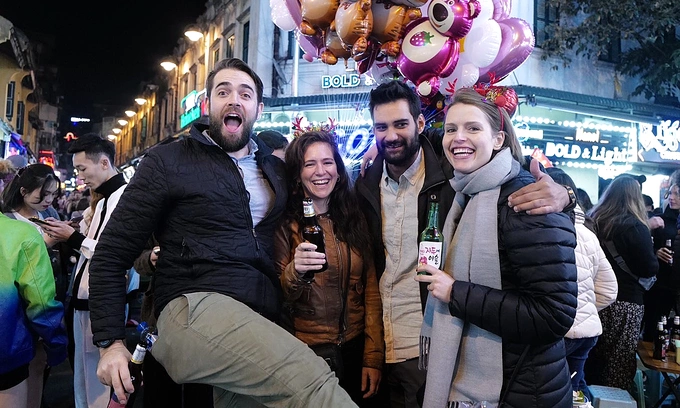
Foreign tourists on Ta Hien beer street in Hanoi. Photo by VnExpress/Ngoc Thanh |
Koerner said Vietnam has also invested heavily in aviation and transport infrastructure. Upgraded airport terminals and improved domestic connectivity have helped address one of the country’s longstanding tourism constraints, he said.
Major projects are expected to further improve accessibility.
Long Thanh International Airport in Dong Nai City, next to Ho Chi Minh City, is slated to begin commercial operations in December and replace Tan Son Nhat as Vietnam’s largest aviation hub.
Diverse tourism offerings
Infrastructure and easier access have been accompanied by an expansion of tourism products, particularly in food, wellness, adventure and nature-based tourism.
Dr. Justin Matthew Pang, senior program manager of the Tourism and Hospitality Management program at RMIT Vietnam, said Vietnam had made significant progress in both its tourism offerings and policy development.
Vietnamese cuisine has gained greater international recognition, with more local restaurants receiving international accolades, including Michelin Guide recognition, he said.
“There have been more tourism offerings ranging from attractions to resorts from Nha Trang, Mu Cang Chai, Moc Chau, Phong Nha – Ke Bang. These offerings have put Vietnam on the map, and these emerging destinations offer more wellness, adventure, beach and rustic activities,” Pang said.
Vietnam performed strongly in areas including price competitiveness, air transport, port infrastructure, natural resources, and safety and security in this year’s WEF index.
Koerner said geopolitical developments had affected travel patterns.
Global uncertainty, including the conflict in the Middle East, has disrupted traditional travel routes and shifted some demand toward destinations in Southeast Asia.
Vietnam is well positioned in this environment because it is perceived as “a safe, stable and good-value destination,” he said.
Despite the improvement, Vietnam still ranked behind several Southeast Asian tourism markets. Singapore placed 13th globally, followed by Indonesia at 23rd, Malaysia at 26th and Thailand at 38th.
Industry insiders said Vietnam needs further improvements to strengthen its position and compete more effectively with regional tourism destinations.
“The result reflects both broader changes in the global tourism environment and some improvements within Vietnam. The more important question is whether Vietnam can turn this momentum into sustainable tourism competitiveness,” said Dr. Matt Kim, a lecturer in the Tourism and Hospitality Management program at RMIT Vietnam.
Koerner said Vietnam could move further up the rankings by combining infrastructure investment and easier access with environmental sustainability, consistent service standards and stronger international marketing.