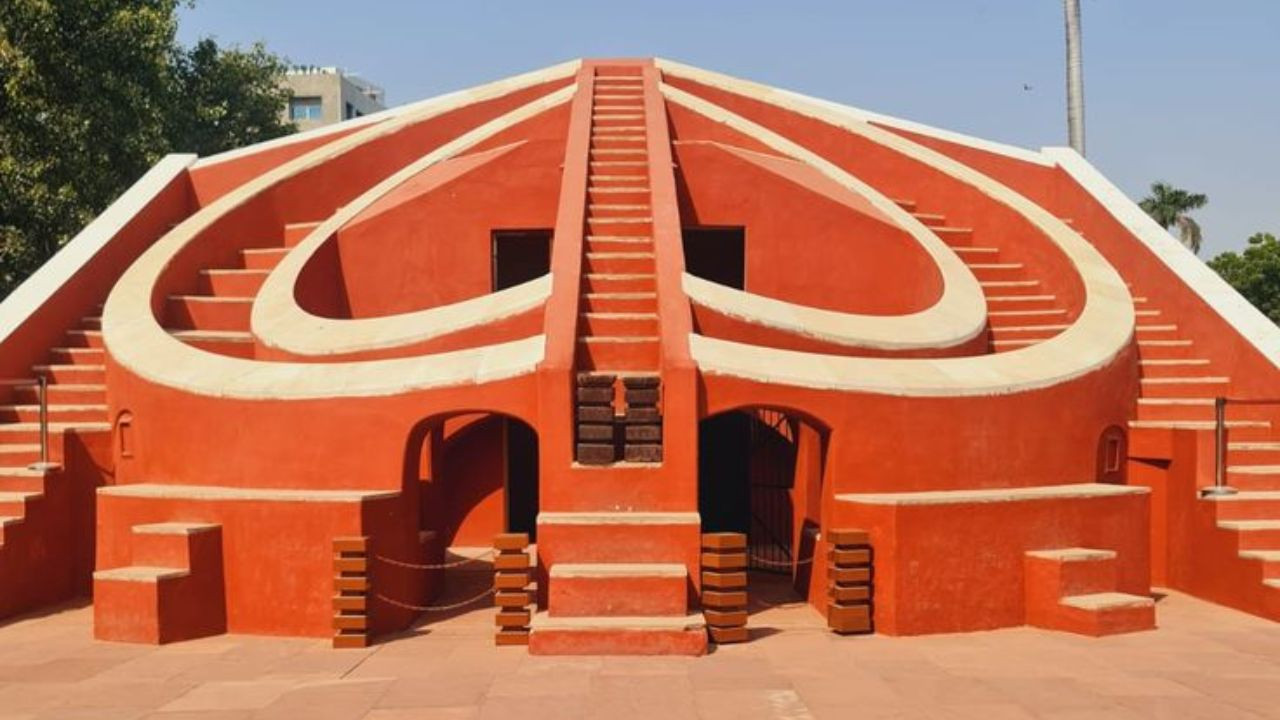
New Delhi: Delhi’s Jantar Mantar is once again in the news these days due to the ongoing protests there. Today, Jantar Mantar is known as a major protest site, but it wasn’t built for that purpose. Originally, Jantar Mantar was built as an astronomical observatory, and subsequent Jantar Mantars were built in Jaipur, Varanasi, and Ujjain. Do you know who built Jantar Mantar and why? It wasn’t just a historical building, but also to accurately determine the time, planets, and stars. Even today, four special instruments remain here, each with their own unique functions and significance. Let’s explore the history of Jantar Mantar and the special features of these unique instruments.
Who got Jantar Mantar constructed?
Delhi’s Jantar Mantar was built in 1724 by Maharaja Sawai Jai Singh II of Jaipur. He had a keen interest in mathematics and astronomy, which is why he commissioned this unique observatory. Modern clocks and scientific instruments were unavailable at the time. Therefore, Jantar Mantar was built to accurately determine the time, day, and the position of the planets and stars. Special instruments installed here allowed astronomical calculations and accurate time estimation.
Time was determined by the light of the sun and the moon.
The special instruments installed at Jantar Mantar were designed to accurately tell the time using sunlight and moonlight. Modern clocks were not available at that time, so people used these scientific instruments to determine the time.
The astronomical calendars and calculations used at that time were prone to numerous errors. This made it difficult to determine the correct timing of festivals and auspicious dates. To address these shortcomings, observatories like Jantar Mantar were built in Jaipur, Ujjain, Varanasi, and Mathura, following Delhi. These instruments were used to accurately determine not only the time but also the positions and movements of the Sun, Moon, Mercury, Mars, Jupiter, and Venus, among other planets.
Weather information was also available
Jantar Mantar was useful not only for determining the time and planetary positions, but also for predicting solar and lunar eclipses. It also provided valuable information about the weather and celestial events of that time. Several special instruments were installed at Jantar Mantar, allowing accurate studies of time, planetary movements, the Sun’s direction, and other celestial activities. The four main instruments were designed for their own specific purposes. Each instrument served a different purpose and provided unique information about time, direction, planetary positions, and celestial bodies.
4 main instruments of Jantar Mantar
1. Samrat Yantra: One of the largest stone sundials in the world, it was used to accurately measure local time, the altitude of the Sun, and the positions of celestial bodies.
2. Jai Prakash Yantra: Consisting of two hemispherical structures, it was used to study the precise positions of the Sun, stars, and other celestial bodies.
3. Ram Yantra: Consisting of two cylindrical structures, it was used to measure the altitude and direction of celestial objects.
4. Mishra Yantra: A combination of five separate instruments, it was used to determine the exact time of noon, the longest and shortest days of the year, and to compare the time at different locations.