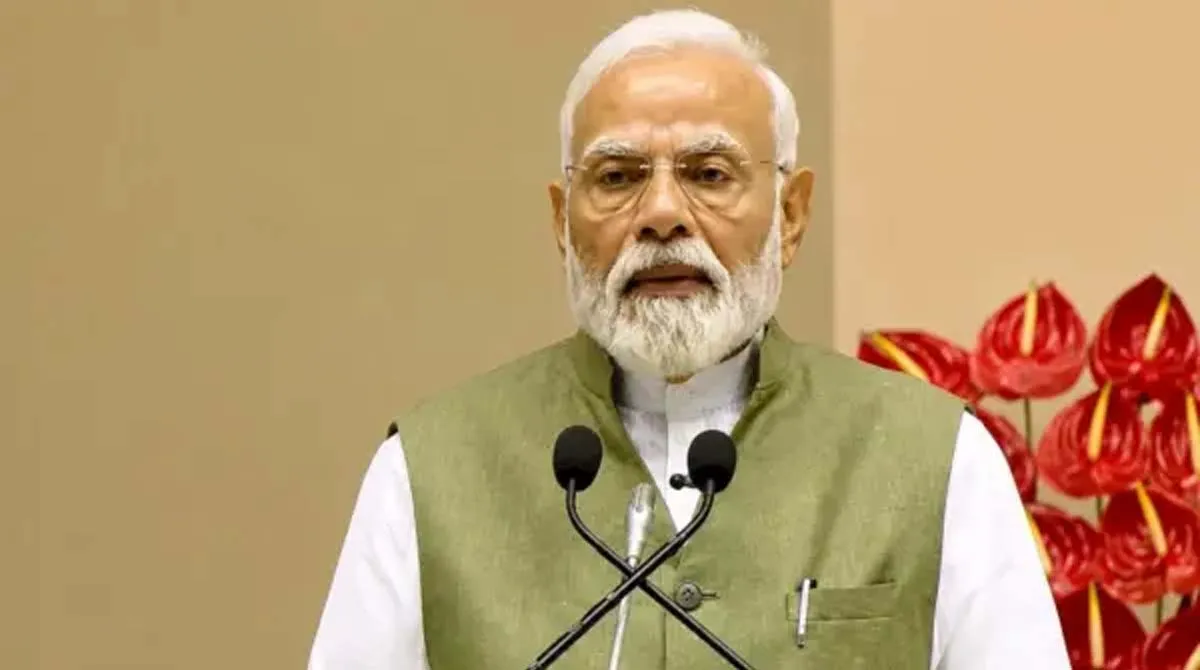
Prime Minister Narendra Modi on Sunday addressed the countrymen through the 137th episode of his popular monthly radio program 'Mann Ki Baat'. In his address, he praised the efforts of grassroots heroes across the country who are bringing positive changes in the society. During this period, the message of women empowerment and 'Vocal for Local' emerged prominently. Referring to the efforts of Krishna Seshadri of Mumbai, flower grower Vesalu Puro of Nagaland and women associated with forest conservation in Odisha, the Prime Minister described them as inspiring for the country. Along with this, he made a special appeal to the youth of the country to share creative content on social media with the hashtag #NashaMuktYuva to spread awareness against drug addiction.
The country became a fan of Mumbai's Krishna Seshadri's 'Bharat Rajya' website.
Prime Minister Narendra Modi wholeheartedly praised the unique website 'Bharat Rajya' prepared by Mumbai resident Krishna Seshadri. This special digital platform allows users to choose any year in the history of India and know which part of the country was ruled by which dynasty or ruler during that period. The PM said that on the occasion of Ashadh Ekadashi, his attention was drawn to this innovative initiative of Krishna Sheshadri on social media and he found this idea of knowing history very interesting and informative.
During the program, Krishna Seshadri also communicated directly with the Prime Minister through phone call. He told how by combining his deep interest in technology and history, he has brought both together on one platform through the 'Bharat Rajya' initiative.
Women entrepreneurs are getting new identity from 'PM Swanidhi'
Highlighting the rapidly increasing role of women in India's economy, the Prime Minister said that 'PM Swanidhi Yojana' is today giving new strength to millions of street vendor women of the country. He regretted that this practical aspect of women empowerment is not discussed as much as it should be. According to statistics, women constitute about 46 percent of the total beneficiaries availing the benefits of PM Swanidhi Yojana.
The Prime Minister said that from morning to evening, lakhs of sisters work hard to earn their livelihood on the streets of our cities and towns. Many of them sell vegetables and fruits, while many run tea-snack shops. Many women do business of flowers, lamps and puja items. He said that often due to lack of very little capital, the work of these women could not progress, but now with the Swanidhi scheme, lakhs of such mothers and sisters are getting new strength to stand on their feet.
From Ghaziabad to Bengaluru: Inspiring success stories
Prime Minister Modi also shared with the country the examples of struggle and success of Babita Sharma from Ghaziabad, Uttar Pradesh and TS Ningamma from Bengaluru. Starting from a small roadside stall, Babita Sharma has today set up her own permanent shop. At the same time, TS Ningamma of Bengaluru is successfully running a small but popular food shop along with her husband.
Maitili Bhuye of Odisha: Made forest conservation a means of livelihood
Narrating the story of Maitili Bhuye, a resident of 'Dhodarkusum' village located in the famous Debrigarh region of Odisha, the PM praised her efforts related to forest conservation and eco-tourism. He told that till a few years ago Maitili used to earn his living only by collecting dry wood from the forest or picking Mahua and Kendu leaves. But when she joined the 'Debrigarh Eco-Tourism' initiative, her relationship with the forest changed forever.
Now protecting the forest has become their permanent means of employment. The Prime Minister proudly informed that inspired by this bold step of Maitili, more than 60 other women of her village are now making their mark by getting involved in wildlife conservation and eco-tourism activities.
Vesalu Puro of Nagaland: Fortune changed due to flower farming
Referring to Vesalu Puro, a resident of Phek district of Nagaland, the PM said that sometimes even a small personal interest opens the door to big opportunities. Vesalu Puro understood the growing demand for flowers at weddings and local festivals in time and took the bold decision to convert his hobby into a business opportunity.
He received training in modern flower cultivation scientifically from the local Agricultural Science Centre. After this, he planted thousands of gladiolus flower bulbs in just one-fourth acre of his land. In his very first attempt, more than 5,000 beautiful flowers bloomed in Vesalu's field, which changed his fortunes.
Lives of rural women are changing with hard work and proper guidance.
Prime Minister Modi stressed that all these examples are direct proof that if given the right guidance and encouragement, the hard work of women can change the entire world. This change is clearly visible from the big metros of the country to the small villages situated in remote forest areas.
Appeal for 'Vocal for Local' and 'Made in India' on festivals
Referring to major festivals like Janmashtami and Vishwakarma Puja coming in the month of September, the Prime Minister urged the countrymen to imbibe the mantra of 'Vocal for Local' and pledge to buy only 'Made in India' products. He said that giving priority to local products will give impetus to the creation of a self-reliant India.
He told that the holy festival of Janmashtami will be celebrated on 4th September and after this Vishwakarma Puja will also come. He appealed to the countrymen to honor the local artisans, craftsmen and Vishwakarma companions of their respective areas on the occasion of Vishwakarma Puja. Apart from this, he reminded that only a few months are left for Diwali and preparations for it have already started. The PM clarified that 'Vocal for Local' does not just mean buying earthen lamps, but the spirit behind it is to strengthen the local economy.
Let us tell you that 'Vocal for Local' is a national movement of the Central Government, which also has the full support of NITI Aayog. Its main objective is to economically empower local entrepreneurs and increase India's manufacturing capacity by giving priority to goods and services made in the country.
'Mission ShaktiSat': Path to space paved for daughters of 108 countries
Referring to the National Space Day recently celebrated on 23rd August, the Prime Minister praised India's ambitious 'Mission ShaktiSat'. He said that through this unique mission, more than 12,000 girl students from 108 countries of the world are getting a golden opportunity to learn satellite technology and move forward in space innovation.
Under this international program, students complete a specialized space curriculum consisting of 21 modules designed by eminent professors from the US, Europe and India. Participants receive approximately 120 hours of intensive online training, covering complex topics such as spacecraft systems, programming and payload development. The most exciting aspect of this mission is that a selected representative student from each participating country comes to India, where she gets the opportunity to participate in practical integration and leadership workshops.
#NashaMuktYuva: Youth's call for drug-free India
The Prime Minister appealed to the youth of the country to create a new and creative mass movement on social media against the ill effects of drugs. He asked the youth to share artistic content giving the message of a drug-free society using the hashtag #NashaMuktYuva. Expressing concern, he said that drug addiction does not destroy only one person, but his entire family and society pays a heavy price for it.
He urged the young content creators, musicians and students of the country to come forward. He asked them to compose inspirational songs focusing on de-addiction, write effective slogans and prepare short plays depicting the dangers of drug addiction and the ways to overcome it. The PM said that there is no dearth of talented creators in India and they can bring a big change in the society by creating such content in different regional languages.
'Avocado' dominates India's dining tables
During the conversation, Prime Minister Narendra Modi also made an interesting mention of the rapidly increasing popularity of Avocado fruit in the country. He said that till a few years ago very few people knew about avocado in India. At that time both its demand and price in the market were very low, but today this fruit has become the first choice of health conscious people and is often seen on the dining tables of homes. The PM said that the example of avocado shows how food habits and agricultural possibilities are changing rapidly in India.