
MIT releases world’s largest free math Olympiad library with 30,000 problems from 47 countries, territories

The database, MathNet, aims at students training for elite math competitions who have historically had to prepare on their own.
It was built by researchers at MIT’s Computer Science and Artificial Intelligence Laboratory (CSAIL) together with Saudi Arabia’s King Abdullah University of Science and Technology (KAUST) and Saudi AI firm HUMAIN. It was unveiled on April 20 and is available free to the public on the CSAIL website.
Every year, countries competing in the International Mathematical Olympiad arrive with a booklet of their most original problems. The booklets are traded among delegations and then largely disappear. MathNet is the first systematic attempt to collect, digitize, and open them to the world.
“Every country brings a booklet of its most novel and most creative problems,” Shaden Alshammari, the project’s lead author and an MIT PhD student, said in the announcement. “They share the booklets with each other, but no one had made the effort to collect them, clean them, and upload them online.”
Website interface of MathNet, a collection of more than 30,000 problems and expert-written solutions released by MIT. Photo by Read/Khanh Linh |
The collection contains 30,676 problems from 143 competitions in 17 languages, spanning roughly four decades of elite mathematics. It is five times larger than the next-biggest dataset of its kind, MIT CSAIL said.
Vietnam’s 259 problems place it among the better-represented countries in the archive.
What distinguishes MathNet from existing online math forums is the quality of the solutions. Community sites typically offer short, unofficial answers, sometimes crowdsourced and unverified. Every MathNet solution was written by experts and peer-reviewed, often running to several pages and walking through multiple approaches to the same problem, MIT CSAIL said.
To validate the dataset, the researchers recruited more than 30 human evaluators from countries including Vietnam, Armenia, Russia, Ukraine, and Poland to verify thousands of solutions.
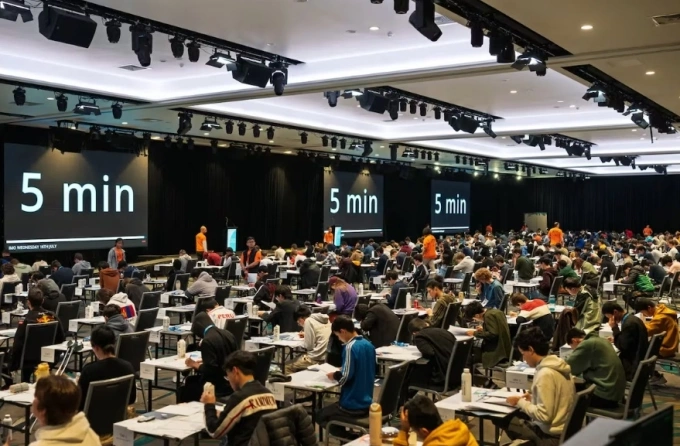 |
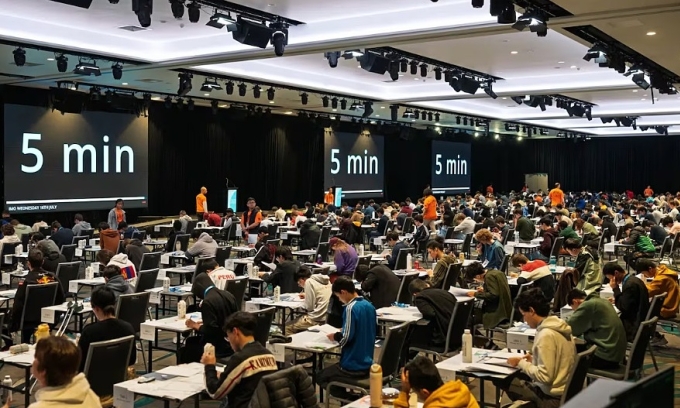
A competition day of the International Mathematical Olympiad 2025. Photo courtesy of IMO |
Alshammari said the project was motivated partly by students in countries without strong olympiad training infrastructure.
“I remember so many students for whom it was an individual effort. No one in their country was training them for this kind of competition,” she said in the MIT announcement. “We hope this gives them a centralized place with high-quality problems and solutions to learn from.”
Assembling the archive took years. Researchers tracked down 1,595 PDF volumes totaling more than 25,000 pages in more than a dozen languages. A large portion came from co-author Navid Safaei, a longtime International Mathematical Olympiad community figure who had been collecting and scanning the booklets by hand since 2006, Popular Science reported.
The research paper accompanying the dataset will be presented at the International Conference on Learning Representations in Brazil later this month.
Comments are closed.