
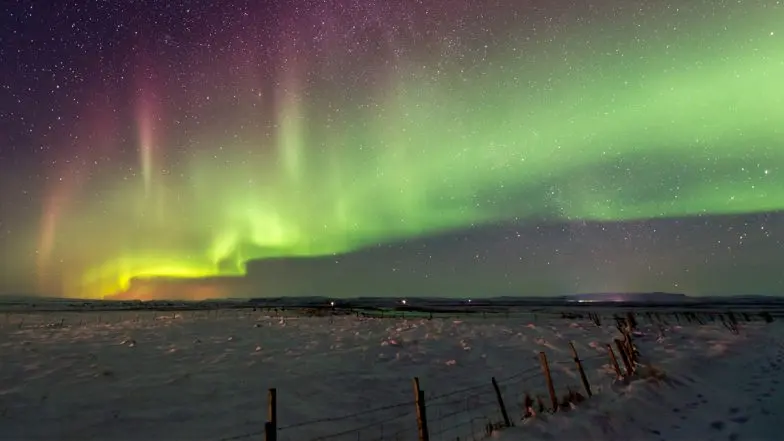

New Delhi: A powerful solar explosion that is racing towards our planet could trigger a strong geomagnetic storm on Monday, raising the possibility of rare aurora borealis sightings from some parts of northern India.
Space weather forecasters issued a G3 (Strong) geomagnetic storm watch after an Earth-directed solar eruption came from the Sun on June 6.
The eruption originated from Active Region 4461, a highly active area on the Sun that produced an M1.8-class solar flare along with a fast-moving filament eruption, said experts.
According to scientists, the solar cloud is travelling through space at around 1,400 kilometres per second and is expected to interact with Earth’s magnetic field on Monday.
The US Space Weather Prediction Center (SWPC) predicted that the incoming eruption contains a dense, magnetised filament, a large structure of solar plasma held together by magnetic fields.
Space weather scientist Tamitha Skov identified the event through satellite observations, describing it as a “textbook core filament eruption”.
She suggested that aurora watchers should closely monitor conditions on June 8 as this event could possibly lead to auroras extending farther south than usual.
During strong geomagnetic storms – which occur when charged particles and magnetic fields from the Sun collide with Earth’s magnetosphere (invisible magnetic shield that surrounds our planet) — the auroral oval expands away from polar regions.
According to scientists, certain cities in northern India could be fortunate to witness faint auroral activity if the storm intensifies and weather conditions remain favourable.
However, they made it clear that such a possibility depends largely on the critical Bz magnetic field component. If the incoming solar cloud carries a strongly southward-pointing magnetic field, it can reconnect efficiently with Earth’s magnetic field. This will allow larger amounts of solar energy to enter the atmosphere, increasing the intensity of auroras and pushing them to lower latitudes.
Despite the forecast, experts have pointed out that the most important detail remains unknown until shortly before the solar cloud arrives. The orientation of the magnetic field inside the incoming eruption can be measured when it reaches monitoring satellites located around 1.5 million kilometres from Earth. Forecasters will have 15 to 60 minutes of warning before impact.
The direction of the Bz field will determine whether the magnetic storm remains moderate or develops into a stronger event capable of producing widespread auroras.

Comments are closed.