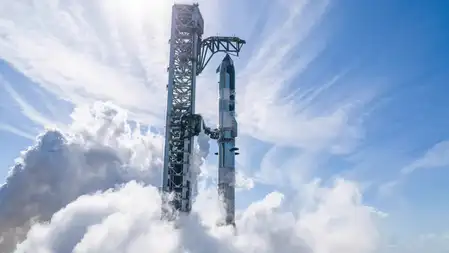
New Delhi, September 28 (IANS). Elon Musk's company SpaceX on Monday achieved an important achievement in the field of space missions. The company's massive spacecraft Starship successfully reached Earth's orbit and successfully deployed 26 next-generation Starlink V3 satellites. This achievement is considered an important step towards developing a fully reusable launch system for future missions to the Moon and Mars.
However, the mission was not entirely smooth sailing. One of the vehicle's six Raptor vacuum (RV) engines shut down during flight, creating a briefly challenging situation for the mission control team. But after evaluating the performance and condition of the remaining engines, engineers decided to continue the mission and successfully delivered the spacecraft to orbit.
According to SpaceX, Starship will complete six orbits of Earth during an approximately 10-hour flight followed by a controlled splashdown in the Pacific Ocean west of Chile.
“All 26 Starlink V3 operational satellites have been successfully deployed and are functioning normally,” the company said on social media platform X.
The most important objective of this mission was to place the new generation Starlink V3 satellites in space. SpaceX says these satellites will significantly improve global internet service speeds, network reliability and system capacity.
Technologically Starlink V3 satellites are much more advanced than previous versions. According to the company, each satellite is capable of providing downlink capacity of up to 1 terabit per second (Tbps) and uplink capacity of up to 160 gigabits per second (Gbps). This represents approximately a 10-fold increase in downlink capacity and a 22-fold increase in uplink performance compared to Starlink V2 satellites.
Following deployment, the satellites will open their antennas, extend solar panels and establish initial contact with ground stations and the broader Starlink network via radio frequency and laser links. They will then slowly reach the designated operational orbit with the help of their onboard thrusters.
SpaceX said the improved capabilities of the V3 satellites are based on next-generation beamforming chips developed by the company. This technology is able to move traffic between different data beams more efficiently and increases modem throughput capacity by up to 64 times compared to earlier systems.
The company says that this will provide better internet services in densely populated urban areas as well as in remote and low connectivity areas. The network will also be able to dynamically adjust its capacity according to demand.
–IANS
DBP