

1
Historic property debates reveal enduring tensions between legacy and public purpose
The recent controversy surrounding notices issued to Delhi Gymkhana Club, frequented by some of the capital’s most affluent and influential residents, has prompted several prominent voices to invoke the historical and heritage significance of the institution in its defence. Their arguments reminded me that, years ago, proposals had also surfaced to vacate Rashtrapati Bhavan itself. This may sound surprising, but the facts can be verified through official records. Importantly, the proposal did not emerge during Prime Minister Narendra Modi’s tenure. Nor was it suggested by communist leaders or activist groups. Rather, it was proposed by none other than the President of India himself.
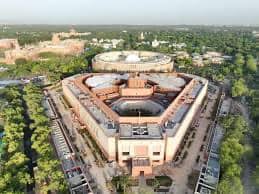
The idea came back to mind because, in March 1978, while serving as political correspondent for Saptahik Hindustan (published by Hindustan Times), I wrote a nearly three-page special report titled “Rashtrapati Bhavan: Bigul Baje Ya Na Baje!” A copy of that published article remains in my files even today. Rashtrapati Bhavan is not merely an official residence; it is regarded as the foremost symbol of the Indian Republic. Yet very few people know that during 1977–78, serious discussions took place between the President, the Prime Minister, the Home Minister and the Urban Development Ministry regarding whether the President should be moved to a smaller residence.
The year 1977 marked a major turning point in Indian politics. The Emergency had ended, power had changed hands, and for the first time a non-Congress government had assumed office at the Centre. In this new political climate, questions began to be raised about government expenditure, colonial legacies and symbols of power. Within this context emerged a debate: was it appropriate for the President of democratic India to reside in one of the world’s largest official residences?
Originally built as the residence of the British Viceroy, Rashtrapati Bhavan comprises around 340 rooms spread across an enormous estate. It had long been viewed as a symbol of colonial grandeur and imperial authority. The maintenance of such a vast complex involved substantial public expenditure. Leaders who championed simplicity and austerity argued that the costs were difficult to justify. Some believed that an independent India should distance itself from grand colonial symbols. Others suggested that the building could be repurposed as a museum, national institution or public facility.
The Janata Party government had come to power with massive public support under the moral influence of Lok Nayak Jayaprakash Narayan. President Neelam Sanjiva Reddy, Prime Minister Morarji Desai, Home Minister Chaudhary Charan Singh and Defence Minister Jagjivan Ram all spoke frequently of Gandhian values and simplicity. One of the first indications of this change came during the President’s address to the joint session of Parliament. Traditionally, Presidents travelled in a ceremonial horse-drawn carriage. However, President Neelam Sanjiva Reddy abandoned this practice and instead travelled to Parliament in an old six-door car.
I noted another departure from tradition in my report. For decades, before the President entered Parliament’s Central Hall, two buglers stationed in the upper gallery would sound a ceremonial trumpet announcing his arrival. During that session, however, no such bugle call was sounded. As a parliamentary reporter since 1972, I was familiar with the custom. I later learned that the order to discontinue the ceremonial bugle had come from President Reddy himself. This inspired the title of my report: “Bigul Baje Ya Na Baje” (“Whether the Bugle Sounds or Not”).
In the same spirit, President Reddy reportedly advanced the proposal that the President of India need not reside in such a vast and elaborate complex. Prime Minister Morarji Desai initially viewed the suggestion favourably. Subsequently, files circulated among various ministries examining alternative residences for the President. Among the options considered was Hyderabad House, located near India Gate. While researching the matter, I discovered that a similar suggestion had been made much earlier. On 28 July 1947, Mahatma Gandhi reportedly wrote to Jawaharlal Nehru and Viceroy Lord Louis Mountbatten urging that the head of state of independent India should reside in a modest residence rather than in the former Viceroy’s palace. Neither Nehru nor Mountbatten accepted the proposal, and the matter was set aside.
The political atmosphere of 1977, however, once again encouraged discussion of such ideas. Yet practical considerations ultimately proved decisive. Security requirements, state ceremonies, meetings with foreign heads of state and the operational needs of the Presidency made relocation extremely difficult. As a result, the proposal was never implemented. In today’s circumstances, Rashtrapati Bhavan certainly cannot function merely as a museum because of the extensive security and administrative responsibilities attached to the office of the President.
Yet the episode raises an interesting question. If leaders occupying the highest constitutional offices were willing to consider relocating from historic premises, could not senior officials, former military officers and influential citizens attached to institutions such as Gymkhana Club also contemplate shifting their recreational facilities, bars, dining rooms and memorabilia to alternative premises? Perhaps the matter will ultimately be resolved only by the courts.
Another aspect of my 1978 report is worth recalling in this context. Following the death of Prime Minister Jawaharlal Nehru, Prime Minister Lal Bahadur Shastri decided that Teen Murti Bhavan should be converted into a Nehru memorial and museum. Rather than occupy that expansive complex himself, Shastri chose to continue residing in the comparatively modest government bungalow at 10 Janpath. Located within New Delhi’s Lutyens’ Zone, 10 Janpath forms part of the series of official residences built during the 1920s and 1930s.
Interestingly, since 1964, 10 Janpath has remained one of the most politically significant addresses in India. After Shastri’s untimely death, his family continued to reside there for a few years. Subsequently, under Congress governments, a section of the property was separated and redesignated as 1 Motilal Nehru Marg, housing the Lal Bahadur Shastri Memorial. The principal bungalow later became the residence of former Prime Minister Rajiv Gandhi and subsequently of Sonia Gandhi and her family. Rahul Gandhi also resided at 10 Janpath before entering Parliament. Because it remained a major political power centre, the nearby premises at 24 Akbar Road and adjoining properties effectively functioned as the headquarters of the Congress Party for many years.
A particularly interesting fact is that, according to government records, the monthly rent of 10 Janpath remained only Rs 4,610 until 2020. Yet controversies periodically surfaced regarding non-payment of rent and outstanding dues. Similarly, disputes over unpaid lease charges and outstanding dues relating to Gymkhana land may continue to arise.
History demonstrates that debates over public property, heritage, privilege and institutional legacy are hardly new. Whether the subject is Rashtrapati Bhavan, Teen Murti Bhavan, 10 Janpath or Gymkhana Club, the larger question remains the same: how should a democratic republic balance historical legacy with contemporary public purpose?

Comments are closed.