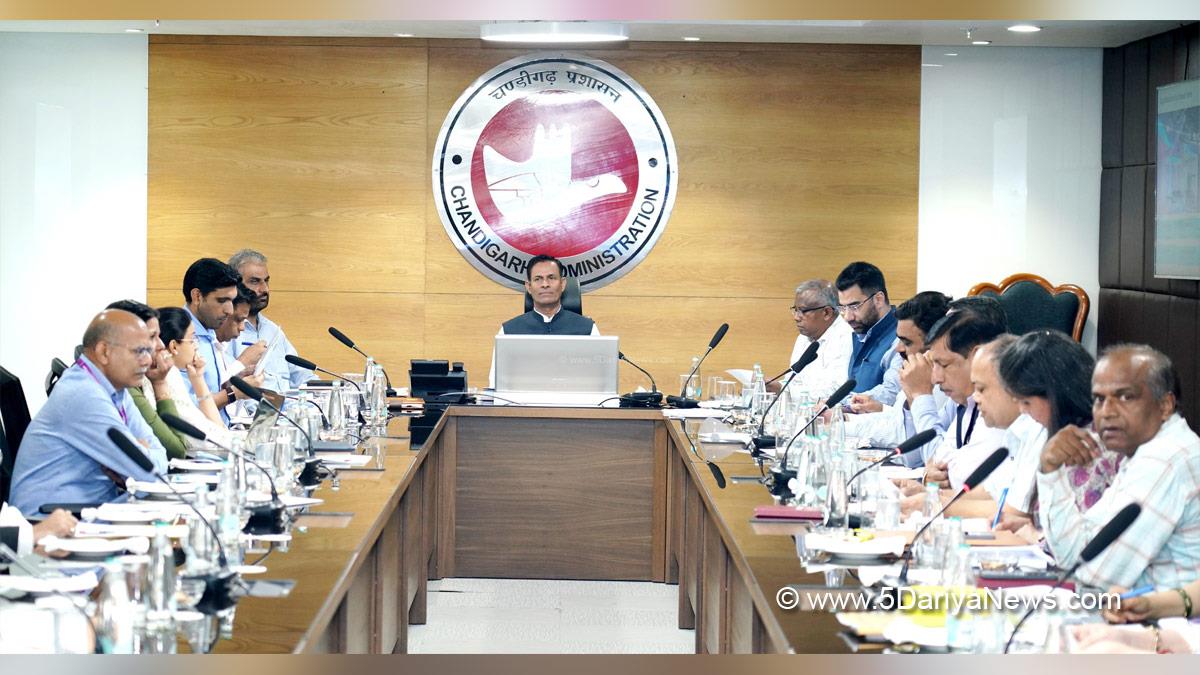
The 27th meeting of the Chandigarh Heritage Conservation Committee (CHCC) was held today under the chairmanship of Shri H. Rajesh Prasad, IAS, Chief Secretary, U.T. Chandigarh, to consider key proposals relating to the conservation of Chandigarh’s architectural heritage and preservation of its UNESCO World Heritage values.
Among those present were Shri Mandip Singh Brar, IAS, Home Secretary; Shri Diprava Lakra, IAS, Finance Secretary; Dr. Syed Abid Rasheed Shah, IAS, Secretary, Tourism & Culture; Shri Amit Kumar, IAS, Commissioner, Municipal Corporation Chandigarh; Shri Nishant Kumar Yadav, IAS, Deputy Commissioner, U.T. Chandigarh; Chief Engineer Shri C.B. Ojha; Chief Architect Shri Rajiv Mehta; members of the Sub Heritage Committee; Dr. (Mrs.) Sangeeta Bagga Mehta, Principal, Chandigarh College of Architecture (CCA); consultants engaged by the Engineering Department; and other senior officers of the Chandigarh Administration.
At the outset, Chief Architect Shri Rajiv Mehta apprised the Chair of the Action Taken Report on the decisions taken during the 26th meeting of the Committee held on 20 January 2026. The Committee thereafter confirmed the minutes of the previous meeting. The Committee considered the proposal for establishing a Digital Museum at the Le Corbusier Centre, Sector 19 under the Swadesh Darshan Scheme 2.0 of the Ministry of Tourism, Government of India. The Detailed Project Report (DPR) has been prepared by the Department of Tourism.
Dr. Syed Abid Rasheed Shah, IAS, Secretary, Tourism & Culture, presented the proposal and informed the Committee that the project aims to develop a world-class digital museum through minimum interventions while preserving the heritage character of the building. He highlighted the historical significance of the Le Corbusier Centre, the project’s tourism potential, the proposed layout, project cost, anticipated outcomes and revenue projections, and informed that the safeguards recommended by the Sub Heritage Committee have been incorporated into the proposal.
Following detailed deliberations and suggestions from the members of the Sub Heritage Committee and senior officials of the Chandigarh Administration, the Chair approved the proposal for establishing the Digital Museum at the Le Corbusier Centre, Sector 19. The Committee next considered the revised zoning plan for Sectors 2, 3, 4 and 5, which fall within the buffer zone of the Capitol Complex, a UNESCO World Heritage Site.
As these sectors are governed by special heritage planning norms, the proposal was examined by the Sub Heritage Committee before being placed before the CHCC. Smt. Mandip Mehndiratta, Senior Town Planner, Department of Urban Planning, presented the revised zoning proposal, including the architectural controls and building height restrictions prescribed under the Chandigarh Master Plan-2031.
During the deliberations, the Chair observed that the buffer zone had been created to protect the heritage value and visual character of the Capitol Complex and that the rationale for its creation continues to remain valid. The Chair deferred the matter and advised the Department of Urban Planning to place the proposal before the Committee again with specific, rationale-based recommendations for further consideration.
The Committee reviewed the Holistic Master Plan Framework for implementation of the Holistic Development Plan of the Punjab and Haryana High Court at the Capitol Complex, a UNESCO World Heritage Site. Consultants engaged by the Engineering Department presented the framework prepared in compliance with the directions of the Hon’ble Punjab and Haryana High Court. After detailed deliberations, the Chair advised the Engineering Department to process the proposal further in accordance with the observations of the Committee and the applicable heritage conservation guidelines.
The meeting concluded with the Chair reiterating the Chandigarh Administration’s commitment to preserving the city’s unique architectural heritage while promoting sustainable and sensitive development in accordance with UNESCO guidelines.