A new analysis estimates on The Reporters Collective that motorists spent Rs 88,234 crore on additional fuel between April 2023 and March 2026 because ethanol-blended petrol delivers less energy per litre than pure petrol. The estimated burden for FY2025-26 alone is Rs 37,843 crore.
The calculation is based on a basic physical fact. Ethanol contains about 33 percent less energy per litre than petrol. At a 20 percent blend, the theoretical energy content of E20 is roughly 6.7 percent lower than unblended petrol.
That does not mean every vehicle will lose exactly 6.7 percent mileage. Engine calibration, traffic, driving style, temperature and the vehicle’s original fuel compatibility all influence the result. The Rs 88,234 crore figure is therefore an estimate, not a direct measurement of every motorist’s fuel bill.
Average ethanol blending increased from 11.8 percent to nearly 20 percent over the three financial years studied. During FY2025-26, total motor-spirit consumption reached 42.6 million metric tonnes.
The analysis calculated that the same energy demand would have required about 39.76 million metric tonnes of pure petrol. The difference was 2.83 million metric tonnes for that year and 6.57 million metric tonnes across the three-year period.
This additional volume was valued using prevailing petrol prices in Delhi, assuming unblended petrol could have been sold at the same pump price as blended fuel. That produced the Rs 37,843 crore estimate for FY2025-26 and Rs 88,234 crore for three years.
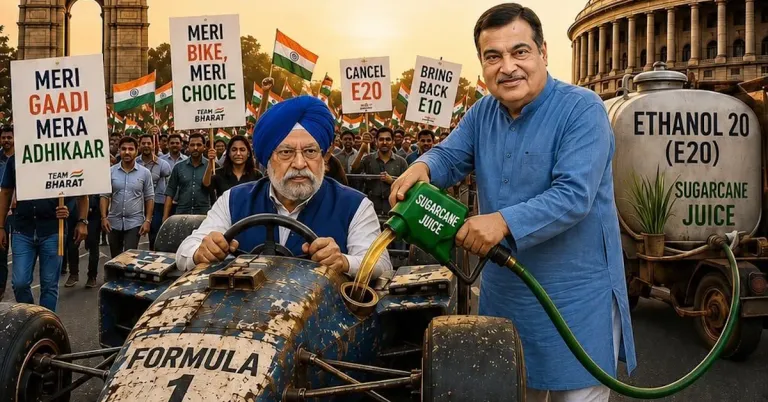
A 2021 NITI Aayog roadmap estimated a 6 to 7 percent fuel-efficiency loss for four-wheelers originally designed for E0 and calibrated for E10. It estimated a 3 to 4 percent loss for comparable two-wheelers.
For four-wheelers designed for E10 and calibrated for E20, the stated loss was much lower at 1 to 2 percent. This difference is important because the national fleet includes older vehicles, E10-era vehicles and newer E20-compatible models.
Consider a car returning 15km per litre on pure petrol. A 6.7 percent loss would reduce that to about 14km per litre. Covering 1,000km would then require roughly 4.8 extra litres, adding close to Rs 490 at a petrol price of Rs 102 per litre.
An E20-calibrated car losing 2 percent would use around 1.4 additional litres over the same distance, adding about Rs 140. Real-world outcomes can fall above or below these examples.
The estimate assumes that total fuel demand can be translated through calorific value with limited adjustment. It cannot fully separate ethanol’s effect from longer annual driving distances, heavier congestion, changing vehicle types or shifts in two-wheeler and car usage.
The researchers compared fuel-consumption growth with estimated growth in active vehicles, but reliable nationwide data on kilometres travelled each year is not publicly available. That missing variable could reduce or increase the final estimate.
The government argues that E20-compatible vehicles show no significant performance variation or abnormal wear in testing. However, the detailed official field-trial reports behind that position have not been placed fully in the public domain.
Ethanol blending also reduces crude-oil dependence and supports domestic ethanol production. Those benefits do not remove the lower energy content or the cost borne at the pump.
The practical issue is pricing. E20 petrol has generally not been discounted to compensate for lower energy content, while unblended petrol is scarce and considerably more expensive. Motorists therefore have little ability to choose.
The precise national cost can be debated but the direction of the effect cannot. A litre of E20 carries less energy than a litre of pure petrol, and most vehicles must burn more of it to cover the same distance. So, E20 Petrol does suck money out of motorists’ pockets. There are no two ways about it!