
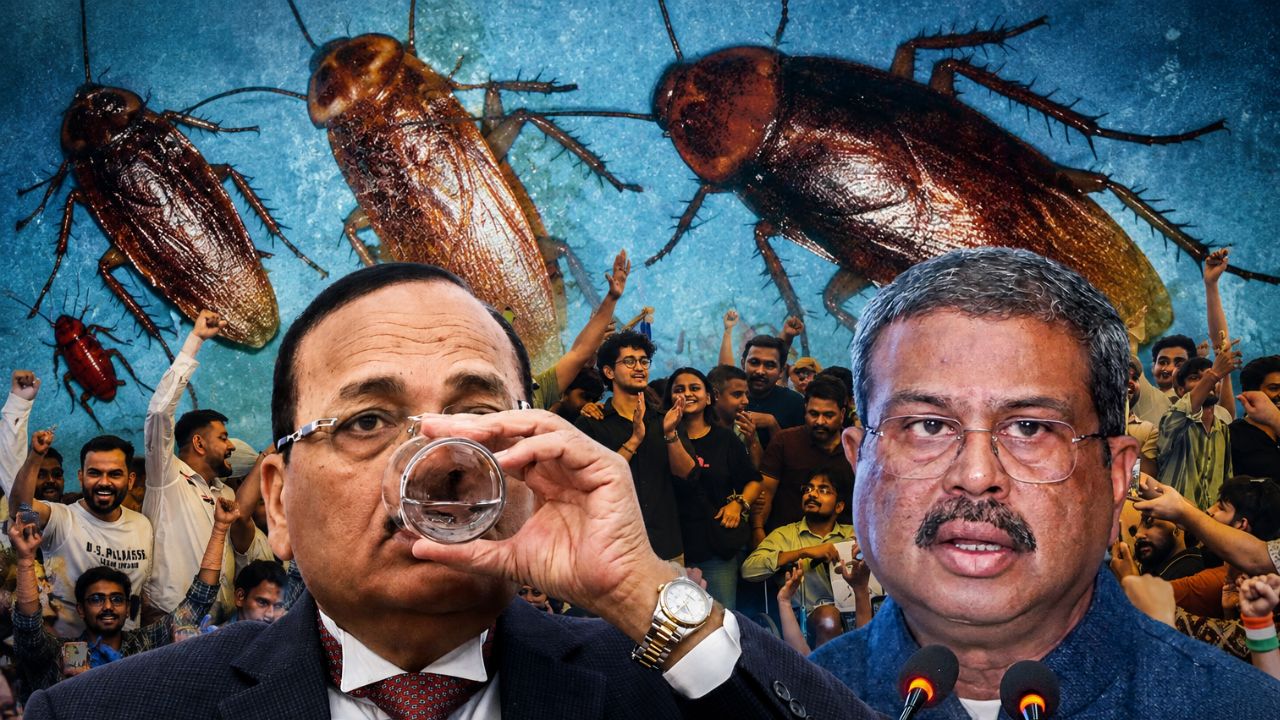

It is said that an arrow shot from a bow does not come back and a word from the tongue also does not come back. Words are sometimes spoken for just a few seconds, but their impact can last for months and years. Something similar happened with CJI Justice Surya Kant’s ‘cockroach’ and ‘parasite’ remarks during a Supreme Court hearing on 15 May 2026.
At that time, hardly anyone would have thought that a few lines spoken in the courtroom would, after a few hours, become a meme on social media, then become the face of a digital movement and within no time, it would turn into a big political fight related to the country’s education system, unemployment, paper leaks and government accountability. On May 16, Abhijeet Deepke started Cockroach Janta Party i.e. CJP amidst this controversy. It started with satire, but within a short time this name became a symbol for thousands and lakhs of youth.
And then on July 25, the story reached a place where perhaps no one had even imagined in the beginning. Resignation of Union Education Minister Dharmendra Pradhan. An announcement was made to end the movement, an agreement was reached between the government and the CJP and the question started echoing on social media. After all, how did the story that started with a ‘cockroach’ statement reach here?
It started with just a statement…
On May 15, during the hearing of a case in the Supreme Court, CJI Surya Kant commented on some people about whom there was talk in the court of coming into professional fields with the help of fake degrees. A part of his comments appeared in media reports as some unemployed youth are like ‘cockroaches’ and later on start attacking the system through media, social media or RTI activism.
When the statement came out, reaction started immediately.
A section of the youth felt that the people whose biggest concerns were employment, competitive exams and future were being called ‘cockroaches’ from the top level of the system. Anger started increasing on social media. Questions began to arise that instead of understanding the unemployment and restlessness of the youth, is it being viewed in derogatory terms? But the story did not end here. The very next day the CJI gave clarification, saying that my statement was being misrepresented.
On May 16, CJI Surya Kant issued a clarification. He said that a section of the media had misrepresented his verbal comments. He said that his target was not the entire youth of the country, but those people who enter professions like law with the help of fake or forged degrees and later infiltrate into other fields as well. He also said that he is proud of the youth of the country and sees them as the pillars of developed India. That means a clarification had come from the CJI. But once the narrative was created on social media, it was not easy to take it back and from here a statement started turning into a movement.
The word ‘cockroach’ was turned into a weapon
On May 16, political communication strategist Abhijit Dipke launched a satirical digital platform called Cockroach Janta Party. The name itself was such that it was sure to attract people’s attention. The same word which was used in the controversy in reference to the youth, was made a symbol of their identity and satire by the youth. That means the message was clear. If we are being called ‘cockroach’, then it is okay, now this cockroach will ask questions.
CJP started as a satirical digital initiative and quickly grew its social media reach. Reuters also described it as a movement born out of a statement that went viral in May, which gave a platform to youth’s anger over unemployment and the examination system. Then the issue moved from CJI to the education system.
This was the biggest twist of this story.
Initially the controversy was over the statement of the CJI, but gradually the anger of the youth was not limited to just one comment. Questions related to alleged paper leak in NEET and competitive examinations, examination system, employment and future of students came to the center of the movement. Now ‘cockroach’ was not just a word.
It had become an identity.
A symbol through which the youth were saying that they should not be mistaken for a crowd active only on social media. They want answers regarding exams, jobs and their future. From here the online mockery of CJP slowly started taking off.
- June 6: ‘Cockroach’ reached Jantar Mantar through social media
- On June 6, CJP held its first major grassroots demonstration at Jantar Mantar in Delhi. With this the direction of the movement changed.
- It was no longer just a matter of Instagram posts, memes and viral videos.
- The youth were on the street.
- The demands were also clear now. Demand for improvement in examination system, accountability on matters like paper leak and resignation of Education Minister Dharmendra Pradhan.
- From here Dharmendra Pradhan started coming into the center of this entire story.
Why did Dharmendra Pradhan become the biggest face of the movement?
In any major movement there is a face or position on which dissatisfaction gets concentrated. Gradually this role in the CJP movement came to the share of Union Education Minister Dharmendra Pradhan. Pradhan’s resignation became the most prominent demand of the movement amid students’ questions regarding NEET and other examination arrangements. The problem for the government was that the matter was no longer just opposition versus government.
There was a large number of youth who grew up on social media, who were seen with CJP’s name and the ‘cockroach’ symbol instead of the banners of traditional political parties. This means that the face of the movement was becoming Gen Z instead of any established party.
Second demonstration, again increasing pressure
The movement did not stop after June 6. On June 20, CJP held another big demonstration. During this period, the demands became more vocal and the demand for Dharmendra Pradhan’s resignation continued to grow louder. Meanwhile, the movement got the support of famous faces like Sonam Wangchuk and the debate about education, the future of students and the accountability of the government became broader. Now Delhi’s Jantar Mantar was not just a place of protest. This had become a symbol of the increasing conflict between the government and the youth.
- July 20: ‘Chalo Sansad’ changed the entire atmosphere
- July 20 came and CJP announced a march from Jantar Mantar to Parliament.
- This is where the picture of the movement became more aggressive.
Scenes like confrontation between protesters and police, barricades, police action and tear gas took the movement out of social media and into the center of national news. International media reports also recorded the events of this day as a major turning point in the movement.
What was till now a social media campaign for government supporters had become a political issue for both the opposition and the government. And then another big name was added to the story – Sonam Wangchuk. Sonam Wangchuk’s hunger strike gave emotional strength to the movement. When a movement goes beyond just slogans and posters and connects to a person’s hunger strike and health, its emotional impact increases manifold.
- Sonam Wangchuk’s hunger strike gave a similar emotional turn to the CJP movement.
- Now the question was not just about paper leak or resignation of the Education Minister.
- The question was – will the government listen to the youth?
- Increasing political pressure for the government
- Here the movement was intensifying and on the other side the opposition also became active.
- Congress also demonstrated against the government. The activism of Rahul Gandhi and opposition leaders took this issue to Parliament and political circles.
- From the ruling party it was called opposition politics.
- But for CJP, this fight was not for the support of any party, but for its own demands.
- This was the point where the most difficult challenge arose before the government.
- If the movement were to be called an opposition movement, there would be a risk of ignoring the large portion of Gen Z that did not consider themselves part of any established political party.
- And if the movement was completely accepted, a political message could have been sent to the government to bow down to pressure.
- Then came 25th July… and suddenly the story changed
- The agitation continued till the afternoon of 25th July.
- Then suddenly the news came – Dharmendra Pradhan resigned from the post of Education Minister.
- This was the moment that turned the story that started with the ‘cockroach’ statement of May 15 into a full political cycle.
- On one side there was CJP movement.
- On the other side was the government.
- There was a struggle of 36 days in between.
- And in the end the Education Minister lost his chair.
After Pradhan’s resignation, the protesters called it their victory and announced to end the movement. According to the report, the government also agreed on examination reforms, cases against protesters and other issues related to students. The ‘cockroach’ which was considered a joke became the brand of the movement, now let’s go back to the beginning.

Comments are closed.