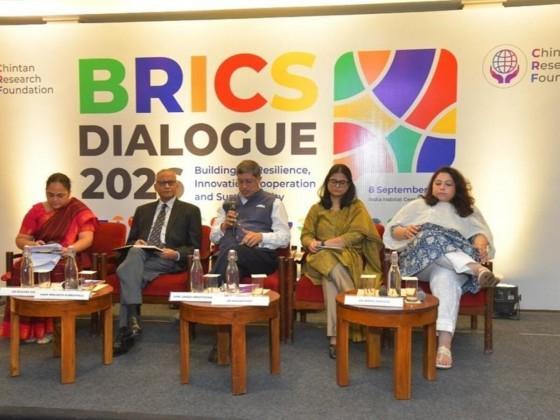
The BRICS group is entering a pivotal stage with its expanding membership and increased economic and geopolitical clout presenting new prospects and complexities, experts said during a dialogue held ahead of the 18th BRICS Summit in New Delhi.
The Chintan Research Foundation organised the BRICS Dialogue, gathering diplomats, policymakers, and scholars to assess BRICS’ evolving role in global affairs.
Experts stressed that India’s fourth presidency of BRICS occurs amid heightened geopolitical tensions, economic division, technological disruption, and pressing demands for reform in global governance.
Under the theme ‘Building for Resilience, Innovation, Cooperation and Sustainability,’ India aims to reinforce BRICS as a platform for practical and inclusive collaboration.
Dammu Ravi, former MEA Secretary (Economic Relations), highlighted BRICS’ centrality to the Global South and its growing relevance in a shifting world order, underscoring trilateral cooperation as key despite member differences.
He clarified that BRICS is not focused on de-dollarisation but on developing alternative trade and finance routes, noting the New Development Bank’s role in facilitating local currency transactions and suggesting India lead in setting up a BRICS Secretariat.
Shishir Priyadarshi, CRF President and former WTO Director, pointed out that trade, financial cooperation, technology, and geopolitical integration are pillars of BRICS’ geo-economic cooperation, though geopolitical differences remain a challenge.
BRICS’ agenda has broadened beyond economics to include governance reform, trade, investment, technology, AI, energy, climate, digital transformation, and South-South cooperation.
Following recent expansion, BRICS now accounts for roughly 49.5% of the global population and nearly 40% of world GDP, amplifying its influence on international economic and political discussions.
Former BRICS Sherpa Ambassador Sanjay Bhattacharyya noted that while the group began focused on economic development, it now engages more deeply with multilateral institutions and global digital issues, urging a pursuit of issue-based multilateralism and greater global rule-making roles.
Professor Srikanth Kondapalli remarked that in the emerging multipolar world, BRICS offers a bottom-up approach that helps members build resilience and alternative partnerships without full decoupling from current systems.
Heena Makhija observed BRICS’ expansion has led to power asymmetries, making consensus on initiatives like establishing a Secretariat in New Delhi potentially difficult.
Professor Harsh V Pant from ORF said geopolitical divergences among BRICS countries have added complexity to the originally geo-economic group and questioned BRICS’ capacity to advance India’s multilateral agenda effectively.
Sabyasachi Saha of RIS cited India's principle of 'Vasudhaiva Kutumbakam,' advocating that BRICS deliver collective value beyond bilateral ties.
Pritam Banerjee echoed calls for innovative financial tools within the New Development Bank to improve financial cooperation.
The dialogue explored concrete areas for cooperation such as a BRICS Grain Exchange, interoperable paperless trade, reduction of non-tariff barriers, and enhancing local currency trade to boost economic resilience and demonstrate BRICS’ practical benefits.
A key consensus was that BRICS’ future credibility depends on translating declarations into action, with its larger membership increasing both representation and the difficulty of consensus-building.
Analysts emphasized that India’s 2026 presidency should establish sustainable mechanisms since continuity will be vital as China assumes the chair next year to maintain momentum.
Participants agreed BRICS stands at a crucial crossroads where its success in turning diversity into complementarity and political aims into practical outcomes will shape its influence in the global order.