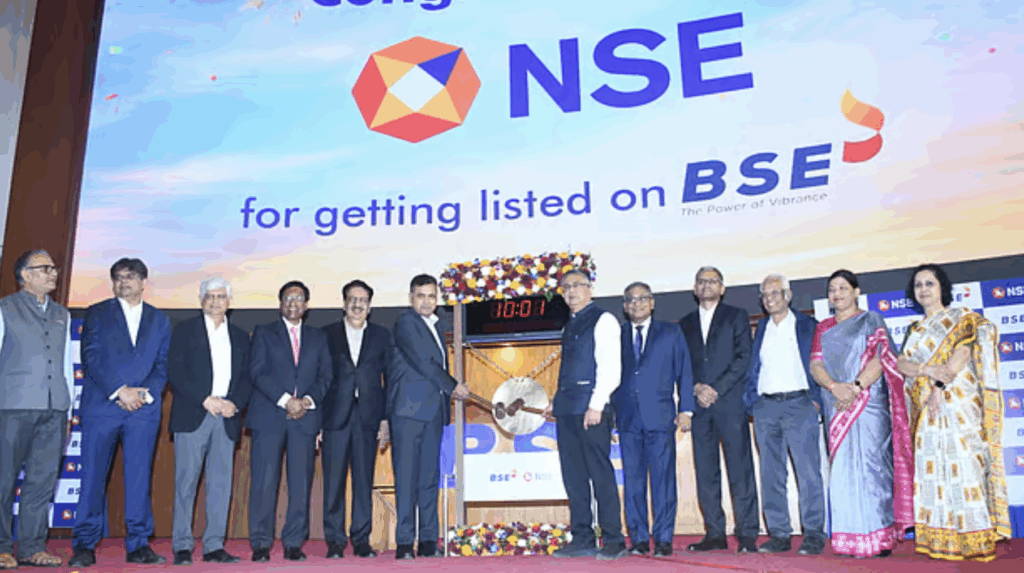
The National Stock Exchange of India made its much-awaited stock market debut on September 24, closing its first trading session 1.85% above its IPO price. While the gain was modest, it was enough to give NSE the strongest debut among India’s five biggest IPOs.
NSE Shares Open At Rs 1,800
NSE shares opened on the BSE at Rs 1,800, representing a 0.84% premium over the issue price of Rs 1,785.
The stock initially gained momentum and touched an intraday high of Rs 1,878, which was 5.21% above the IPO price. However, most of those gains disappeared later in the session.
NSE eventually closed at Rs 1,818, giving investors a first-day gain of 1.85%.
Rs 22,562 Crore IPO
NSE’s IPO raised around Rs 22,562 crore, making it India’s second-largest IPO ever, behind Hyundai Motor India’s 2024 offering.
The issue received strong investor demand, with bids for 50.58 crore shares against 8.86 crore shares available. Overall, the IPO was subscribed 5.71 times, generating demand worth more than Rs 90,000 crore.
The IPO was entirely an offer for sale, meaning existing shareholders sold their shares and NSE itself did not receive the proceeds.
Best Debut Among Five Mega IPOs
Despite the relatively small 1.85% gain, NSE performed better on debut than the other four companies currently occupying India’s five largest IPOs.
Tata Capital gained 1.35% on its first trading day in 2025, making it the only other company among the five to finish above its issue price.
Hyundai Motor India fell 7.12% on debut, while LIC declined 7.75%. Paytm had an even sharper fall, losing 27.25% during its first trading session.
This makes NSE’s debut the strongest first-day performance among the five largest IPOs by issue size.
NSE Valued At Around Rs 4.5 Lakh Crore
At its closing price of Rs 1,818, NSE’s market capitalisation stood at approximately Rs 4.5 lakh crore.
The listing also comes after a nearly decade-long effort to take the exchange public. Regulatory and legal issues had repeatedly delayed NSE’s plans to list.
Interestingly, NSE could not list on its own platform because stock exchange rules prevent an exchange from listing its own shares. Its shares therefore made their debut on rival BSE.
A Debut On A Weak Market Day
NSE’s relatively positive performance came despite a sharp decline in the broader stock market.
The Sensex fell more than 1,200 points during the session, making NSE’s ability to remain above its IPO price particularly notable in terms of its first-day trading performance.
However, the modest gain also shows that investors did not push the stock dramatically higher despite the enormous interest in the IPO.
What Happens Next?
With NSE now publicly traded, investors will closely watch its earnings, trading volumes, regulatory changes and the future growth of India’s capital markets.
The company has a dominant position in India’s equity and derivatives markets, but regulatory changes affecting derivatives trading remain an important factor for its future performance.
Summary
NSE made its stock market debut on September 24, opening at Rs 1,800 and closing at Rs 1,818, a 1.85% gain over its Rs 1,785 IPO price. Despite the modest rise, NSE recorded the strongest debut among India’s five largest IPOs. The Rs 22,562 crore issue was subscribed 5.71 times and valued the exchange at around Rs 4.5 lakh crore.
Image Source