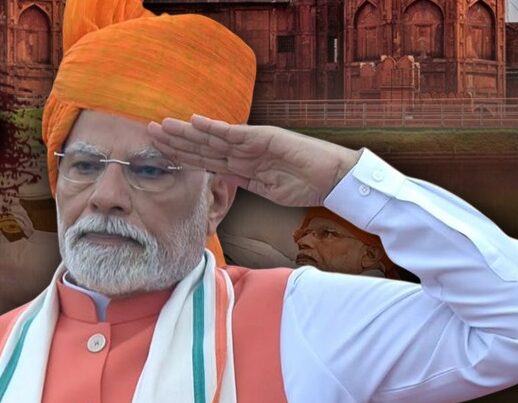
Every year, as August 15th approaches, the nation’s eyes are fixed on the Red Fort. The Prime Minister arrives at the ramparts of the Red Fort, hoists the tricolor, the national anthem is played, and then addresses the nation. But is it written anywhere in the Constitution that the Prime Minister must hoist the tricolor from the Red Fort on Independence Day? The answer is no. So, how did the Red Fort become the nation’s most important platform for independence? Learn everything through this story.
What happened at the Red Fort on 15 August 1947?
This story begins not with the Constitution, but on August 15, 1947. India gained independence from British rule, and Jawaharlal Nehru became independent India’s first Prime Minister. According to the Ministry of Defense’s official Rashtraparv portal, on that day, Nehru hoisted the national flag above the Lahore Gate of Delhi’s Red Fort. This tradition of the Prime Minister hoisting the flag and addressing the nation from the Red Fort on every Independence Day has continued.
It is worth noting that the first Independence Day flag hoisting ceremony from the Red Fort took place before the Constitution of India came into effect in 1950. The Constitution of India came into effect on January 26, 1950. Therefore, the Red Fort’s role was established not by any constitutional mandate, but by the initial national celebration of independence.
Why did the Red Fort become the symbol of independence?
The Red Fort wasn’t just a historical building. Since the time of Shah Jahan, it has been a prominent symbol of power in Delhi. According to UNESCO, the Red Fort served as a symbol of power for a long time and later witnessed British military occupation.
The Revolt of 1857 further linked the Red Fort to the history of Indian resistance. Bahadur Shah Zafar and the Delhi Rebellion were linked to this fort. Following the rebellion, the British army occupied the Red Fort and used large parts of it for military purposes.
In the 1940s, the trials of officers of the Azad Hind Fauj (Indian National Army), or INA Trials, linked the Red Fort to the memory of the independence movement. These trials, held at the Red Fort, influenced political and public sentiment across the country.
That is, whenever we search for answers to why the Prime Minister hoists the tricolor here every August 15th, despite the Red Fort not even being mentioned in the Constitution, three major historical layers related to the Red Fort emerge. First, Mughal rule, second, the struggle of 1857, and third, the INA trials. This is why hoisting the tricolor of independent India at this very spot in 1947 became a very powerful symbol.
Is Red Fort constitutionally necessary for the PM?
It’s important to clear up a major misconception here. There’s no Constitutional provision requiring the Prime Minister to hoist the tricolor from the Red Fort every August 15th. Article 75 provides for the constitutional framework for the Prime Minister and Council of Ministers, but does not specify the location of the flag hoisting. Therefore, it would be incorrect to call it a constitutional obligation. The truth is that the historic beginnings of August 15, 1947, later evolved into national tradition and state protocol.
According to the Ministry of Defense’s portal, Rashtraparv, the official Independence Day celebrations include the Prime Minister’s arrival at the Red Fort, the flag hoisting, the national anthem, a 21-gun salute, and an address to the nation. The Ministry of Defense’s program also follows this established tradition: the Prime Minister’s address from the ramparts of the Red Fort.
Can the PM hoist the flag from some other place in the future?
In principle, there is no specific constitutional provision mandating the Red Fort. However, this does not mean that relocating the site would be a simple administrative decision. Since 1947, the ramparts of the Red Fort have been a part of the national Independence Day commemoration. UNESCO also associates the Red Fort with the history of Indian rule and the celebration of independence.
So, if the main ceremony were to be shifted, it would not be simply a change of location. It would be a change in the national tradition and public memory of independence that has existed since 1947.
Why are the stages of 15th August Red Fort and 26th January different?
Both August 15 and January 26 are national holidays, but their significance differs. August 15 marks India’s Independence Day. On this day, the Prime Minister hoists the national flag from the Red Fort and addresses the nation. January 26 commemorates the adoption of the Constitution and the establishment of India as a republic. The President plays a prominent role on this day, and the main Republic Day celebrations are accompanied by a parade. Therefore, the platforms and ceremonies for both occasions are different.
So why is the tricolor hoisted at the Red Fort every 15th August?
The Constitution didn’t choose the Red Fort, history did. After Nehru hoisted the tricolor for the first time from the Red Fort on August 15, 1947, this tradition continued. It marked many historical milestones. This is why, despite the absence of the Red Fort in the Constitution, the tricolor flag fluttering there on the morning of August 15 is not just a flag hoisting ceremony—it commemorates that first morning of independent India, when a slave nation declared its sovereignty.